

Quantum Secure Encrypted Money
Joined March 2025
- Tweets2.5K
- Following15
- Followers31.9K
- Likes2.2K



Pinned Tweet
QTC is now live on near.com, powered by @near_intents.
Swap into QTC from 180+ assets across 30+ chains, including BTC, ETH, SOL, and ZEC.
Every swap is confidential by default.
Quantum secure encrypted money, now one swap away.
Quantus retweeted

I’m not really a defi guy but wow this guy ships like crazy. Respect 🫡

v3 is live.
One curve for every token. Buy and sell any amount, launch yours from 0.03 QTC, graduate to NEAR.
app.qlyphs.com
Quantus retweeted

First lending market for $QTC is live on $NEAR.
Collateral on @rhea_finance, powered by @near_intents.

QTC collateral is live on @rhea_finance
The first lending market for quantus:native , powered by @near_intents.

Neither result breaks a key today. Both shrink the margin under ECC.
Quantus never bet on elliptic curves. ML-DSA from genesis.
Quantum Secure Encrypted Money

You thought this was a bad week in crypto? You might have missed the bigger news.
Two results just landed on elliptic-curve cryptography. Both are worrying. Neither one breaks a key anyone uses today.
1️⃣ The problem under ECC is less hard than we thought.
ECC is secure because the elliptic-curve discrete log is hard. The best general algorithm we had was Pollard's rho, and it is exponential: add bits to the key, and breaking it gets exponentially harder.
That assumption is now false, with one caveat. A paper from Bochum and MPI-SP gives a subexponential algorithm. It assumes an OpenAI claim that is still under review. If the claim holds, the new algorithm is faster asymptotically. In practice it changes nothing. On secp256k1, P-256, or Ed25519, rho is still the best algorithm, and it still takes the age of the universe. The new one only pulls ahead on hypothetical curves of enormous size, and there the cost is even more absurd.
github.com/bochum-crypto/sub…
2️⃣ The quantum circuit is getting cheaper. The computer is not here.
We still have no quantum computer. The circuit that would run on one to break ECDSA keeps getting cheaper. ecdsa.fail is a public auto-research loop aimed at exactly that. Its current best is about 70% cheaper than the circuit Google reported, on logical qubits times Toffolis (0.91 billion against 2.99 billion). Google's circuit was already two to three times cheaper than the previous published one.
Alice & Bob @Alice__Bob , a French Quantum Computing company, just estimated that breaking secp256k1, the Bitcoin curve, takes at most about 30,000 cat qubits and one hour. That figure assumes a machine nobody has built. We are still far from it. The machine being asked for keeps getting smaller.
eprint.iacr.org/2026/2665
What a crazy time to be alive.


Quantus retweeted

Everything QTC is now in one app: Meteor ☄️
With Meteor you can:
- Bridge funds from native Quantus L1 to Meteor App
- Access QTC’s LP and lending borrowing on Meteor Explore
No switching apps. Everything in one place.

ECDSA and EdDSA now have an end date.
NIST says they're discouraged after 2030. Disallowed after 2035.
Most chains still sign with one of the two. Only ±0.27% of the crypto market cap sits on chains that have already migrated.
Follow the progress:
migration.fail


NIST’s new PQC migration guidelines can help organizations transition to post-quantum cryptography standards. This report outlines the timelines and activities for federal agencies and serves as a resource for organizations navigating the transition.
🔗 nist.gov/news-events/news/20…

ALT A digital illustration shows a transition from old encryption standards to new encryption standards. On the left, an outdated server is connected to symbols and codes. In the center, a large, futuristic quantum computer is depicted. On the right, a shield represents the new encryption standards, with symbols indicating modern data security. The background features a binary code theme.
Quantus retweeted

NEW INTEGRATION
Aurora Intents is now live on @qlyphsxyz.
Bring assets into @QuantusNetwork from other chains, right inside the Qlyphs app and wallet extension.
Live quotes. Tracking from deposit to settlement. And back out the same way.
Bridge in → trade → bridge out.
Powered by @near_intents.
QTC collateral is live on @rhea_finance
The first lending market for quantus:native , powered by @near_intents.
.@YuviLightman will be heading to @BlLife_Forum this December in Dubai.
If you're in town, make sure you catch his keynote on whether blockchains survive Q-Day.

Quantus retweeted
I think Fortune is underestimating it tbh. It’s quite a bit more than $2 trillion at this point. migration.fail puts it at $2.7 trillion, and even that is an underestimate.
Get the details here:
beincrypto.com/bitcoin-quant…
Last week in quantum:
@Starknet backed research into becoming an independent post-quantum Layer 1.
More than 93.5% of voting power backed the research, across 2,800+ wallets, and StarkWare didn’t vote. It’s research only. Any actual move needs a second vote, and a whitepaper draft is expected in November.
Quantum risk entered the insurance conversation.
@projecteleven named Relm Insurance a development partner for Strongpoint, its custody product, to explore how post-quantum security could factor into digital asset underwriting. No premium or policy changes have been announced.
@QuantinuumQC reported a new error-correction record.
Its Helios system reached 99.9995% logical memory fidelity per cycle, about 10 times better than its own September result.
That figure measures memory reliability, not a complete computation. The team also demonstrated improving logical gate accuracy, though further work remains to scale all the components needed for universal fault-tolerant computing.
Postquant Labs launched the Quip Virtual Machine.
The QVM provides a shared programming environment for quantum annealers, gate-based quantum computers, and classical machines, with a maximum cost quoted before execution.
It is live on @quipnetwork’s Aglais testnet.
Post-quantum readiness increasingly needs evidence. Chains need tested migration plans. Custodians need controls insurers can assess. Quantum hardware needs reliable computation beyond memory benchmarks.
The useful question is what each announcement actually demonstrates.
Native QTC is live on @instaswap_io.
Swap BTC, ETH, SOL, or stablecoins straight into QTC
Routed through @near_intents

QTC is now live on @CoinMarketCap
It just got easier to find, track, and talk about post-quantum money


Quantus retweeted
Normies are starting to notice that Bitcoin isn’t taking quantum seriously.
ambcrypto.com/tezos-algorand…


Quantus retweeted

➥ My quantum-resistant token wishlist
I’m spending more time on this sector because the migration is already happening.
Google targets 2029 for post-quantum readiness, with Google Cloud publishing a detailed migration roadmap in August.
That’s a deadline to prepare infra, not a prediction that Bitcoin gets broken in 2029.
I believe wallets, custodians and institutions will need to evaluate quantum exposure before a capable quantum computer arrives.
But I’m checking what actually protects user funds: native signatures, optional account upgrades, or unfinished implementations.
Here’s my wishlist:
→ base:0x37696cd8f723ce541ac376f79fc109080e505ba3 - the operating history I want to study.
Native transactions have used hash-based XMSS signatures since 2018.
Next checkpoint is Zond: whether its post-quantum smart-contract stack can attract developers beyond the security thesis.
→ $QTC - the newer implementation I’m following closely.
@QuantusNetwork native ML-DSA transaction signing.
I want to see sustained usage, accessible liquidity and demand that can absorb mining emissions.
→ $CKB - cryptographic flexibility interests me.
Its SPHINCS+ Lock Script and Quantum Purse let users adopt post-quantum protection today.
It’s optional, so wallet adoption matters as much as protocol capability.
→ algorand:native - a concrete migration path on an established chain.
Native Falcon-1024 accounts are supported. I’m watching wallet and app compatibility.
→ $NEAR - migration without changing the account address.
ML-DSA-65 signing went live in July.
Fireblocks demonstrated rotating a funded account in 2 transactions, then receiving and sending funds with the new key.
That’s the kind of practical integration I care about.
→ abelian:native - privacy and post-quantum security together.
@PQabelian uses lattice-based cryptography for private transactions.
I want to understand whether that translates into recurring payment demand and stronger liquidity.
→ $CELL - the ability to change algorithms over time.
@cellframenet supports multiple post-quantum signature schemes.
I’m watching adoption of its native infra, while checking which chain and token representation users actually hold.
→ $STRK - promising architecture, with dependencies.
Hash-based STARK proofs and working Falcon account implementations give Starknet a migration path.
Those account implementations remain early-stage, and full protection still depends on Ethereum’s transition.
I’m also tracking $ZEC’s quantum-recoverability work.
It supports a future migration; it doesn’t make current Zcash fully quantum-resistant.
Where I expect growth:
→ wallets that make key migration usable.
→ custody systems that can support new signatures.
→ infra that handles their higher verification costs.
→ networks that turn those capabilities into retained users and fees.
Existing chains can upgrade too, so post-quantum cryptography alone won’t guarantee token demand.

Quantus retweeted

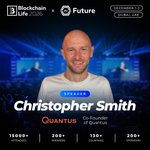
Christopher Smith says Bitcoin should take quantum seriously
"If you've got a trillion dollar asset secured by elliptic curves, you might want to be taking it seriously."
"Signal, iMessage, Cloudflare, they already went post quantum and just nobody noticed."


