

Techno-Optimist. GM, AI Business Solutions @Microsoft. Angel Investor. 💙 🌍🧢
Palo Alto, CA
Joined February 2008
- Tweets3.4K
- Following369
- Followers434
- Likes5.5K

Rajmohan Rajagopalan retweeted

🚀 📖 Check out the docs for Microsoft Agent 365, now generally available! Observe, govern, and secure every AI agent in your organization from one unified control plane.
Get started: 👉 msft.it/6015vPqCb
#MicrosoftAgent365 #AI #EnterpriseAI

I’ve been using Jacard from the early days of development. This is the AI UX that I’m missing from all the frontier labs! Check it out.. congrats on the launch @bala_tk !

AI answers got smarter, but also longer and harder to use. A few months ago, I left @MSFTResearch to solve that problem and build Jacard.
With @sigchi in full swing this week, I’m excited to share that today, our Beta version is now live on Product Hunt.
Jacard turns prompts into interactive answer pages you can actually use, right alongside the text response. It gives every knowledge task the interface it deserves.
We’re launching now and would love your early feedback on the PH thread: producthunt.com/products/jac…
Grateful to Jacard’s advisors, my peers at Microsoft, and the broader HCI community for their support throughout.
#ProductHunt #Launched #AgenticAI #JacardAI

1
70
Rajmohan Rajagopalan retweeted

AI answers got smarter, but also longer and harder to use. A few months ago, I left @MSFTResearch to solve that problem and build Jacard.
With @sigchi in full swing this week, I’m excited to share that today, our Beta version is now live on Product Hunt.
Jacard turns prompts into interactive answer pages you can actually use, right alongside the text response. It gives every knowledge task the interface it deserves.
We’re launching now and would love your early feedback on the PH thread: producthunt.com/products/jac…
Grateful to Jacard’s advisors, my peers at Microsoft, and the broader HCI community for their support throughout.
#ProductHunt #Launched #AgenticAI #JacardAI
Rajmohan Rajagopalan retweeted

Liftoff.
The Artemis II mission launched from @NASAKennedy at 6:35pm ET (2235 UTC), propelling four astronauts on a journey around the Moon.
Artemis II will pave the way for future Moon landings, as well as the next giant leap — astronauts on Mars.

1st Mag7 exit of an early investment.. congrats @LimitlessAI @dsiroker!

Meta acquires AI device startup Limitless techcrunch.com/2025/12/05/me…

1
125

Rajmohan Rajagopalan retweeted

Technology advances rapidly and affects us all, with new products and production methods replacing old ones in a never-ending cycle. This is the basis for sustained economic growth, which results in a better standard of living, health and quality of life for people around the globe.
#NobelPrize

Fun trivia: People are often curious about how much energy a ChatGPT query uses; the average query uses about 0.34 watt-hours, about what an oven would use in a little over one second, or a high-efficiency lightbulb would use in a couple of minutes. It also uses about 0.000085 gallons of water; roughly one fifteenth of a teaspoon.

wrote a new post, the gentle singularity.
realized it may be the last one like this i write with no AI help at all.
(proud to have written "From a relativistic perspective, the singularity happens bit by bit, and the merge happens slowly" the old-fashioned way)
173

Rajmohan Rajagopalan retweeted

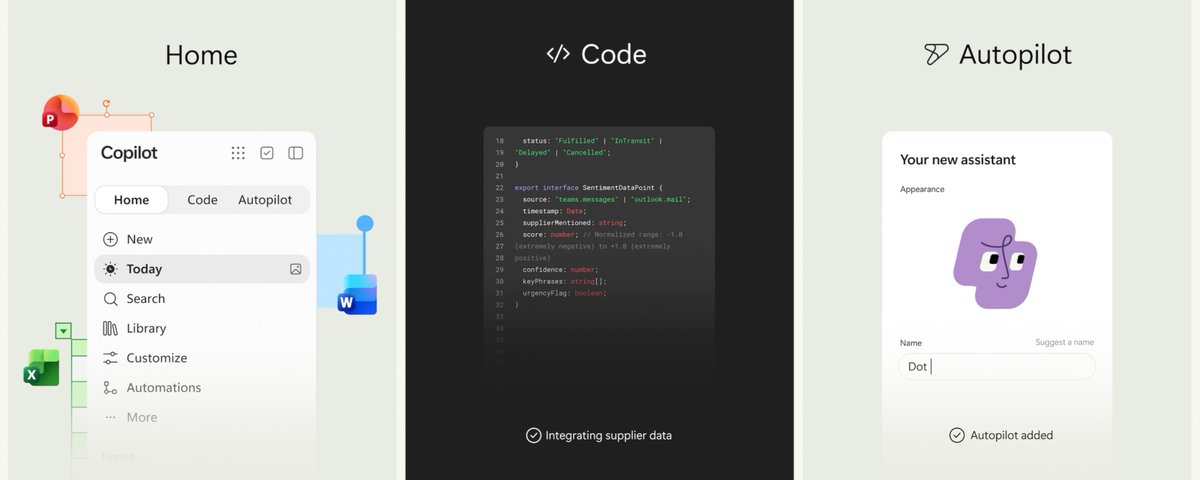
1/ Big day for Microsoft 365 Copilot: I’m really excited about our latest update.
Copilot has truly become the UI for AI – and for me, it’s the scaffolding for my workday.
Here are four new features I’ve especially been enjoying.
Rajmohan Rajagopalan retweeted

50 years of Microsoft. 🎉 As we approach the next 50, we look forward to new innovations, challenges, and possibilities. The future is built by those who dare to dream and create. Here's to the makers! #Microsoft50
May 2025 inspire us, like the Golden Gate Bridge, to forge strong connections, rise above challenges, and appreciate the beauty in every journey. 💐🎉❤️

2
103
Rajmohan Rajagopalan retweeted

AI Product Management
AI Product Management is evolving rapidly. The growth of generative AI and AI-based developer tools has created numerous opportunities to build AI applications. This is making it possible to build new kinds of things, which in turn is driving shifts in best practices in product management — the discipline of defining what to build to serve users — because what is possible to build has shifted. In this post, I’ll share some best practices I have noticed.
Use concrete examples to specify AI products. Starting with a concrete idea helps teams gain speed. If a product manager (PM) proposes to build “a chatbot to answer banking inquiries that relate to user accounts,” this is a vague specification that leaves much to the imagination. For instance, should the chatbot answer questions only about account balances or also about interest rates, processes for initiating a wire transfer, and so on? But if the PM writes out a number (say, between 10 and 50) of concrete examples of conversations they’d like a chatbot to execute, the scope of their proposal becomes much clearer. Just as a machine learning algorithm needs training examples to learn from, an AI product development team needs concrete examples of what we want an AI system to do. In other words, the data is your PRD (product requirements document)!
In a similar vein, if someone requests “a vision system to detect pedestrians outside our store,” it’s hard for a developer to understand the boundary conditions. Is the system expected to work at night? What is the range of permissible camera angles? Is it expected to detect pedestrians who appear in the image even though they’re 100m away? But if the PM collects a handful of pictures and annotates them with the desired output, the meaning of “detect pedestrians” becomes concrete. An engineer can assess if the specification is technically feasible and if so, build toward it. Initially, the data might be obtained via a one-off, scrappy process, such as the PM walking around taking pictures and annotating them. Eventually, the data mix will shift to real-word data collected by a system running in production.
Using examples (such as inputs and desired outputs) to specify a product has been helpful for many years, but the explosion of possible AI applications is creating a need for more product managers to learn this practice.
Assess technical feasibility of LLM-based applications by prompting. When a PM scopes out a potential AI application, whether the application can actually be built — that is, its technical feasibility — is a key criterion in deciding what to do next. For many ideas for LLM-based applications, it’s increasingly possible for a PM, who might not be a software engineer, to try prompting — or write just small amounts of code — to get an initial sense of feasibility.
For example, a PM may envision a new internal tool for routing emails from customers to the right department (such as customer service, sales, etc.). They can prompt an LLM to see if they can get it to select the right department based on an input email, and see if they can achieve high accuracy. If so, this gives engineering a great starting point from which to implement the tool. If not, the PM can falsify the idea themselves and perhaps improve the product idea much faster than if they had to rely on an engineer to build a prototype.
Often, testing feasibility requires a little more than prompting. For example, perhaps the LLM-based email system needs basic RAG capability to help it make decisions. Fortunately, the barrier to writing small amounts of code is now quite low, since AI can help by acting as a coding companion, as I describe in the course, “AI Python for Beginners.” This means that PMs can do much more technical feasibility testing, at least at a basic level, than was possible before.
Prototype and test even without engineers. User feedback to initial prototypes is also instrumental to shaping products. Fortunately, barriers to building prototypes rapidly are falling, and PMs themselves can move basic prototypes forward without needing professional software developers.
In addition to using LLMs to help write code for prototyping, tools like Replit, Vercel’s V0, Bolt, and Anthropic’s Artifacts (I’m a fan of all of these!) are making it easier for people without a coding background to build and experiment with simple prototypes. These tools are increasingly accessible to non-technical users, though I find that those who understand basic coding are able to use them much more effectively, so it’s still important to learn basic coding. (Interestingly, highly technical, experienced developers use them too!) Many members of my teams routinely use such tools to prototype, get user feedback, and iterate quickly.
AI is enabling a lot of new applications to be built, creating massive growth in demand for AI product managers who know how to scope out and help drive progress in building these products. AI product management existed before the rise of generative AI, but the increasing ease of building applications is creating greater demand for AI applications, and thus a lot of PMs are learning AI and these emerging best practices for building AI products. I find this discipline fascinating, and will keep on sharing best practices as they grow and evolve.
[Original text: deeplearning.ai/the-batch/is… ]

It is tragic he passed away at such young age.. 😢 quantamagazine.org/srinivasa…
78