

Technologist: Principal Compute Architect @ Azure; Ex-Sr. PE @ Intel. Tweets barely represent my own opinions, let alone my employers
Hillsboro, OR
Joined July 2007
- Tweets1.3K
- Following452
- Followers437
- Likes1.3K






Pinned Tweet
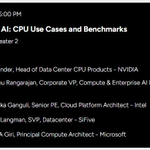
1/ I'm moderating a panel at the AI Infra Summit next week and the topic is "Agentic AI: CPU Use Cases and Benchmarks". 🧵

Ravi A Giri retweeted

Read more: blogs.microsoft.com/blog/202…


Listening to @dylan522p and Peter Desantis at the #AIInfraSummit
- "AWS is a top 5 TSMC N2 customer"
- "Going to see more chips built for specific workloads"
- "Largest volume of CPUs are for agentic and RL workloads"

- "Tranium has the highest mem bw/$"
- "Entering the Era of increasing specialization in the AI space"
- "Chips going through 9 months of Post-Si does not work for AI
- " Our design goal is to two weeks from a chip being packaged to behind usable for a customer"
- "Major advantage for Graviton was that customers were primarily running open source SW that we optimized"
- "In AI, software headwinds are a challenge"
Ravi A Giri retweeted

The contagion of fear
bcantrill.dtrace.org/2026/09…
5/ Here’s a couple of papers from my colleagues in Microsoft research that cover production data and use cases: 1. Agentic Coding in the Wild: Characterizing GitHub Copilot Traces at Production Scale: arxiv.org/pdf/2608.00101, 2. Architectural Implications of Agentic AI Workflows: arxiv.org/abs/2608.04458v1
6/ We've got time reserved in the session for the audience, so if you've been wondering what your agent fleet actually needs and how to measure it, come ask! Expo Theater 2, Santa Clara Convention Center; 🗓 Wednesday, September 16 4:15–5:00 PM. See you there! #AIInfraSummit #AgenticAI #CPUs #AIInfrastructure
Ravi A Giri retweeted

We presented how Maia 200's Software-Define Dataflow delivers highest inference performance for production LLMs in Microsoft's fleet at #HotChips26 today. We also released the full paper with many details on arXiv: arxiv.org/abs/2608.24664
And a blog post: techcommunity.microsoft.com/…


Ravi A Giri retweeted

We are living through a Gutenberg moment. Before the printing press, books were rare and expensive. Gutenberg showed how to make them far cheaper. It took decades, but books became widely available in Europe. Then came the scientific revolution.
Today it is fashionable to treat science as a closed institution run by an elite. The scientific revolution was not that. It let ordinary people raise ideas and objections. Newton’s father was an illiterate farmer. Galileo came from a modest family; his father was a musician.
Many lost out to the printing press. Kings, queens, and later wealthy publishers fought to control what could be printed. The Statute of Anne in 1710 introduced modern copyright. It took another two centuries to spread across the world.
Software followed a similar path. Early software was freely copied. People treated it more like mathematical techniques or fashion: if you saw something you liked, you could reproduce it. Bill Gates and others stopped that. Software became like books. You could still copy it for friends, but it was wrong. Businesses could not, because they could be sued.
People like to share and copy. “You can’t just copy this piece of code” is a legal construction, not human nature.
Open source was a hack on a relatively recent copyright system (1710 is not ancient). It took decades, but it became a massive success. Even Microsoft is deep into open source now.
AI changes the world again. It is another Gutenberg press: it makes copying cheap. I can take any book and have an AI rewrite it to sidestep copyright. This need not be done with bad intent. I still write books (two are in preparation), but anyone can now “write” a book with little effort. Mine will remain better, at least until the models improve further.
Anyone can also clone, port, or adapt the thousands of pieces of software I have published over the last two decades. The reputation economics shift. You can invest months in a beautiful library only to see it copied, emulated, and ported hundreds of times the minute it is released, often without credit.
At first glance this looks bad for the little guy. That is how copyright has always been sold: “it protects the little guy.” What is at stake is different. Power is shifting. Just as with the printing press, the technology may favour ordinary people more than is obvious.
A single person today can take software that a large corporation uses as a barrier and produce their own version with the engineering resources of one individual. This is not theory. It is happening now. If I were a powerful but stagnant organization, I would be worried about what the common man can now do.
Ravi A Giri retweeted

You don’t need to wait for Ultra Ethernet to build a better Ethernet, and Microsoft and OpenAI proved it. $MSFT $NVDA $AMD $AVGO
nextplatform.com/connect/202…

Ravi A Giri retweeted

Good lord. Half-ish of the cloud backlog at Microsoft, Oracle, Google and Amazon is OpenAI and Anthropic????

Ravi A Giri retweeted
Our newest AI accelerator Maia 200 is now online in Azure.
Designed for industry-leading inference efficiency, it delivers 30% better performance per dollar than current systems.
And with 10+ PFLOPS FP4 throughput, ~5 PFLOPS FP8, and 216GB HBM3e with 7TB/s of memory bandwidth it's optimized for large-scale AI workloads.
It joins our broader portfolio of CPUs, GPUs, and custom accelerators, giving customers more options to run advanced AI workloads faster and more cost-effectively on Azure.
Ravi A Giri retweeted

📢 Introducing Cobalt 200!
In partnership with @Microsoft we're bringing you the first publicly announced silicon built on the Arm Neoverse Compute Subsystem V3 (CSS V3).
A vital part of our commitment to a more efficient, scalable, and sustainable cloud!
okt.to/8cfXIk

