

The Reese Lab at UT Southwestern Medical Center studies the human parasite #Toxoplasma. Opinions are my own (or do they belong to the parasites in my brain...?)
Dallas, TX
Joined February 2019
- Tweets707
- Following120
- Followers605
- Likes711






Moving to Mastodon. Much better fit. Should anyone want to find me I'm @notoriousiptg@fediscience.org


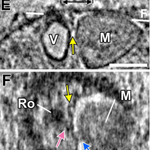
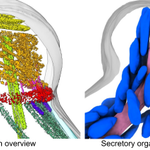
After a few years of hard work, our cryoFIB/#cryoET of the #apicomplexan #parasite invasion machinery is finally on bioRxiv! This is in close collaboration with the Nicastro lab here at UTSW (not on twitter). biorxiv.org/content/10.1101/…

We see that the microneme is docked just beside its partner organelle, the rhoptry, and both appear anchored to the same structural "ridge". Of course, we have no idea (yet) what the proteins involved are, but I'm excited for the community to find out!
Good week so far, our paper with @ToxInLa and @peter_s_back is out in @mbiojournal and I just heard I've been recommended for tenure! Time to take the lab out for lunch...
It's been a long time coming, but our new paper is now out on bioRxiv doi.org/10.1101/2021.12.09.4…! Here we figured out the ERK7 binding partner responsible for destruction of the Toxoplasma apical complex when ERK7 is lost.
Normally, CSAR1 recycles the mother cytoskeleton after division, which is never turned over in Δcsar1. You can see this in the movie. This leads to lots of screwy things in these parasites, including daughter cell counting during division (notice 3 and 4 buds in movie).
This was a really satisfying project, both because we were able to iron out a mechanism for a perplexing phenotype and because the answer was a huge surprise. Science is most fun when you are kept on your toes! Great work by a team led by Wil O'Shaughnessy & @estherhu1122