A trader with a passion for the world of transactions and data. All trades are executed using the Renk indicator a tool that has consistently proven its strong
Joined June 2026
- Tweets571
- Following62
- Followers86
- Likes485




Renkdata retweeted

We're scaling up the honest part of this project: the sample size.
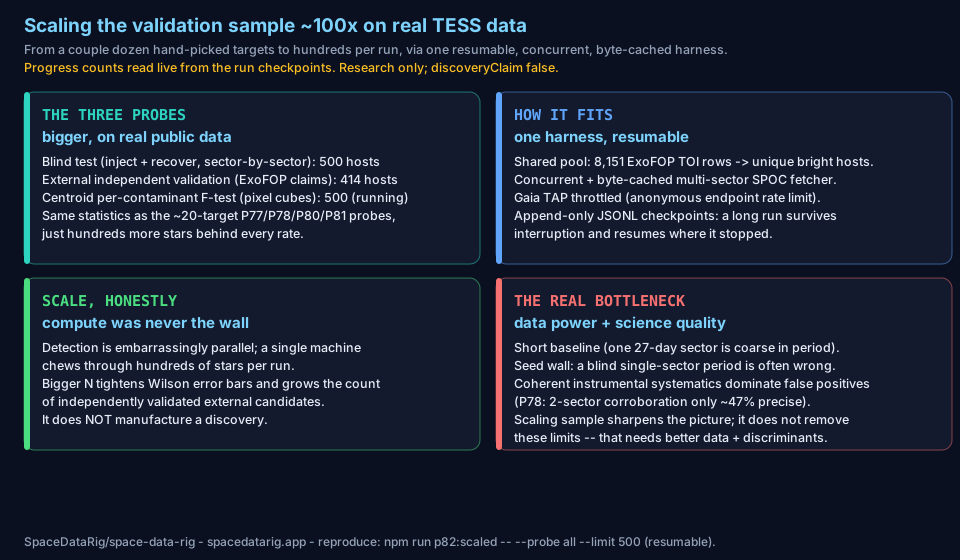
Our centroid check, blind test and external-candidate validation were each running on a couple dozen hand-picked stars -- small enough that a couple of mislabels moved the whole number. So we rebuilt all three as one resumable, concurrent, byte-cached batch harness that pulls real TESS light curves (and Gaia neighbours) for hundreds of stars per run.
A single run right now: 500 stars for the blind inject-and-recover test, 414 for independent external-candidate validation, and a few hundred more for a per-neighbour centroid F-test (still going). Every star is real public data, every run is reproducible.
Honest note: compute was never the bottleneck and still isn't. More stars tighten the error bars and grow how many external candidates we can independently confirm -- they do not manufacture a discovery. The real walls are short baselines, getting the right period from one sector, and coherent instrumental systematics. Scaling just lets us measure those more sharply.
Repo: github.com/SpaceDataRig/spac…
Live: spacedatarig.app
Proof links:
Harness (resumable, concurrent, byte-cached): github.com/SpaceDataRig/spac…
Scale-up figure: github.com/SpaceDataRig/spac…
Figure (raw): raw.githubusercontent.com/Sp…
Blind test method (P78): github.com/SpaceDataRig/spac…
External validation method (P80): github.com/SpaceDataRig/spac…
Per-contaminant centroid F-test (P77): github.com/SpaceDataRig/spac…
CI: github.com/SpaceDataRig/spac…