






Pinned Tweet
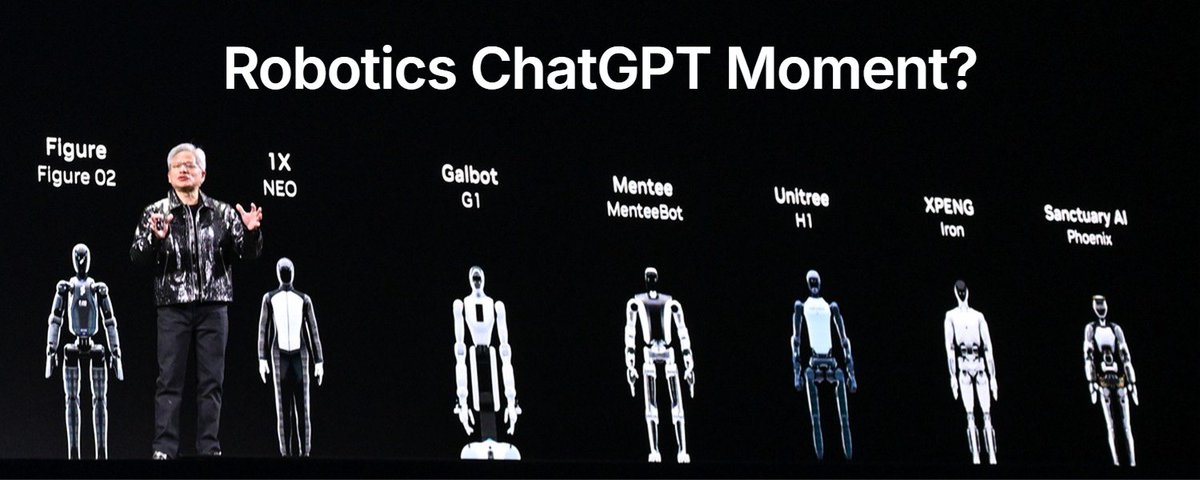
When is the ChatGPT moment for robotics?
Some say it's happened, some say it's coming. How capable are Physical AI models today? What does the adoption curve for robotics look like?
We've talked to most of the major players and make sense of it here
robostrategy.co/news/the-cha…

We probably have the top humanoid companies reaching 1 million annual production rate in 2029-2030
But robots even at smaller scale have an incredible economic impact. The largest robotics company in the world, Intuitive Surgical (~$150b), sells ~2,000 robot systems per year. Unitree sold ~5,500 humanoids last year. Symbotic sells 5,000-10,000 SymBots per year.
Take an example of Tesla and Figure scaling production at their current rate and hypothetically each achieving 50,000 robots / year next year. A robot in the US working 2-3 shifts would produce >$100,000 of economic value compared to fully loaded labor equivalent.
That would be >$500k of economic value over a 5 year useful life. Annually, that would be >$25 billion of future economic value created at that 50k robot / year scale.
This value will be split between customer and robot OEMs, but I expect the value realization split to shift from customers to OEMs. Hardware will be a bottleneck and machines will be increasingly leased, not sold.
This has been evidenced by the large RaaS contracts we have seen in the industry this year. Hardware will not be a commodity.

A million Optimus robots next year means one off the Fremont line every 30 seconds.
@GoingBallistic5 doesn't think Tesla gets there that fast. Here's why.

Andrew Kang retweeted

A million Optimus robots next year means one off the Fremont line every 30 seconds.
@GoingBallistic5 doesn't think Tesla gets there that fast. Here's why.
Winning in the humanoid space is not going to be easy. Some companies in the space will become absolute giants while many others will fail. The dispersion in returns over the next year will be massive as the wheat separates from the chaff.
Outperforming as an investor in this space requires real expertise and it will only pay for true discerning investors.
Only compound winners, everything else is noise

It looks like Figure AI founder Brett Adcock was onto something last year when he predicted that Agility Robotics would be out of business within 12 months.
Though Oregon-based Agility hasn't gone under, its 2026 SEC filing shows that its management believed the robotics firm did not have enough cash to fund operations for the following year without raising more.
The filing is unusually serious for a company preparing to go public. Agility reported never having a positive cash flow and said that losses could become greater as it expands operations. Agility reported losing $138.1 million in 2025 and warned that losses could become greater.
"Without consideration of the proposed business combination transaction, Agility has concluded there is substantial doubt about its ability to continue as a going concern, which could materially adversely affect the Post-Closing Company’s business, financial condition, and the value of your investment," the filing says.
Agility's auditor cited the company's ability to continue as a going-concern based on financial statements for 2024 and 2025. The startup later raised another $100 million in July 2026 by selling SAFEs, which are agreements that give investors the right to receive company shares in the future.
Agility, spun out of Oregon State University in 2015, is pursuing an SPAC merger with Churchill Capital Corp XI that would take the company public and give it access to additional capital. The planned deal values Agility at around $2.5 billion and includes a separate $201 million PIPE investment.
If it closes, the SPAC could extend Agility's runway considerably, but the startup is still burning cash. Describing itself as an early-state company, Agility burned $99.8 million in operating cash in 2025, up from $70.7 million the prior year, and it has since added more overhead by expanding into Silicon Valley. The company opened a new facility in Fremont in July 2026 to serve as a software and AI development hub.
According to the filing, Agility's Digit v4 humanoid robots are deployed or committed for deployment across nine customer facilities. Named customers include Amazon, GXO Logistics, Schaeffler, Toyota Motor Manufacturing Canada, and Mercado Libre. Most of the work they're doing is simple material-handling jobs like moving bins and totes.
Agility says it's also secured $300 million in multi-year orders for 1,000 Digit v5 robots under 3-year Robots-as-a-Service (RaaS) agreements. However, those orders hinge on Agility meeting certain product and contract milestones.
Though the deals offer a reason for optimism, Agility says the RaaS model still has not proven it can make money at scale. The economics depend on still-unproven assumptions about Digit's useful life, repair costs, customer renewals, and servicing expenses. Since Agility owns the hardware, it spends the money from the RaaS deals to build them upfront and receives money gradually afterward.
Agility names Boston Dynamics, Tesla, Figure AI, Apptronik, 1X Technologies, Sanctuary AI, Hexagon, and NEURA Robotics as its main competitors in the filing. The company says many of them have more resources for technical development, mass manufacturing, and marketing as well as stronger brand recognition and more existing customer relationships.

Andrew Kang retweeted

A talented crew (EO) spent weeks on a mini documentary on @standardbots, and it's live today.
Their crew came to our factory in Glen Cove, New York, and saw everything up close. That included the SMT room where we make every circuit board that goes into our robots, a factory floor we're growing from 30,000 to 70,000 square feet, and the team training our AI on real data from robots working in the field. A lot of the Standard Bots team came in to show them what we do and why we care so much about it.
I'm really proud of how they told our story, including the hard parts. It took us seven years to sell our first 100 robots. At one point my friends staged an intervention and told me it was time to go do something else. We kept going.
Here's why. Last year China installed 9x as many robots as the United States. Robots aren't just another kind of hardware. They're what makes everything else: semiconductors, medicines, defense systems, energy infrastructure.
Our mission is to bring robotics and manufacturing back to the U.S. and rebuild the middle class along with it. Manufacturing has always been the heart of the American middle class. Robots make American workers more productive, and that's how we earn the right to create high-paying jobs here. Instead of welding in the smoke, a worker runs six welding robots. That's a better job, a safer job and a higher-paying job.
We build robots in America, for use in America.
Thank you to the EO team, and to everyone at Standard Bots who made time for this. Watch the full episode here:
youtube.com/watch?v=T31kO2LO…

The FCC rule earlier this year restricted foreign made advanced robots. This presidential action goes further into the rest of the factory floor to include industrial arms, CNC, grinding, turning, milling, industrial stamping and pressing machines
The president will consider "establishing a program to incentivize new investment in United States production of robotics and industrial machinery"
With enough focus on automation, operational excellence, and investment, America can become as competitive on manufacturing as any other country

Andrew Kang retweeted

the white house just declared our dependence on imported robots and industrial machinery a national security threat.
no new tariffs yet. trade negotiations come first.
the bigger point: rebuilding american industry means building the machines that make everything else.

This same phenomena is happening in physical AI
Even after GPT-4 came out, I remember talking to computer scientists/ML experts that were so confident that general purpose models were overhyped and wouldn’t be able to produce real useful work soon. A lot of reductionist talk about stochastic parrots and next token predictors.
It is surprisingly difficult for a lot of career technologists to grasp non linear technological trends and how slopes can change.
Different experts in the same domain can have widely different expectations for technological advancement even 1-2 years in the future.
There is also an element of information asymmetry. Organizations on the frontier move at vastly different paces than those that don’t. They are privy to key know how and training/data collection approaches that can potentially compress R&D pace by orders of magnitude.
It’s important to remember that those that aren’t on the frontier are somewhat blind to the full state of the world even though they might not think that they are.
We see time and time again that research paradigms are always changing and the same bottlenecks that existed yesterday get solved by smart brains (and AI models) motivated enough to tackle them.
Laggards claim “we are so far”. We bet on the people that respond with “skill issue”.

Dario reveals the people who called his GPT-2 fears "pseudoscience" in 2019 are now all applying for jobs at AI labs
"I personally was super freaked out by [GPT-2]. I looked at it and I said, my God, you just scale this thing up another factor of a million and it'll be better than humans at everything. This is the defining economic and scientific moment of the modern age. We just don't know it yet. This is going to determine the fate of nations and economies and the future of humanity."
"Maybe 10% of the people around me had exactly the same reaction, and it was often the smartest ones. 90% of the people around me, because GPT-2's capabilities in any particular area were not that impressive, it could translate languages, summarize a document and write a few lines of code here and there. It was the broadness and the generality."
"But people would look at it and say, in any particular area, that doesn't seem so smart. And so many people just shrugged and they just dismissed it."
"I just look at it and I say it's the same thing over and over again. The limitations of the models, six months from now, the things that seemed hard, they're going to be easy. 12 months from now, the things that seemed impossible, the models are going to be doing them regularly."
"It's everything we saw with GPT-2; we're seeing it over and over again in wider and wider swaths of the world. And the world is gradually finally being convinced."
Daniela Amodei: "I remember at the time there were some very well-respected computer scientists and AI and ML leaders who basically bullied some of the researchers who worked on [GPT-2] on Twitter and were like, this is stupid. We don't know why you guys are even talking, this model is so incapable."
"It was like you were sort of a quack if you believed this was a really significant moment."
Dario: "That's all been memory-holed. All the researchers who were like, oh, this is pseudoscience, it doesn't make sense, all of them are applying for jobs at the LLM companies."
"We never say it out loud to any particular one, but we look at them and they're like, we remember what you were saying in 2019. You have no credibility on this matter."
Andrew Kang retweeted
Summing up the challenge of commercializing robots in one photo
The bar for both reliability and output quality is much higher for physical labor than it is for knowledge work. A chatbot that produces work that is just “good enough” or low quality can still be useful.
A mediocre rough draft could still save time because a person can keep what’s good and fix the rest before its final. Copywriting, slides, and contracts can all be edited.
What is considered “good enough” for physical work has much higher standards. A bad weld can ruin metal. A wrong dose given to a patient is unacceptable.
Outputs from work done by humans or robots in the physical often serve as direct inputs into the workflow that are hard to recover from if an error arises. Outputs from work done by humans or Chatbots for knowledge work are much more tolerant of errors and poor quality because supervision can be baked in before the output is used further down the workflow.
The reliability threshold is 2-4 orders of magnitude greater for physical work than knowledge work and it’s what we’ve started to achieve this year. The upside is that by optimizing for reliability, robots will be able to work at a high level of utilization and operate at higher levels of autonomy compared to general purpose AI models in 2023. Machines that can deliver up to 24 hours of work a day as opposed to minutes or hours of work.


When is the ChatGPT moment for robotics?
Some say it's happened, some say it's coming. How capable are Physical AI models today? What does the adoption curve for robotics look like?
We've talked to most of the major players and make sense of it here
robostrategy.co/news/the-cha…
Elon announced Optimus’ first autonomous demonstration video in 1-2 months.
Scott has been very spot on with Optimus predictions. He estimates V3 reveal to be in Q2 2027 and the capacity ramp to be:
2026E: 10-20k / year
2027E: ~100k / year
2029: ~1M / year
2030: Millions per year
A Tesla supplier says Optimus V3 is basically done. So why are they hiding it?
Full discussion:
0:00 Why Tesla is hiding Optimus V3
2:16 V3 hardware frozen
6:35 The pickle jar and robot skin problem
12:48 Optimus 2.5 hand tendon clip
16:06 Fingertip skin patent
22:03 Production snags in hands and joints
25:58 Theory: a 5,000 robot V3 reveal
32:02 AI5 chip and DRAM change
38:01 The Optimus factory at Giga Texas
42:41 Ramp to millions by 2030
@GoingBallistic5 @herbertong
Summing up the challenge of commercializing robots in one photo
The bar for both reliability and output quality is much higher for physical labor than it is for knowledge work. A chatbot that produces work that is just “good enough” or low quality can still be useful.
A mediocre rough draft could still save time because a person can keep what’s good and fix the rest before its final. Copywriting, slides, and contracts can all be edited.
What is considered “good enough” for physical work has much higher standards. A bad weld can ruin metal. A wrong dose given to a patient is unacceptable.
Outputs from work done by humans or robots in the physical often serve as direct inputs into the workflow that are hard to recover from if an error arises. Outputs from work done by humans or Chatbots for knowledge work are much more tolerant of errors and poor quality because supervision can be baked in before the output is used further down the workflow.
The reliability threshold is 2-4 orders of magnitude greater for physical work than knowledge work and it’s what we’ve started to achieve this year. The upside is that by optimizing for reliability, robots will be able to work at a high level of utilization and operate at higher levels of autonomy compared to general purpose AI models in 2023. Machines that can deliver up to 24 hours of work a day as opposed to minutes or hours of work.
When is the ChatGPT moment for robotics?
Some say it's happened, some say it's coming. How capable are Physical AI models today? What does the adoption curve for robotics look like?
We've talked to most of the major players and make sense of it here
robostrategy.co/news/the-cha…
We are hiring top talent from research to marketing to distribution to more
robostrategy.co/careers

Andrew Kang retweeted
Figure held an all-hands this week, and I've decided to share it here publicly
Given our rate of progress, our roadmap has completely changed over the last year, and the team has doubled
It's important to get everyone aligned on our mission going forward

Andrew Kang retweeted
Evan Beard of @standardbots on where robotics is today:
“Robots are in their infancy. It’s like the 1973 equivalent for the computer industry.”
With millions of use cases coming, their answer is an AI platform:
“We’re building a platform, not just robots, but the whole software ecosystem. That’s what we’ve tried to do from the beginning, to be that common layer across all these different use cases.”
Standard Bots CEO @evanbeard breaks down their new AI platform and how it could revolutionize American manufacturing.
"This allows you to essentially vibe code your robot"
Full interview:
0:00 Intro
6:39 Vibe coding robots
8:19 Locate vision system
11:52 400+ customers
13:58 Origin story
16:08 Where are the competitors?
18:56 Vertical integration is key
22:29 Why robot arms over humanoids
27:04 Robots vs the car industry
29:23 The thing to fear as a builder
31:31 America vs China
34:21 Congress and FCC robot ban
38:31 99% of US arms made abroad
42:31 Building everything inhouse
44:47 The plan to win
47:10 Targeting 10% of US installs
49:22 How the next decade will look like