

Researching native 🐝 biodiversity & health w/ @schuemaa. Entomology PhD student at @virginia_tech
- Tweets2.4K
- Following1.5K
- Followers2.1K
- Likes7.5K










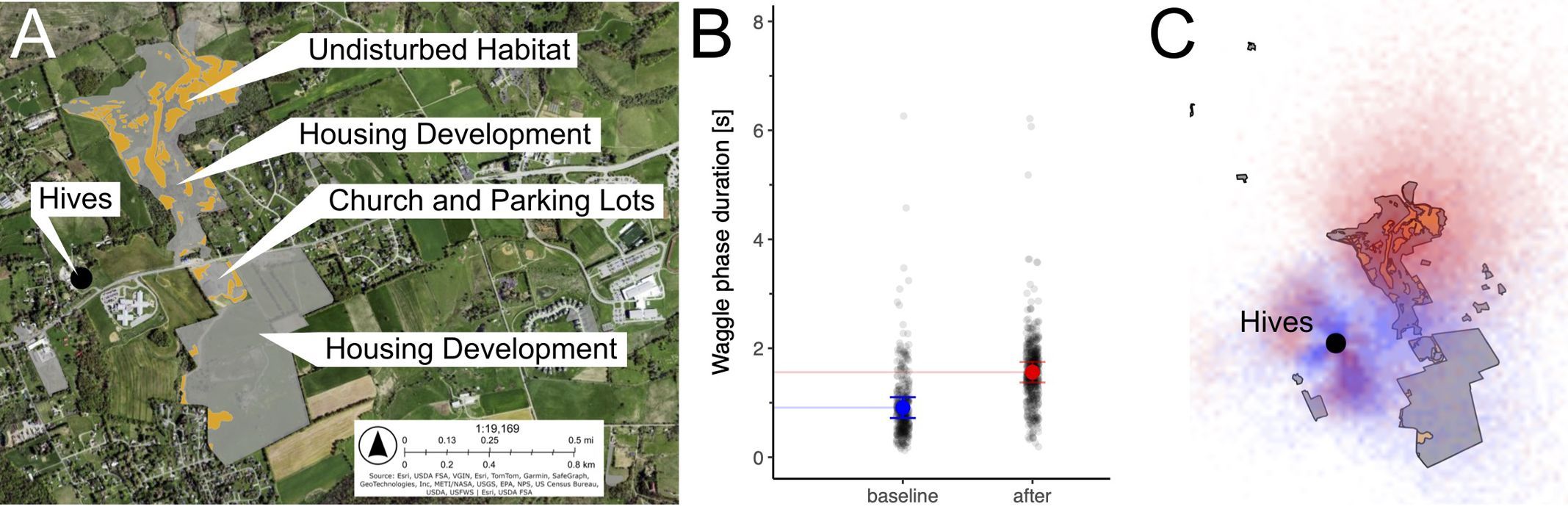
ALT Honey bees nearly double their foraging distance by shifting and consolidating their preferred sites to remaining, isolated habitat patches within the larger land use changes. (A) Aerial imagery in 2022 of the study area in Blacksburg, VA, USA. Grey polygons represent all the lands converted in 2020-2021. Orange represents small patches of undisturbed microhabitat left within the developments. Black circle denotes the location of the hives. (B) Honey bees nearly double their communicated foraging distance in 2022 (sample size n=502) compared to 2018-2019 (sample size n=382) (mean±c.i, two-tailed likelihood ratio test used for analysis). Here each datapoint is a decoded waggle dance. (C) Honey bee foraging, as determined by dance decoding before (2018-2019, blue) and after (2022, red) the land use change, demonstrated that the bees shifted recruitment to the more distant, remaining orange patches within the grey, especially in the northern corner of the new housing development.


ALT Power plant emissions


