

I ghostwrite Educational Email Courses for coaches and consultants. Former high school teacher. Builder of online courses and training programs.
Fullerton, California
Joined January 2008
- Tweets14.7K
- Following2.2K
- Followers2.6K
- Likes37.4K





10 questions to ask before you write a single lesson:
1. What should people be able to do when they finish?
2. What exercise gets them there?
3. What's the minimum they need to know to do that exercise well?
4. What is the concept, in one sentence?
5. Why is it useful to them?
6. What are the steps?
7. What examples will make it click?
8. Does the technique have a name people will remember? (Or can you give it one?)
9. Which exercises do I already walk clients through?
10. Could I get this down to three steps?
2
40
9 lessons from building exercise-first courses:
1. Clients buy results, and results come from doing things - exercise first courses: get your clients to do what gets them results
2. Design the exercise before you write a single lesson to avoid wasting time creating content you won't need.
3. Don't skip the why. People take a technique seriously when they understand why it works the way it does.
4. Name your technique. A named technique makes people think, "Ooh, I should try this."
5. Less content makes a course shorter AND more effective.
6. If practice gets squeezed out by too much content, people leave without the skill.
7. You already use exercises with clients. Write down the steps.
8. When AI analyzes your transcripts, make it read every word. Otherwise it samples and guesses.
9. Try to get each exercise down to three to five steps.
1
2
67
My client's old weekend seminars for physical therapists:
- Lots of lecture
- Some demonstration
- A little practice at the end
- Afterward he complained: "It's as if I didn't teach them anything."
His online program (which we created together):
- Much less content
- Mostly practice
- Four days a week
- He was impressed because he noticed they actually got better.
But there was external proof too:
- The clinicians he trained worked for Kaiser Permanente
- Kaiser said that member satisfaction scores improved for the first time ever
The method didn't change. The order did.
1
57
Content-first course:
- Starts with your ideas
- Polishes every insight
- Bolts on a worksheet at the end
- Asks "Am I brilliant enough?"
- Clients leave with ideas
Exercise-first course:
- Starts with the goal
- Designs the exercises
- Adds only the content needed to complete the exercises
- Asks "Did the exercise work?" "How can I make it better?"
- Clients leave with a skill
Results come from doing things. Build for that.
4
63
Signs your course was built backwards:
- You spent most of your time polishing lessons.
- The exercise showed up near the end, as a worksheet.
- You kept asking yourself, "Is this content brilliant enough?"
- There's hardly any time left for practice.
- Clients finish with a head full of ideas and no new skill.
- The testimonials and referrals don't talk about results achieved.
1
48
Here's the outline I use for every lesson in an exercise-first course:
1. Hook
2. What is the strategy?
3. Why is it useful?
4. How do you use it?
5. Examples
6. Exercise
The twist? I don't build it in that order. I come up with the how first, because that tells me what exercise people need. Then I write the what and the why.
This ensures you give ONLY the information that will get your clients results.
1
37
If you're a coach or consultant, you already have a ton of exercises you could use in a course or workshop. You just haven't noticed.
- Pull your Zoom transcripts.
- Have AI find the strategies and techniques you use with clients. Tell it to read one transcript at a time, every single word. (or else it reads 5%)
- After each client conversation, write down what you helped them do.
- Ask whether it could become an exercise. Try to get it down to three steps.
- Keep all these notes in one document.
Over time, that document becomes the starting point for your next course. But likely several courses.
1
1
39
Most people write the content first and bolt on an exercise at the end. Flip it.
- Start with the goal. What should people be able to DO when they finish?
- Design the exercise that gets them there.
- Write only the content they need to do that exercise well.
- Teach it in this order: what the exercise is, why it's useful, how to use your approach, examples, then practice.
- Give your technique a name so people want to try it.
Your course gets shorter, and your clients actually get the result they paid for.
1
47
A teacher of physical therapy watched his students try his method after a weekend of his lectures. His conclusion? "It's as if I didn't teach them anything." He had taught plenty. That was the problem. There was so much information that practice got squeezed out. When he flipped his program to mostly practice with much less content, Kaiser Permanente saw member satisfaction and provider performance improve for the first time ever. Teaching less made him a better teacher.
1
2
59
🟡 Rodney Daut 🚢 retweeted

A major cheat code in life:
Borrow @Jayyanginspires's proven hook formats from the quoted post below.
The hook, "I'm 33. Trust me on this:" is something I NEVER would have thought to test.
And yet the post below did at least ~15x more views than I typically get.
In fairness, Jay's RT undoubtedly helped - and might have driven 99% of that result.
But even still, the hook clearly didn't hurt.
Do with this data what you will, and thanks again for writing such a useful breakdown, Jay! ✊

Your clients didn't buy your course to admire your insights. They bought it to get a result. And results come from doing things. So stop polishing lessons and start designing exercises. Pick the goal. Build the exercise that gets people there. THEN write the minimum content they need to do it well. Anything beyond that is not just nice to have, it's wasting your client's time and energy.
2
4
112
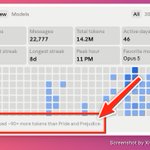
Claude Code just told me that I've used 90 times more tokens than Jane Austen's Pride and Prejudice.
I never noticed those little notes until today.

ALT A screenshot of Claude Code with the following message "You've used ~90x more tokens than Pride and Prejudice."
1
2
82
Three ways to help people imagine themselves gaining the benefits of your course (so they are more willing to buy):
- Written course: screenshot the most beautiful pages you have
- Video course: create an image of somebody on a screen going through a lesson
- Audio course: let them listen to a segment, the way audible.com does it
Pick one. It takes about 20 minutes. Then put it on your sales page under a heading that says "what's inside."
52
People buy the thing they can picture using.
Before Dropbox was well known, they had a demo video with no production values at all.
A file goes into a folder on one computer. Somebody pulls it off another. Then an email field underneath.
Their waiting list grew from 5,000 to 75,000 almost overnight.
Clearly, the simple demo was enough.
Here's how to do the same thing:
- Show the product in use rather than the product in a box
- Use a real screen, not a rendered mockup
- Pick the moment where the value is obvious
- Let them see it before you ask them for anything
If somebody can run the experience in their head, you've already done most of the selling.
2
75
If you like this tweet, you will love my newsletter The Course Builder's Corner.
Join here: coursebuilderscorner.com

17
Your sales page is showing people a book that doesn't exist.
That 3D mockup, the one at a slight angle with the nice little shadow, is a picture of packaging your product never had.
Here is what to put there instead:
- Screenshot the three best-looking pages inside your course
- If it's video, show somebody's screen partway through a lesson
- If it's audio, let them hear 60 seconds of it
Proof this works:
Mission Aviation Fellowship ran exactly this test on a live landing page for 29 days. Showing the inside pulled 35.5% more email signups than the mockup did.
You can test this yourself.
If you do, let me know about your results.
1
2
83
Evidence from your own experience outranks evidence from somebody else's.
A thousand people telling you a cookie tastes good is a good bet. It isn't certainty. One bite settles it.
That is why free samples work in a grocery store, and it's why some free content converts and some just sits there.
Your best free piece isn't a token people trade an email for. It's a taste.
It hands somebody firsthand proof that what you make is useful, and no testimonial can do that job.
1
1
49
A mockup is packaging for a product that has no packaging.
Your course doesn't come in a binder. So when you put a floating tablet on your sales page, you're showing somebody an object that will never sit on a shelf. They can't picture owning it, because there is nothing to own.
Show them the inside instead.
The lesson page. The worksheet. The thing they'd actually be looking at on a Tuesday night when they finally sit down with it. People buy what they can picture using.
In one test, an ebook page with a mockup was tested against simple screenshots of the inside of the ebook.
The winner?
The screenshots. They increased conversions by over 35%.
More details here: rodneydaut.substack.com/p/wh…
1
2
41
🟡 Rodney Daut 🚢 retweeted

Fable 5 is INSANE for creating ads
i built an agent that studies your competition and thousands of viral ads, then gives you a full viral blueprint for your brand to copy
just feed it a product photo and a landing page link and competitors names, 3 minutes later you've got a proven creative playbook for your ads, here's how it works:
- scans your brand's own website (copy, offers, structure, CTAs)
- scans competitor websites (you list them, or Claude finds likely ones for you)
- pulls live ad data straight from Meta Ad Library + TikTok via spytools
- extracts proven hooks, scripts, and visual/creative patterns from every source
- synthesizes everything into one swipe-file library
- output is a ready-to-paste doc, drop it into Claude and generate new ad scripts from proven angles instantly
- runs locally, one command, your own API keys, no video generation step slowing you down
runs 100% local, without $300/mo on spytool subscriptions or agency fees, full control, and API cost only
RT + reply w/ "AGENT" and i'll send it to you so you can use it for your brand (must follow so i can DM)