


Pinned Tweet
This is f*cking insane. Aravind Srinivas, the billionaire who built Perplexity into a $20 billion company, just named the 6 industries where the next AI jobs are:
"Finance, legal, corporate strategy, web app building, e-commerce, small and mid-market companies that are short of labor
This year we grew our headcount hardly by 10 or 20%, but grew our revenue by 4 to 5x. Our goal is to give that power to every other company on the planet"
In 60 seconds, he says out loud what every board is asking: why hire 50 people when 10 and their agents bring in 5x the revenue
His own company runs on its own product, and that's how they fix bugs before anyone files a ticket
One Team → AI Agents → A Harness → A Company That Grows 5x Without Hiring
Finance, legal and e-commerce are first. The companies that wire agents in now stop hiring for growth, the rest keep paying for it
Most people still think AI is a chat window. Almost nobody is building the system that does the work of 40 hires
This clip is worth more than a $200,000 MBA
Bookmark it and watch it tonight
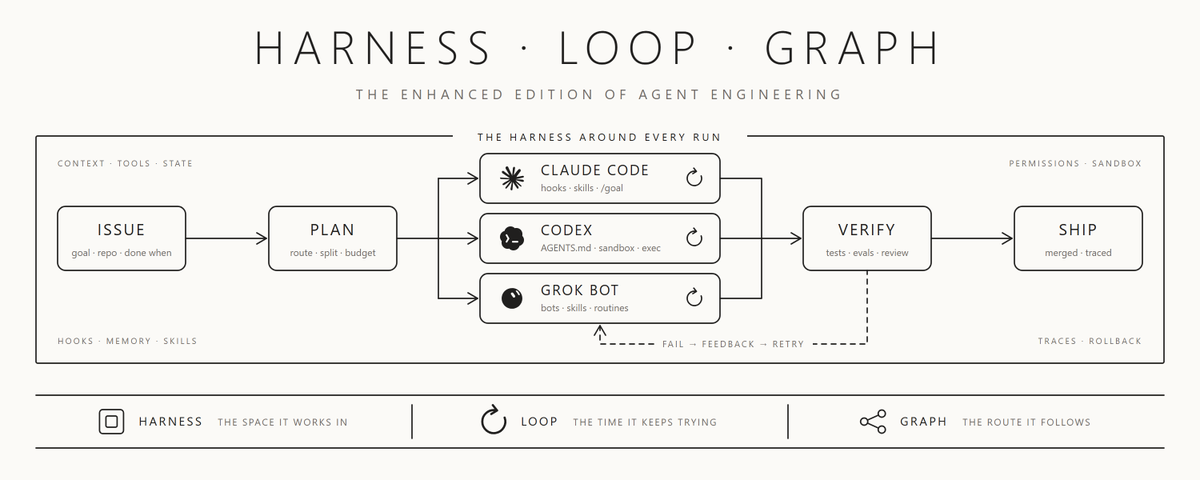
Then read the harness engineering guide below ↓

rossa retweeted
This is f*cking insane. Aravind Srinivas, the billionaire who built Perplexity into a $20 billion company, just named the 6 industries where the next AI jobs are:
"Finance, legal, corporate strategy, web app building, e-commerce, small and mid-market companies that are short of labor
This year we grew our headcount hardly by 10 or 20%, but grew our revenue by 4 to 5x. Our goal is to give that power to every other company on the planet"
In 60 seconds, he says out loud what every board is asking: why hire 50 people when 10 and their agents bring in 5x the revenue
His own company runs on its own product, and that's how they fix bugs before anyone files a ticket
One Team → AI Agents → A Harness → A Company That Grows 5x Without Hiring
Finance, legal and e-commerce are first. The companies that wire agents in now stop hiring for growth, the rest keep paying for it
Most people still think AI is a chat window. Almost nobody is building the system that does the work of 40 hires
This clip is worth more than a $200,000 MBA
Bookmark it and watch it tonight
Then read the harness engineering guide below ↓
This is f*cking insane. Mark Cuban, the billionaire who sold Broadcast.com to Yahoo for $5.7 billion, just said where the next jobs are:
"Software is dead because everything's going to be customized to your unique usage. Who's going to do it for them?
There are 33 million companies in this country. Millions of them aren't going to have AI budgets, aren't going to have AI experts"
In 150 seconds, he names the one job every company will need: the person who walks in and wires AI into their business
He hired two interns this summer because they didn't send a resume. They took a day and built something
Your Skills → AI Agents → Harness → A Company's Real Workflow → The Job Nobody Else Can Do
Off-the-shelf software dies. The person who can build the custom version for a shoe store, a clinic or a 50-person firm gets paid
Most people are still asking AI questions. Almost nobody is walking into companies and building it for them
This clip is worth more than a $150,000 business degree
Bookmark it and watch it tonight
Then read the harness engineering guide below ↓

This is f*cking insane. Aravind Srinivas, the billionaire who built Perplexity into a $20 billion company, just named the 6 industries where the next AI jobs are:
"Finance, legal, corporate strategy, web app building, e-commerce, small and mid-market companies that are short of labor
This year we grew our headcount hardly by 10 or 20%, but grew our revenue by 4 to 5x. Our goal is to give that power to every other company on the planet"
In 60 seconds, he says out loud what every board is asking: why hire 50 people when 10 and their agents bring in 5x the revenue
His own company runs on its own product, and that's how they fix bugs before anyone files a ticket
One Team → AI Agents → A Harness → A Company That Grows 5x Without Hiring
Finance, legal and e-commerce are first. The companies that wire agents in now stop hiring for growth, the rest keep paying for it
Most people still think AI is a chat window. Almost nobody is building the system that does the work of 40 hires
This clip is worth more than a $200,000 MBA
Bookmark it and watch it tonight
Then read the harness engineering guide below ↓
1
71
rossa retweeted
This is f*cking insane. Mark Cuban, the billionaire who sold Broadcast.com to Yahoo for $5.7 billion, just said where the next jobs are:
"Software is dead because everything's going to be customized to your unique usage. Who's going to do it for them?
There are 33 million companies in this country. Millions of them aren't going to have AI budgets, aren't going to have AI experts"
In 150 seconds, he names the one job every company will need: the person who walks in and wires AI into their business
He hired two interns this summer because they didn't send a resume. They took a day and built something
Your Skills → AI Agents → Harness → A Company's Real Workflow → The Job Nobody Else Can Do
Off-the-shelf software dies. The person who can build the custom version for a shoe store, a clinic or a 50-person firm gets paid
Most people are still asking AI questions. Almost nobody is walking into companies and building it for them
This clip is worth more than a $150,000 business degree
Bookmark it and watch it tonight
Then read the harness engineering guide below ↓
rossa retweeted
This is f*cking insane. Vinod Khosla, the billionaire who co-founded Sun Microsystems and wrote OpenAI's first venture check, just named the jobs:
"Whether you're a physician, a radiologist, an accountant, a chip designer or a salesperson, AI will do your job better
15 trillion of US GDP is labor. 15 trillion that would mostly go away"
In 73 seconds, he gives the date: starting around 2030, two-thirds of all jobs can be done by an AI
Before that, every professional gets four AI interns. After it, the paycheck itself is the thing at risk
Senior Professional → 4 AI Interns → Harness → The Interns Do The Job
The next 4 years are the window: the person who runs the interns keeps the job, the person who competes with them loses it
Most people are still waiting to see what 2030 looks like. Almost nobody is training their interns today
This clip is worth more than a $200,000 degree in any of those 5 jobs
Bookmark it and watch it tonight
Then read the harness engineering guide below ↓
rossa retweeted
This is f*cking insane. Marc Andreessen, the billionaire who co-founded a16z and has sat on Meta's board since 2008:
"The minute things change, the manager personality type doesn't know how to deal with change
Okay, your management, what good are your management skills at that point?"
In 4 minutes, he explains why the $250,000 MBA was built for a world that just stopped existing
Founder → Manager → Business School → Conglomerate → Collapse
A manager can run something that never changes: a bank, a power company, soup is soup
A founder rebuilds the whole thing when it breaks, the way SpaceX landed the rockets everyone else threw away
AI is that change, for every company at the same time
Anyone can buy a Harvard degree. Almost nobody can run a company that rewrites itself every 6 months
This clip is worth more than a full year of business school
Bookmark it and watch it tonight
Then read the harness engineering guide below ↓
rossa retweeted
Anthropic just explained why every AI-built interface looks the same
Inter, a purple gradient on white, almost no motion. Same page, every time. And the fix wasn't a better model.
The fix: a ~400 token skill that bans the defaults and directs the motion.
default → ban → type → one orchestrated load → accent → skill
The 6 parts of the anti-slop skill:
Part 1 → The default
Ask for a landing page, get the same page almost every time
Anthropic calls it distributional convergence
Part 2 → Ban the defaults
Never Inter, Roboto, Arial or system fonts
Never a purple gradient on white
Part 3 → Type with extremes
Weights 200 vs 800, not 400 vs 600
Size jumps of 3x or more
Part 4 → One orchestrated load
One page load with staggered reveals (animation-delay)
More delight than scattered micro-interactions
Part 5 → Dominant + accent
Every color in a CSS variable, one sharp accent
A layered background, never a flat solid
Part 6 → Load it as a skill
About 400 tokens, loaded only on frontend tasks
Every other task stays lean
"Make it look nice" gets you slop. Telling the model what to ban and where to move gets you design.
I packed all 6 parts into one prompt. Drop it into Claude Code and the next UI it builds stops looking AI-made.
6 parts. 1 prompt. ~400 tokens.
Anthropic just explained why every AI-built interface looks the same
Inter, a purple gradient on white, almost no motion. Same page, every time. And the fix wasn't a better model.
The fix: a ~400 token skill that bans the defaults and directs the motion.
default → ban → type → one orchestrated load → accent → skill
The 6 parts of the anti-slop skill:
Part 1 → The default
Ask for a landing page, get the same page almost every time
Anthropic calls it distributional convergence
Part 2 → Ban the defaults
Never Inter, Roboto, Arial or system fonts
Never a purple gradient on white
Part 3 → Type with extremes
Weights 200 vs 800, not 400 vs 600
Size jumps of 3x or more
Part 4 → One orchestrated load
One page load with staggered reveals (animation-delay)
More delight than scattered micro-interactions
Part 5 → Dominant + accent
Every color in a CSS variable, one sharp accent
A layered background, never a flat solid
Part 6 → Load it as a skill
About 400 tokens, loaded only on frontend tasks
Every other task stays lean
"Make it look nice" gets you slop. Telling the model what to ban and where to move gets you design.
I packed all 6 parts into one prompt. Drop it into Claude Code and the next UI it builds stops looking AI-made.
6 parts. 1 prompt. ~400 tokens.
rossa retweeted
Motion designers are not ready for Opus 5.5
A full sign-in flow, email, password, a 6-digit code, the check on the drop, a profile card and a bell that rings, in 12 seconds. One shape, 8 UI states
All code. 0 After Effects, 0 plugins, 0 timeline
steal the stack ↓
01 / shadcn/ui → the buttons, inputs and cards every state is built from
github.com/shadcn-ui/ui
02 / Magic UI → animated components you drop straight in
github.com/magicuidesign/mag…
03 / Motion → the morphs: one shape that turns into the next screen
github.com/motiondivision/mo…
04 / react-spring → spring physics for every pop-in
github.com/pmndrs/react-spri…
05 / GSAP → one timeline that puts every move on the beat
github.com/greensock/GSAP
06 / Anime.js → a tiny engine when the whole film is one HTML file
github.com/juliangarnier/ani…
07 / Motion Canvas → animation written as code, with a live preview
github.com/motion-canvas/mot…
08 / Remotion → turns your React animation into a real video
github.com/remotion-dev/remo…
09 / Playwright → captures every frame of the page, motion blur included
github.com/microsoft/playwri…
10 / FFmpeg → stitches the frames, the music and the clicks into one mp4
github.com/FFmpeg/FFmpeg
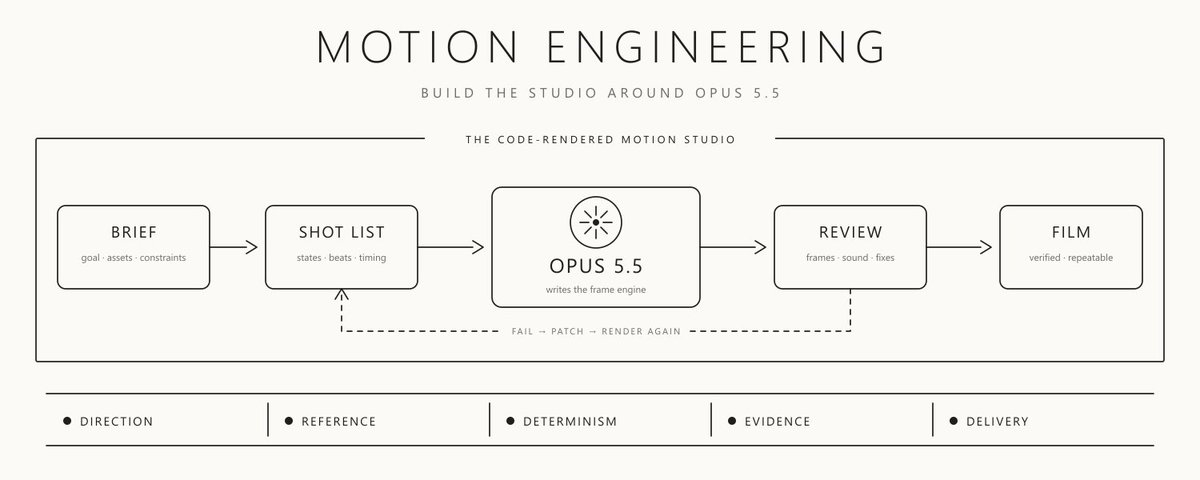
Give Opus 5.5 these 10 repos and one sentence of what you want. That's the whole studio
rossa retweeted
Opus 5.5 built this whole video inside a single HTML file
Upload, progress, a switch, a counter, a colour pick and a code card that copies itself on the drop, in 10 seconds. One shape, 7 UI states, 0 After Effects
Zero plugins, zero timeline. Studios still charge $2k+ for this
steal the prompt ↓
<inputs>
Ask me for: the accent colour, a song (mp3), the first button label, the 3 segment labels, the counter's start number and unit, 5 swatch colours, 5 short code lines and the toast. If I skip any, use the defaults: green #1ed760, any 130-145 BPM trap or electronic track, "Upload", "Day / Week / Month", "126 BPM", white, violet, cobalt, green, lime, a seek(t) function that sets w, r and zoom, "Copied. Every frame is code".
</inputs>
<direction>
One black shape (#0e0e10) on a warm light stage (#f4f4f1 to #e1e1dc radial). It never cuts: every UI state is born out of the one before it. White text, Geist for UI, Geist Mono for numbers, labels and code. The accent shows up only where something is live or chosen: the progress fill, the plus button, the picked swatch, the highlighted code line, the copied button, the toast check.
A macOS cursor drives every change with real clicks. Each click lands on a beat.
Every morph uses one curve: cubic-bezier(.45,0,.15,1). Pop-ins use a closed-form spring with a small overshoot. Text and numbers rise through a mask line, they never fade in.
The camera zooms per state so each state fills about 60% of the frame, and creeps 1.2% through the whole loop.
Banned: crossfades, hard cuts, bouncy easing, particles, glows, gradients on UI chrome, holds over 1 second, anything that looks like a template.
</direction>
<structure>
120 BPM grid, 24 beats, then the whole film is time-warped once onto the real song's tempo.
Upload pill → click → it flattens into a thin progress bar, the accent fill runs 0 to 100% with the number → thickens into a segmented control, the white highlight springs in under the first label → click the third label, the highlight slides across and the label colours swap → folds into a counter card: a small label, a big number, an accent plus button → click plus twice on two beats, the number rolls up one digit each time through its mask → stretches into a long swatch bar, 5 dots spring in one after another → click the accent dot, a white ring springs around it → grows into a code card, file name and 5 lines rise one by one, the middle line lights up in the accent → click Copy on the drop, the button turns accent and reads Copied → collapses into a toast with a check → back into the Upload pill. Last frame = first frame, cursor included.
</structure>
<build>
1. One HTML file, square 1440x1440. Every style is computed from time inside seek(t): no CSS transitions, no timers, no state between frames.
2. The shape is one div. Width, height, radius and zoom come from one keyframe table [t, [w, h, r, zoom]], eased with the one curve. Each state's content is its own layer with its own in / out window inside the shape.
3. Every element inside a layer is placed from the shape's live width (centre + offset), so the segments, swatches and the progress fill stay glued to the shape while it morphs.
4. Cursor: one track of screen positions. Each click target is 720 + local position x zoom, so the cursor sits on the button at the zoom it is clicked at. A click is a short scale dip on the cursor, the button it hits dips too.
5. The counter: pick the number from time (before click 1, before click 2, after), and run the rise from the time of the last change, so each new digit rolls in from below.
6. Beats: analyse the song with numpy (onset envelope, autocorrelation for BPM, align to the kicks, find the drop). Put the Copy click on the drop; the song plays low-passed until then, as if in the next room.
7. Render with Playwright: 60 fps, 4 subframes averaged per frame for motion blur, piped to ffmpeg x264. Then one real SFX per event (click, select, tone, whoosh), placed by its measured peak, quiet under the music, loudnorm to -14 LUFS.
</build>
<gotchas>
- The big counter number vanished: it was absolutely positioned inside its mask span, so the mask collapsed to zero size. Position the mask, keep the text inside it inline-block.
- The code card sat empty for a third of a second after it grew. Start the first line's rise inside the morph, not after it.
- A 139.65 BPM song against a 120 BPM grid: warp time once (t x 12 / 10.312) instead of retiming every key, then place the Copy click by the drop, not by the grid.
- Two morphs go from a wide shape to a tall one in under half a second. They will read as jumps in a frame-by-frame check; that is fine as long as the shape itself never cuts.
</gotchas>
<start>
Ask me for the inputs, then show me the state list on the beat grid before you write any code.
</start>
rossa retweeted
A studio would charge you $2k+ for this
A full music player in 13 seconds: play, cover, queue, a live scrub on the drop, a like. One shape, 7 UI states, 0 After Effects
Opus 5.5 wrote every frame in one HTML file. No MCP, no plugins, no timeline
steal the prompt ↓
<inputs>
Ask me for: the accent colour, a song (mp3), the track title, the 3 queue rows, the cover number and the toast. If I skip any, use the defaults: cobalt #3B5BFF, any 100-120 BPM pop or electronic track, "Every frame is code", "Every frame is code / One shape, no cuts / Made in one file", "09", "Added to your library".
</inputs>
<direction>
One black shape (#0e0e10) on a warm light stage (#f4f4f1 to #e1e1dc radial). It never cuts: every UI state is born out of the one before it. White text, Geist for UI, Geist Mono for labels, times and small print. The accent shows up only where something is live or chosen: the play triangle, the cover, the progress fill, the picked queue row, the scrub fill, the filled heart, the toast check.
A macOS cursor drives every change with real clicks, and the scrub is a real drag: the knob follows the cursor, not a keyframe.
Every morph uses one curve: cubic-bezier(.45,0,.15,1). Pop-ins use a closed-form spring with a small overshoot. Text rises through a mask line, it never fades in.
The camera zooms per state so each state fills about 60% of the frame, and creeps 1.2% through the whole loop.
Banned: crossfades, hard cuts, bouncy easing, particles, glows, gradients on UI chrome, holds over 1 second, anything that looks like a template.
</direction>
<structure>
120 BPM grid, 24 beats, then the whole film is time-warped once onto the real song's beat.
Play pill → click → it folds into a square cover that turns accent, the number and the label rise → stretches into a player card: cover thumb springs in, title and subtitle rise, the progress bar runs, the time counts → click next → grows into a queue card, "Up next" and 3 rows rise → click row 2, it fills with the accent → collapses into a long scrubber pill → the cursor grabs the knob and drags it across on the drop, both times update every frame → shrinks into a round like button, the heart outline springs in → click, the heart fills with a spring → stretches into a toast with a check → back into the Play pill. Last frame = first frame, cursor included.
</structure>
<build>
1. One HTML file, square 1440x1440. Every style is computed from time inside seek(t): no CSS transitions, no timers, no state between frames.
2. The shape is one div. Width, height, radius and zoom come from one keyframe table [t, w, h, r, zoom], every column eased with the one curve. Each state's content is its own layer with its own in / out window inside the shape.
3. The shape's colour is a track too: black, then accent while it is the cover, then black. Mix the RGB channels, never swap classes.
4. Cursor: one track of screen positions. Each click target is 720 + local position x zoom, so the cursor sits on the button at the zoom it is clicked at.
5. The drag: during the drag window the knob's local x = (cursor x - 720) / zoom, using the same zoom the camera uses that frame (creep included). Clamp it to the track and derive the fill and both times from it.
6. Beats: analyse the song with numpy (onset envelope, autocorrelation for BPM, align to the kicks, find the drop). The song plays low-passed until the drop, as if in the next room.
7. Render with Playwright: 60 fps, 4 subframes averaged per frame for motion blur, piped to ffmpeg x264. Then one real SFX per event (click, select, tone, whoosh), placed by its measured peak, quiet under the music, loudnorm to -14 LUFS.
</build>
<gotchas>
- Between the queue and the scrubber the card sat empty for a few frames: the queue left before the scrubber came in. Let the next layer start inside the outgoing layer's fade, both inside the same morph.
- The scrubber's track was pinned to the top of the card, so it rode high while the card was still tall from the queue. Pin content that has to survive a morph to the vertical centre.
- The cursor's press state is a short dip for clicks; a drag needs it held down for the whole drag window or it reads as a click and a glide.
- A 108.8 BPM song against a 120 BPM grid ends almost two beats late. Warp time once (t x 12 / 13.236) instead of retiming every key, and snap the drop to the grid beat just before the drag.
</gotchas>
<start>
Ask me for the inputs, then show me the state list on the beat grid before you write any code.
</start>
Opus 5.5 made this entire video in ONE html file
A voice note turns into 3 tasks and a calendar event in 13 seconds. One shape, 7 UI states, 0 After Effects
No MCP, no plugins, no timeline. A studio would charge you $2k+ for this
steal the prompt ↓
<inputs>
Ask me for: the accent colour, a song (mp3), the transcript sentence, the 3 tasks it becomes, the calendar line and the toast. If I skip any, use the defaults: violet #A898FF, any 105-120 BPM electronic track, "Book the studio for Friday, send the cut to the team, render v3 tonight", the 3 tasks from that sentence, "Studio, 10:00", "Every frame is code".
</inputs>
<direction>
One black shape (#0e0e10) on a warm light stage (#f4f4f1 to #e1e1dc radial). It never cuts: every UI state is born out of the one before it. White text, Geist for UI, Geist Mono for labels, timers and small print. The accent shows up only where something is live or done: the recording button, the stop square, the ticked boxes, the date block, the toast check.
A macOS cursor drives every change with real clicks.
Every morph uses one curve: cubic-bezier(.45,0,.15,1). Pop-ins use a closed-form spring with a small overshoot. Text rises through a mask line, it never fades in. Typed text types, one character per frame step, with a blinking caret.
The camera zooms per state so each state fills about 60% of the frame, and creeps 1.2% through the whole loop.
Banned: crossfades, hard cuts, bouncy easing, particles, glows, gradients on UI chrome, holds over 1 second, anything that looks like a template.
</direction>
<structure>
120 BPM grid, 24 beats, then the whole film is time-warped once onto the real song's beat.
Record pill → click → it shrinks into a round mic button that turns accent and breathes → stretches into a waveform pill, 26 bars dance to fake audio, the timer counts, a stop square on the right → click stop, the bars collapse → it grows into a transcript card, the sentence types itself → unfolds into a checklist card, title and 3 rows rise → the cursor ticks each box on a beat, the drop lands on the first tick → folds into a calendar chip, the date block springs in, click it, it pulses → becomes a toast with a check → back into the Record pill. Last frame = first frame, cursor included.
</structure>
<build>
1. One HTML file, square 1440x1440. Every style is computed from time inside seek(t): no CSS transitions, no timers, no state between frames.
2. The shape is one div. Width, height, radius, zoom and colour come from one keyframe table [t, w, h, r, zoom], every column eased with the one curve. Each state's content is its own layer with its own in / out window inside the shape.
3. The shape's colour is a track too: black, then accent while recording, then black. Mix the RGB channels, never swap classes.
4. Cursor: one track of screen positions. Each click target is computed as 720 + local position x zoom, so the cursor sits on the box at the zoom it is clicked at.
5. Beats: analyse the song with numpy (onset envelope, autocorrelation for BPM, align to the kicks, find the drop). The song plays low-passed until the drop, as if in the next room.
6. Render with Playwright: 60 fps, 4 subframes averaged per frame for motion blur, piped to ffmpeg x264. Then one real SFX per event (click, typing, select, whoosh), placed by its measured peak, quiet under the music, loudnorm to -14 LUFS.
</build>
<gotchas>
- 34 waveform bars ran straight into the timer at a 640 px pill. Count the bars from the free width, not by eye.
- The first checklist row sat on the subtitle. Lay rows out from the card's bottom up and leave one row of air under the title.
- A song at 112 BPM against a 120 BPM grid drifts a quarter beat by the end. Warp time once (t x 12 / 12.81) instead of retiming 40 keys.
- If the drop is placed on the tick time instead of the nearest beat, the music feels late. Snap the drop to the grid beat just before the click.
</gotchas>
<start>
Ask me for the inputs, then show me the state list on the beat grid before you write any code.
</start>
A studio would charge you $2k+ for this
A full music player in 13 seconds: play, cover, queue, a live scrub on the drop, a like. One shape, 7 UI states, 0 After Effects
Opus 5.5 wrote every frame in one HTML file. No MCP, no plugins, no timeline
steal the prompt ↓
<inputs>
Ask me for: the accent colour, a song (mp3), the track title, the 3 queue rows, the cover number and the toast. If I skip any, use the defaults: cobalt #3B5BFF, any 100-120 BPM pop or electronic track, "Every frame is code", "Every frame is code / One shape, no cuts / Made in one file", "09", "Added to your library".
</inputs>
<direction>
One black shape (#0e0e10) on a warm light stage (#f4f4f1 to #e1e1dc radial). It never cuts: every UI state is born out of the one before it. White text, Geist for UI, Geist Mono for labels, times and small print. The accent shows up only where something is live or chosen: the play triangle, the cover, the progress fill, the picked queue row, the scrub fill, the filled heart, the toast check.
A macOS cursor drives every change with real clicks, and the scrub is a real drag: the knob follows the cursor, not a keyframe.
Every morph uses one curve: cubic-bezier(.45,0,.15,1). Pop-ins use a closed-form spring with a small overshoot. Text rises through a mask line, it never fades in.
The camera zooms per state so each state fills about 60% of the frame, and creeps 1.2% through the whole loop.
Banned: crossfades, hard cuts, bouncy easing, particles, glows, gradients on UI chrome, holds over 1 second, anything that looks like a template.
</direction>
<structure>
120 BPM grid, 24 beats, then the whole film is time-warped once onto the real song's beat.
Play pill → click → it folds into a square cover that turns accent, the number and the label rise → stretches into a player card: cover thumb springs in, title and subtitle rise, the progress bar runs, the time counts → click next → grows into a queue card, "Up next" and 3 rows rise → click row 2, it fills with the accent → collapses into a long scrubber pill → the cursor grabs the knob and drags it across on the drop, both times update every frame → shrinks into a round like button, the heart outline springs in → click, the heart fills with a spring → stretches into a toast with a check → back into the Play pill. Last frame = first frame, cursor included.
</structure>
<build>
1. One HTML file, square 1440x1440. Every style is computed from time inside seek(t): no CSS transitions, no timers, no state between frames.
2. The shape is one div. Width, height, radius and zoom come from one keyframe table [t, w, h, r, zoom], every column eased with the one curve. Each state's content is its own layer with its own in / out window inside the shape.
3. The shape's colour is a track too: black, then accent while it is the cover, then black. Mix the RGB channels, never swap classes.
4. Cursor: one track of screen positions. Each click target is 720 + local position x zoom, so the cursor sits on the button at the zoom it is clicked at.
5. The drag: during the drag window the knob's local x = (cursor x - 720) / zoom, using the same zoom the camera uses that frame (creep included). Clamp it to the track and derive the fill and both times from it.
6. Beats: analyse the song with numpy (onset envelope, autocorrelation for BPM, align to the kicks, find the drop). The song plays low-passed until the drop, as if in the next room.
7. Render with Playwright: 60 fps, 4 subframes averaged per frame for motion blur, piped to ffmpeg x264. Then one real SFX per event (click, select, tone, whoosh), placed by its measured peak, quiet under the music, loudnorm to -14 LUFS.
</build>
<gotchas>
- Between the queue and the scrubber the card sat empty for a few frames: the queue left before the scrubber came in. Let the next layer start inside the outgoing layer's fade, both inside the same morph.
- The scrubber's track was pinned to the top of the card, so it rode high while the card was still tall from the queue. Pin content that has to survive a morph to the vertical centre.
- The cursor's press state is a short dip for clicks; a drag needs it held down for the whole drag window or it reads as a click and a glide.
- A 108.8 BPM song against a 120 BPM grid ends almost two beats late. Warp time once (t x 12 / 13.236) instead of retiming every key, and snap the drop to the grid beat just before the drag.
</gotchas>
<start>
Ask me for the inputs, then show me the state list on the beat grid before you write any code.
</start>
14
A studio would charge you $2k+ for this
A full music player in 13 seconds: play, cover, queue, a live scrub on the drop, a like. One shape, 7 UI states, 0 After Effects
Opus 5.5 wrote every frame in one HTML file. No MCP, no plugins, no timeline
steal the prompt ↓
<inputs>
Ask me for: the accent colour, a song (mp3), the track title, the 3 queue rows, the cover number and the toast. If I skip any, use the defaults: cobalt #3B5BFF, any 100-120 BPM pop or electronic track, "Every frame is code", "Every frame is code / One shape, no cuts / Made in one file", "09", "Added to your library".
</inputs>
<direction>
One black shape (#0e0e10) on a warm light stage (#f4f4f1 to #e1e1dc radial). It never cuts: every UI state is born out of the one before it. White text, Geist for UI, Geist Mono for labels, times and small print. The accent shows up only where something is live or chosen: the play triangle, the cover, the progress fill, the picked queue row, the scrub fill, the filled heart, the toast check.
A macOS cursor drives every change with real clicks, and the scrub is a real drag: the knob follows the cursor, not a keyframe.
Every morph uses one curve: cubic-bezier(.45,0,.15,1). Pop-ins use a closed-form spring with a small overshoot. Text rises through a mask line, it never fades in.
The camera zooms per state so each state fills about 60% of the frame, and creeps 1.2% through the whole loop.
Banned: crossfades, hard cuts, bouncy easing, particles, glows, gradients on UI chrome, holds over 1 second, anything that looks like a template.
</direction>
<structure>
120 BPM grid, 24 beats, then the whole film is time-warped once onto the real song's beat.
Play pill → click → it folds into a square cover that turns accent, the number and the label rise → stretches into a player card: cover thumb springs in, title and subtitle rise, the progress bar runs, the time counts → click next → grows into a queue card, "Up next" and 3 rows rise → click row 2, it fills with the accent → collapses into a long scrubber pill → the cursor grabs the knob and drags it across on the drop, both times update every frame → shrinks into a round like button, the heart outline springs in → click, the heart fills with a spring → stretches into a toast with a check → back into the Play pill. Last frame = first frame, cursor included.
</structure>
<build>
1. One HTML file, square 1440x1440. Every style is computed from time inside seek(t): no CSS transitions, no timers, no state between frames.
2. The shape is one div. Width, height, radius and zoom come from one keyframe table [t, w, h, r, zoom], every column eased with the one curve. Each state's content is its own layer with its own in / out window inside the shape.
3. The shape's colour is a track too: black, then accent while it is the cover, then black. Mix the RGB channels, never swap classes.
4. Cursor: one track of screen positions. Each click target is 720 + local position x zoom, so the cursor sits on the button at the zoom it is clicked at.
5. The drag: during the drag window the knob's local x = (cursor x - 720) / zoom, using the same zoom the camera uses that frame (creep included). Clamp it to the track and derive the fill and both times from it.
6. Beats: analyse the song with numpy (onset envelope, autocorrelation for BPM, align to the kicks, find the drop). The song plays low-passed until the drop, as if in the next room.
7. Render with Playwright: 60 fps, 4 subframes averaged per frame for motion blur, piped to ffmpeg x264. Then one real SFX per event (click, select, tone, whoosh), placed by its measured peak, quiet under the music, loudnorm to -14 LUFS.
</build>
<gotchas>
- Between the queue and the scrubber the card sat empty for a few frames: the queue left before the scrubber came in. Let the next layer start inside the outgoing layer's fade, both inside the same morph.
- The scrubber's track was pinned to the top of the card, so it rode high while the card was still tall from the queue. Pin content that has to survive a morph to the vertical centre.
- The cursor's press state is a short dip for clicks; a drag needs it held down for the whole drag window or it reads as a click and a glide.
- A 108.8 BPM song against a 120 BPM grid ends almost two beats late. Warp time once (t x 12 / 13.236) instead of retiming every key, and snap the drop to the grid beat just before the drag.
</gotchas>
<start>
Ask me for the inputs, then show me the state list on the beat grid before you write any code.
</start>
rossa retweeted
Opus 5.5 made this entire video in ONE html file
A voice note turns into 3 tasks and a calendar event in 13 seconds. One shape, 7 UI states, 0 After Effects
No MCP, no plugins, no timeline. A studio would charge you $2k+ for this
steal the prompt ↓
<inputs>
Ask me for: the accent colour, a song (mp3), the transcript sentence, the 3 tasks it becomes, the calendar line and the toast. If I skip any, use the defaults: violet #A898FF, any 105-120 BPM electronic track, "Book the studio for Friday, send the cut to the team, render v3 tonight", the 3 tasks from that sentence, "Studio, 10:00", "Every frame is code".
</inputs>
<direction>
One black shape (#0e0e10) on a warm light stage (#f4f4f1 to #e1e1dc radial). It never cuts: every UI state is born out of the one before it. White text, Geist for UI, Geist Mono for labels, timers and small print. The accent shows up only where something is live or done: the recording button, the stop square, the ticked boxes, the date block, the toast check.
A macOS cursor drives every change with real clicks.
Every morph uses one curve: cubic-bezier(.45,0,.15,1). Pop-ins use a closed-form spring with a small overshoot. Text rises through a mask line, it never fades in. Typed text types, one character per frame step, with a blinking caret.
The camera zooms per state so each state fills about 60% of the frame, and creeps 1.2% through the whole loop.
Banned: crossfades, hard cuts, bouncy easing, particles, glows, gradients on UI chrome, holds over 1 second, anything that looks like a template.
</direction>
<structure>
120 BPM grid, 24 beats, then the whole film is time-warped once onto the real song's beat.
Record pill → click → it shrinks into a round mic button that turns accent and breathes → stretches into a waveform pill, 26 bars dance to fake audio, the timer counts, a stop square on the right → click stop, the bars collapse → it grows into a transcript card, the sentence types itself → unfolds into a checklist card, title and 3 rows rise → the cursor ticks each box on a beat, the drop lands on the first tick → folds into a calendar chip, the date block springs in, click it, it pulses → becomes a toast with a check → back into the Record pill. Last frame = first frame, cursor included.
</structure>
<build>
1. One HTML file, square 1440x1440. Every style is computed from time inside seek(t): no CSS transitions, no timers, no state between frames.
2. The shape is one div. Width, height, radius, zoom and colour come from one keyframe table [t, w, h, r, zoom], every column eased with the one curve. Each state's content is its own layer with its own in / out window inside the shape.
3. The shape's colour is a track too: black, then accent while recording, then black. Mix the RGB channels, never swap classes.
4. Cursor: one track of screen positions. Each click target is computed as 720 + local position x zoom, so the cursor sits on the box at the zoom it is clicked at.
5. Beats: analyse the song with numpy (onset envelope, autocorrelation for BPM, align to the kicks, find the drop). The song plays low-passed until the drop, as if in the next room.
6. Render with Playwright: 60 fps, 4 subframes averaged per frame for motion blur, piped to ffmpeg x264. Then one real SFX per event (click, typing, select, whoosh), placed by its measured peak, quiet under the music, loudnorm to -14 LUFS.
</build>
<gotchas>
- 34 waveform bars ran straight into the timer at a 640 px pill. Count the bars from the free width, not by eye.
- The first checklist row sat on the subtitle. Lay rows out from the card's bottom up and leave one row of air under the title.
- A song at 112 BPM against a 120 BPM grid drifts a quarter beat by the end. Warp time once (t x 12 / 12.81) instead of retiming 40 keys.
- If the drop is placed on the tick time instead of the nearest beat, the music feels late. Snap the drop to the grid beat just before the click.
</gotchas>
<start>
Ask me for the inputs, then show me the state list on the beat grid before you write any code.
</start>