
“The most likely outcome is an age of Amazing Abundance, where anyone can have anything they can think of.” by Elon Musk This is also the future I want.
Taipei, Taiwan
Joined May 2018
- Tweets8.7K
- Following1.9K
- Followers2.8K
- Likes125K







Ryan Wang 🇹🇼 retweeted

when we can do anything,
do we still know what we want?
the full talk from @aiDotEngineer shanghai. every slide handmade in keynote, subs in 中文 and english


Ryan Wang 🇹🇼 retweeted
Just did a round table review with the Grok @Bot engineering team.
Fixes are being implemented overnight and you should notice a dramatic improvement by tomorrow. If not, reply to this post and we will address any remaining issues right away.
Ryan Wang 🇹🇼 retweeted

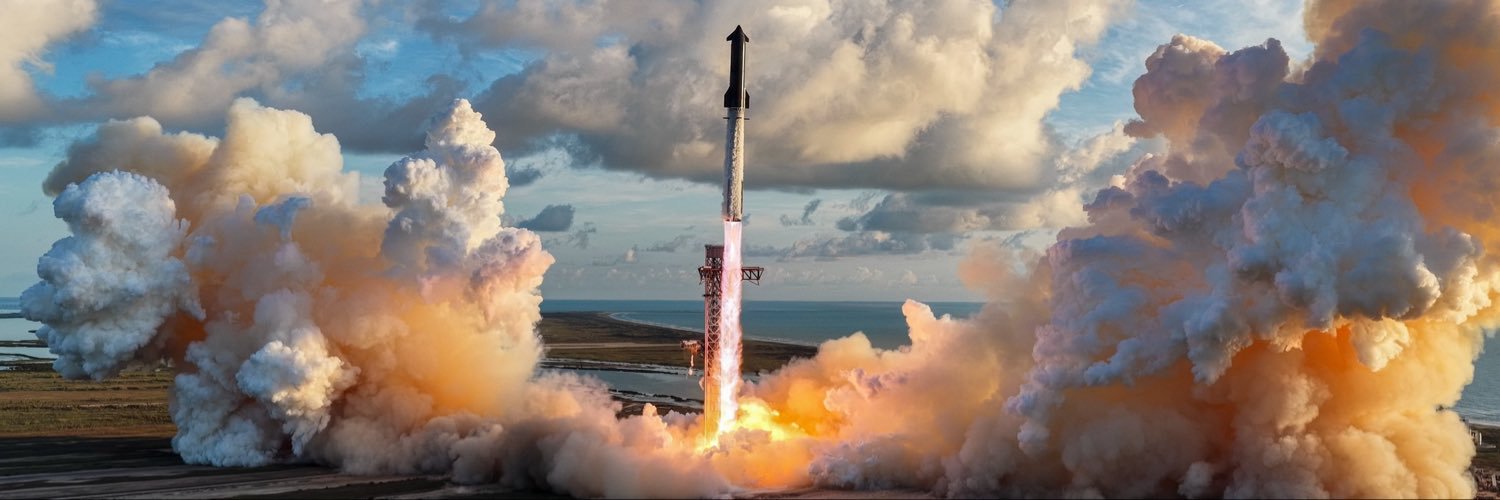
SpaceX has just released a new blog about Starship's upcoming 15th flight planned for Nov 13 with more info about what to expect, the significance of this flight, and their approach to safety:
"Starship is preparing to take a major step towards full reusability: bringing the Starship upper stage back to the launch site for a catch by the tower at Starbase.
To return Starship to Starbase, the spacecraft must now fly a safe trajectory that will take it over inhabited areas in northern Mexico and southern Texas to reach its launch site for catch. Like previous flight testing and the first successful mission to orbit, Starship’s flight profile for this ambitious mission is being designed with opportunities to safely end the mission early if necessary and will follow strict criteria before committing to the final phases of flight.
OUR APPROACH TO A SAFE RETURN:
On Flight 15, Starship will initially launch to a passively safe suborbital trajectory. This is the same flight profile used on Starship’s first orbital mission and ensures that any issues encountered during ascent or shortly thereafter will result in Starship reentering over a cleared area of the Indian Ocean.
After this initial ascent, flight controllers will assess the health of Starship’s systems before giving a “go” or “no-go” for orbit. If “go”, Starship will then perform an orbital insertion burn with a single Raptor sea-level engine, increasing its speed and achieving orbit around Earth.
Once on orbit, Starship will deploy its payload of Starlink V3 satellites. Three of these satellites have been modified to acquire imagery of Starship’s heatshield. This method of analyzing Starship’s heatshield has been tested on previous flights and is one of several data sources to help inform Starship’s readiness to return to the launch site on Flight 15.
After deploying its payload, Starship will then coast in orbit for another ~21 hours until its orbit aligns with Starbase for a return. During this multi-hour orbital coast, flight controllers will continuously perform manual and automated checks of Starship systems which, similar to the first orbital flight, will be intentionally conservative. They include Raptor engine health, loss of power or communications, the health of the flight computers and navigation sensors, the structural integrity of the propellant tanks and feedlines, the ability to hold tank pressure, and Starship’s ability to control its attitude.
During this prolonged coast phase, flight control teams have several options to end the mission early and return Starship to precleared areas of the Pacific Ocean if needed. These locations include early- and late-mission splashdown options around Hawaii and a mid-mission splashdown opportunity several hundred kilometers off the coast of Chile. These precleared areas, which were also used during Flight 14, provide a safe place to land Starship if any conditions arise that may preclude the ability to perform a safe reentry.
WHAT SHIP CATCH WILL LOOK (AND SOUND) LIKE:
Flight controllers will only permit Starship to return to Starbase if the vehicle’s status meets our internally developed, and FAA-approved, conditions for a return to launch site and catch.
If these requirements are met, Starship will perform a deorbit burn with a single Raptor 3 engine. This deorbit burn will alter Starship’s path to place the vehicle on a course to reenter Earth’s atmosphere at a specific point over the Pacific Ocean, thousands of kilometers uprange from Starbase.
During reentry, Starship can alter its flight path by moving its four control flaps. This will permit Starship to maintain a safe and known trajectory while guiding itself with high precision control toward Starbase. This control will also allow Starship to carry out a series of small turns in its trajectory to intentionally fly over sparsely populated areas of northern Mexico and southern Texas.
As Starship approaches Starbase from the west, the vehicle will weave its way around the major cities in the Rio Grande Valley, passing to the north of South Padre Island and out over the Gulf of America as it makes its final turn south towards Starbase. This banking maneuver has been demonstrated several times on previous Starship flight tests.
During this phase, residents of Cameron County and those in the nearby area may hear one or more sonic booms as Starship approaches the launch site. A sonic boom is a brief, thunder-like noise a person on the ground hears when an aircraft or other vehicle in the area flies faster than the speed of sound. The sonic boom does not present a health risk and what people experience will depend on weather and other conditions.
As Starship arrives over Starbase, it will perform the final bellyflop maneuver down towards the tower at Pad 2. This bellyflop was proven during a series of high-altitude test hops and during numerous suborbital flight tests. Shortly before reaching the tower, Starship will ignite its three sea-level Raptor engines and flip itself vertical while stowing its flaps. After the flip is complete, Starship will down-select to two Raptor engines and maneuver between the tower's mechanical arms, before down-selecting to a single engine as it comes to a near hover. The arms will close rapidly to catch Starship on its two catch fittings just below the forward flaps. Once Starship registers contact with the tower arms, it will shut down its final Raptor engine.
During reentry, flight controllers will have several options to end the reentry early and safely by intentionally tumbling Starship to ensure that it breaks up in the atmosphere before reaching land. There is also a late-reentry option to send Starship into the Gulf of America if any of its systems or the tower itself encounter an issue after reentry that would preclude a safe catch at Starbase.
THE HOLY GRAIL OF ROCKETRY:
Recovering an entire orbital launch system has never been done, and Starship has always been designed change that. This full recovery is often referred to as the Holy Grail of rocketry as it enables full and rapid reuse of a rocket – opening the door to airplane-like cadence where a vehicle flies again rapidly.
Reaching this milestone with Starship will allow SpaceX to unlock the true capability of Starship and will enable future missions to establish a permanent human presence on the Moon, expand the worldwide Starlink network, launch our Starmind supercompute constellation, extend the light of consciousness to the stars, and make life multiplanetary."
Video below of the what flight 15's mission profile is:
Ryan Wang 🇹🇼 retweeted

Starship is preparing for catch
Flight 15 is targeting to launch as early as Friday, November 13, pending regulatory approval → spacex.com/launches/starship…
Ryan Wang 🇹🇼 retweeted

Something striking: when you dig into the recent manufacturing employment gains, they're in sectors that have high tariffs. For example, fabricated metals added 29,000 jobs since December 2025 with an average tariff of 25%. People love to claim that tariffs harm manufacturing by making inputs expensive, but that's tough to see in the employment data. Graph:


Ryan Wang 🇹🇼 retweeted

In honor of some “pods blowing up” and me being traveling I will outline some concepts about pod risk management about which I do know a thing or two, as my name might suggest.
It is a common perception that pods are factor beta neutral and thus largely hedged. That is not quite true. A truer statement is that they are factor beta neutral to the extent they can measure the exposures.
Most equity risk models are derivatives of the original axioma and barra factor models. There are now many things that go into this but at their core they are a 12 (IIRC) variable linear regression. And mathematically, the unexplained remainder, the error term, is assumed to be the alpha (Upon which the team gets paid). You well recognize most of these factors: size, momentum (short and long), quality, dividend, domicile, sector, etc.
Now even the dull among you may note that there are in fact many other things that go into a stock. That’s true and that’s one reason why many people at the pods are very rich. There is though a very active and live debate to the highest level of these firms as what you “want” in the other bucket. On the one extreme, scheduling a proprietary drone flyover on the Aurora AV truck up fitting facility to measure parking lot activity vs expected timeline….that feels like pretty good alpha. On the other extreme, going long the Canadian listing rather than the U.S. listing because the Canadian listing diversifies the domicile score so you get a higher portfolio level idio score…..that doesn’t feel like great alpha. But the range is wide: paying GS a billion dollars so your team is the first meeting at the conference? That’s kind of the pod scale advantage. Albeit less so if every other pod is in the room. Going balls long large cap domestic U.S. GLP-1 manufacturers vs non GLP-1? Well that kind of is thematic alpha (depending on the work put in by analyst), but even if you’re of the opinion fuck it, let the kids rip (a reasonable view) you also know at the levered portfolio level that we aren’t measuring that risk completely. This line can really be illustrated with the concept of a “custom factor”. Maybe going long a shit load of SPACs is alpha, maybe it isn’t, but how the FUCK are you gonna build a portfolio level SPAC factor exposure loading in late 2021 when spacs didn’t functionally exist until 2021????
Anyways, interesting & active philosophical debate but there are some downstream derivatives.
Firstly, as a well known matter, 6 sigma events happen in finance all the time. There’s one every year in some corner of the market. So ex ante we know our models aren’t “great”.
Second, everyone knows the agent is an unobserved blind spot. It’s impossible to actually “know” why the analyst and PM are doing anything. You like to think they’re doing it on the back of deep fundamental quality work, but the median analyst and PM isn’t good at their job. So that assumption is known to be unreliable. The capital allocation solution to this is momentum chasing at the portfolio level: you allocate more to winning pods and you cut the losers fast. This is a brilliant approach because it means the pod business model is capital light- they identify and scale the good teams without actually having to invest in knowing which pods have “good” process. It’s worth really appreciating that point because it’s one of the true genius aspects of the model, and at its core it’s why the GPs are so fucking rich. (Deep finance readers will note that some of the original papers on factors saw that one of the earliest possible explanations for the decade-long trend nature for factor performance is implicit fund flow pressure from the momentum chasing nature of capital at the LP level)
(Continued in reply)
Ryan Wang 🇹🇼 retweeted
SpaceX will attempt to catch both the Super Heavy booster and Starship on the upcoming flight.
If both are successful, it will mark the first time that all parts of an orbital rocket return to Earth intact.
This is the critical breakthrough needed to make life multiplanetary.

More than a dozen flight tests and years of development, with countless hours worked by SpaceX engineers and technicians, all come down to this: the first orbital Starship launch carrying advanced Starlink satellites bound for space.
Watch “Go For Orbit” and experience the moments behind flying the most ambitious Starship mission yet
Ryan Wang 🇹🇼 retweeted
One thing I really admire about Elon Musk is that he’s completely unbound by sunk costs, whether it’s the FSD software or the hardware vehicle models.
Even with his own baby, the Cybertruck, he’s just as willing to engage in self-reflection.
Ryan Wang 🇹🇼 retweeted

US industrial capacity has been eroding for decades, and with it the fortunes of our middle class and to an extent, our national security. Data center development and our leadership in AI can reverse that trend, finally. Current hysteria to block all projects everywhere is a gift to China.
Ryan Wang 🇹🇼 retweeted

1️⃣ Why does Europe struggle to fund its own startups? Look at where it keeps its retirement money.
Americans hold retirement savings worth 153% of GDP. The Dutch, 151%. The French, 13%. Germans, 6%.
Most of Europe pays pensions out of today's wages. So it never builds the big pools of long-term capital that fund VC in the US.
(I work at Vsquared Ventures, an early-stage deep tech VC firm investing across Europe. Views my own.)
(OECD)

Ryan Wang 🇹🇼 retweeted

Dan Loeb, Third Point Q3 Letter...
A good read...
'Benign index performance masked significant turmoil in markets during the Third Quarter. The Morgan Stanley TMT Momentum factor recorded its largest drawdown since inception, falling more than 50% from its late-June peak to mid-August, while the broad momentum factor registered its highest volatility in 45 years.'
'With two months left in the year, the Goldman Sachs High-Beta Momentum5 basket has already recorded 39 distinct one-day moves of more than 5%. Outside of 2020, which had 41, that is more than any year since 1999.'
'Nation-sized companies are now competing with sovereigns for the same bond buyers to fund their AI capex plans, which is one of the reasons the 10-Year is above 5% although the economy is still growing.'
'The AI debate has moved from whether demand is real to whether the capital can be funded and earn a return. The bear math is hard to dismiss; consensus has hyperscalers and frontier labs spending $5–7 trillion between 2025 and 2030. At a low teens hurdle and reasonable assumptions around asset depreciation, spenders need to generate $2-3 trillion of incremental annual AI revenue, a considerable sum in the context of $6 trillion in global IT spend today.'
'While the quantum of capital being spent seems hard to justify, there are several reasons to believe that total projected spending is overstated and buildout costs will be significant but more rational and stretched out over more years.'
'.... our view is that who captures the economics matters a lot more than it did in June. Investors are no longer underwriting AI revenue; they are underwriting who pays for it.'
'... anxious investors are selling the small, the cyclical, and the rate-sensitive, while strategic buyers keep paying takeover premiums for the same assets.'
'We are also of the view that such uncertainty will inevitably lead to lower multiples given the fragility of markets, as evidenced last week where companies from Service Now, Intel and Reddit could lose a third of their market capitalization in a single day. All of this calls for significantly lower gross and net exposures and a more selective approach, and that is where we have taken the portfolio.'
Discusses: APi Group $APG
assets-malibu-life.s3.us-wes…



Ryan Wang 🇹🇼 retweeted

Freight market conditions are deteriorating, suggesting the consumer segment of the economy is far weaker than the official data.
This is supposed to be peak season, but truckload rejections are falling when they should be going up.

Ryan Wang 🇹🇼 retweeted
You can't claim both that AI is fake and that it's destroying jobs. If it were fake it wouldn't be able to.
Ryan Wang 🇹🇼 retweeted

$TSLA 🇳🇱
NEWS: Dutch RDW approves changes to Tesla's Assisted Driving.
• Name: FSD Supervised → Tesla Assisted Driving (TAD)
• Speed offset: max +50% → +10%
• At startup: resets to 0% every time
(speed-related features off by default)
• Applies to: HW4 and above, via OTA
• Function: name changes only, system works the same, driver stays responsible
• Existing type approval stays valid; the 9 countries that recognized it have been notified
-> Belgium, Denmark, Estonia, Croatia, Latvia, Lithuania, Slovenia, Slovakia, Czechia

Ryan Wang 🇹🇼 retweeted

CoreWeave's unsecured bonds are trading in distressed territory, yet demand for compute is strong and the company has more than $100 billion in contracted revenue backlog. What is going on with CoreWeave?
Behind the company’s rapid expansion in AI infrastructure is a complex capital structure with SPV-level GPU financing and billions of structurally subordinated corporate-level debt. Understanding the company's financial position requires looking beyond the headline numbers.
In this breakdown, Alex Goston, Lead Instructor of Fundamental Edge's Credit Academy, examines CoreWeave's debt structure, the economics behind its GPU investments, and the assumptions that could make or break the investment thesis.
Are traditional financial metrics telling investors the full story? How much cash flow does the backlog generate? How does the credit vs. equity bet differ here? And is there a more attractive way to invest in the AI infrastructure boom?
Alex walks through the analysis and the key questions investors should be asking as AI infrastructure spending continues to reshape the market.
Timestamps
00:00 Why CoreWeave's Bonds Are Trading in Distressed Territory
01:20 How CoreWeave's GPU Business Model Works
04:13 Project-Level Economics and Financing
07:43 How Pricing and Margins Impact Returns
09:02 Key Risks: Contracts, Customers and GPU Values
14:14 Breaking Down CoreWeave's $44B Capital Structure
18:54 Why Traditional Financial Metrics Fall Short
20:46 Analyzing CoreWeave's $103.7B Backlog
26:41 CoreWeave Bonds vs. Stock: Evaluating the Investment Thesis
Ryan Wang 🇹🇼 retweeted

this is how finding GPUs goes:
1. someone says they have GPUs
2. you ask & turns out they have a lead on an OEM that will ship in maybe Q1 ‘27.
3. you ask & turns out they haven’t found colo space, haven’t ordered networking.
4. you ask & the OEM is SMC with optics in the hot aisle. back of your mind you also know SMC always rugs & ships late.
4. you ask & turns out they’re racked with hydra and they don’t even have final seller’s rights.
5. you say you’ll do $4.9/hr 10% prepay for RFS Jan ‘27. effectively betting there’s a 60% chance it goes live and you get ‘em
6. jan comes, not live, you get 50% of your prepay back and is what it is. everyone’s pissed.
other scenario:
1. guy says he has GPUs RFS tmrw
2. you ask and get test node for 1hr, it has infiniband & storage nodes on network
3. he says $10/hr, sign in next two hrs 100% prepay or piss off.
3. startup knows they’ll make $20/hr so they grit their teeth & snap call sign plus wire. BMC without of band access is given same day, everyone’s happy!
speculative market for yotta compute available maybe Q1 maybe Q3 ‘27 in yucatan is completely different than nodes with immediate RFS. anything under $7/hr probably isn’t real.
