

Cornish software & creative geek, Green, shantyman, sailor, maker.
Cornwall
Joined January 2010
- Tweets7.6K
- Following365
- Followers482
- Likes6.8K







Paul Clark retweeted

The manufacturing of consent for another round of welfare cuts is well under way. And frankly, the whole thing is becoming depressingly familiar.
Before Parliament has even seen Alan Milburn’s final report, we’re being treated to a steady drumbeat of media interviews, briefings and commentary telling us that painful choices are unavoidable. That radical reform is necessary. That anyone raising objections simply doesn’t understand the scale of the problem.
It’s all quite telling. Because increasingly, I don’t think Labour MPs are the real audience for this exercise.
The real audience is outside Parliament: the media commentariat, think tanks and, through their relentless promotion of these proposals as economic ‘common sense’, a currently sceptical public.
The objective, it seems, is to turn scepticism into grudging acceptance, then point to that acceptance as evidence that the reforms are politically viable, perhaps even desirable.
It’s a familiar process of manufacturing consent. A pincer movement: persuade the public there’s no alternative, then tell Labour MPs the public demands it.
And at the heart of it lies a particularly pernicious political trick.
Present people with a false choice, then insist they choose.
Either we cut financial support for some of the most vulnerable people in society, or we face economic ruin. Either we accept the reforms, or we condemn another generation to a lifetime on benefits.
Heads I win, tails you lose.
As any first-year debating student knows, once you’ve conceded your opponent’s premise, much of the argument is already lost.
But why should we accept the premise?
For fellow Star Trek fans, this is our government’s Kobayashi Maru moment. The seemingly impossible, no-win scenario. Kirk’s solution was famously to reprogramme the computer. He refused to accept that the rules of the simulation were the only rules possible.
And that’s precisely what we need to do with our political economy.
Andy Burnham has already identified the operating system that’s been running Britain for the past 40 years. It’s called neoliberalism. And he’s promised to end it.
An economic model that has progressively hollowed out our democracy, stripped communities of economic power, privatised public wealth, weakened organised labour and handed ever greater control over our collective future to financial markets and corporations.
A model that disciplines workers through insecurity, while insulating capital from the consequences of its own failures.
Indeed, what we’re living with now barely resembles the free-market capitalism its advocates once promised. It’s closer to corporate socialism: public money underwriting private risk, public services guaranteeing private returns, and the taxpayer picking up the bill when things go wrong.
Socialism for the powerful. Market discipline for everyone else.
And all the while, the same political and economic establishment tells us what is and isn’t possible. What we can and cannot afford. Which choices are ‘responsible’ and which are supposedly beyond the pale.
That’s the real significance of manufacturing consent. It’s not just about selling unpopular policies. It’s about narrowing the boundaries of political imagination until the public, and eventually Parliament itself, forgets that alternatives exist.
So what does reprogramming the system actually mean?
It means replacing an extractive economy with a productive one.
It means taxing accumulated wealth more fairly, restoring collective bargaining, taking back democratic control of essential infrastructure, and investing in the industries, services and communities that generate genuine prosperity.
It means rewriting fiscal rules that constrain long-term public investment, and ensuring institutions such as the Treasury, the OBR and the Bank of England serve democratically determined economic objectives rather than treating the preferences of financial markets as the final word.
It means being prepared to confront concentrated economic power, whether that sits in the bond markets, water companies, property monopolies or tech corporations.
And it means recognising that economic policy is not simply about distributing whatever crumbs are left after capital has taken its share. It’s about deciding how wealth is created, who controls it and who benefits.
Keynes famously observed that “anything we can actually do we can afford”.
That doesn’t mean resources are infinite. It means the real constraints on an economy are its productive capacity, people, skills and resources, not the fictional idea that a sovereign government operates like a household with a fixed pot of money.
Which brings us back to welfare.
Before asking how much we can cut from the social security bill, shouldn’t we first be asking why so many people need financial support in the first place?
Why do millions of people work yet still need Universal Credit to get by? Why are housing costs swallowing wages? Why are so many people waiting for medical treatment? Why are insecure employment, poor housing and ill health so deeply embedded in our economic model?
Some 3.1 million Universal Credit recipients were already in work in April this year.
That’s not evidence of a country overwhelmed by people unwilling to work. It’s evidence of an economy in which work itself too often fails to provide security.
Of course, Milburn is right about one thing. Too many young people are being failed. We urgently need better mental health services, apprenticeships, training, employment support and good jobs. And he’s right that this requires serious upfront investment.
But here’s the contradiction.
If poverty, poor health and lack of opportunity are keeping young people out of work, how does making some of them poorer solve the problem?
PIP isn’t an unemployment benefit. It helps disabled people meet the additional costs of living, including costs that can enable them to work.
Taking that support away and promising better opportunities later isn’t necessarily a route out of poverty. It risks creating another barrier to escaping it.
And that’s why this debate has to be about much more than the merits of one report.
There is sufficient wealth in this country to provide a decent social security system. What we lack is an economic model that distributes that wealth fairly, invests productively and gives working people genuine power over their lives.
Rising welfare expenditure is not simply the cause of our economic difficulties. Much of it is a symptom of an economy that isn’t working as it should.
Until we’re prepared to tackle that underlying failure, taking money away from people already struggling is neither economically convincing nor morally defensible.
A Labour government should not be taking a penny from people who need support while leaving the structures that generate poverty, insecurity and inequality largely intact.
This feels uncomfortably like the unfinished business of the Starmer government: the same old economic assumptions, dressed up in the language of unavoidable choices.
Andy Burnham has promised something different. An end to neoliberalism. A more democratic economy. A state that shapes markets rather than simply submitting to them.
Well, this is the test.
Because you cannot promise to change the economic operating system while continuing to accept its most damaging assumptions.
We don’t have to choose between supporting vulnerable people and building a stronger economy. Done properly, the former is part of achieving the latter.
The real choice is between continuing to manage the consequences of a broken economy, or finally having the courage to change the economy itself.
And that is the choice Labour should be offering the country.

So today seemed like a good day to release something radical:
radicaleconomics.org
Thoughts about economics - particularly the extractive aspects of capitalism - from an old systems engineer, with some pretty visualisations to play with.
Constructive comments welcome!
11

Paul Clark retweeted

Under a Binface government, anyone who doesn’t accept human-made climate change as fact will be sent back to school, from Year 1 right the way to A Levels, to see if anything goes in the second time round. #VoteBinface

Paul Clark retweeted

You'll want to be sitting down for this bit.
Water companies are currently £82.7 billion in debt, have paid themselves £85 billion in dividends, leak over a trillion of litres of water per year, dump sewage for almost 4 million hours per year, have been convicted of over 1,200 criminal acts since 1989 and an average of 35% of your bill goes on nothing but paying more interest and yet more dividends.
And not a single company has ever lost their operating licence. 👇

Yorkshire Water and Northumbrian Water have nearly 200 criminal convictions between them.
On 6 August 2024, Ofwat fined them £47m and £17m for sewage dumping.
Fines not paid, will not be paid. Firms claim to have invested. No penalty for abusing laws
leftfootforward.org/2026/01/…
"I now have a full understanding"
"I have full information"
"I have enough context now"
Come on @claudeai
@bcherny
you're missing a trick here.
youtu.be/5OHnd1IqWmE?si=yyuf… – at Penryn, England
44
Paul Clark retweeted

There is an escape route for Labour from certain disaster at the general election: use their Commons majority to ram through PR. It’s cynical, + they’d never govern alone again, but it locks Reform out of No10. The left (Lab, Gr, LD) still have a majority over the right in the UK

Paul Clark retweeted

This deserves to be circulated.
A former Red Cross staff member got in touch.
She testifies about @ZackPolanski's role.
For transparency: her name is Brea Thibodeau.
The whole thing is a desperate smear.

Paul Clark retweeted
You know when you use the word "greener" you are referencing Green politics, not just some generic enviromentalism, don't you? The term was brought from Australia via Die Grünen in Germany in the 70's. Before that it was just a colour.
Want Green? Vote Green! 💚
Not sure I'm entirely comfortable with robots being able to run way faster and longer than I can.
#robots #marathon #t1000 #terminator2 – at Penryn, England


50:26. Let that sink in — a humanoid just won the Beijing half marathon at a pace faster than the human world record. 🤯
The winner, “Lightning” from the Monkey King team, didn’t just finish — it ran a sub-51 minute race, while the human record sits at 56:42.
This one is built for speed — around 169 cm, mech-style design, optimized for aerodynamics and burst power.
There are two versions: remote-controlled and fully autonomous.
And yes, the autonomous one can actually navigate and hold that pace.
At this point, the conversation really changes.
It’s no longer about whether robots can run long distance —
it’s about how fast they can push past human limits.
64
Paul Clark retweeted

The US military has 22 sites in the UK.
Every day long range US bombers are taking off here to drop bombs on Iran.
This is a rogue state carrying out war crimes, and threatening more.
The UK Government must grow a spine - and stop our bases being used for this war.

Paul Clark retweeted

There is no way the UK should be allowing the USA to use British bases to,carry out these attacks. They would be War Crimes.
Please RT if you agree.🇬🇧

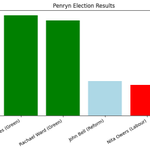
Now here's a real bar chart worth celebrating... #Penryn Town Council, two seats for election, both of taken by Greens, with a landslide!
Congratulations Rachael & Mikey! 💚
@GrnElects – at Penryn, England

What's interesting here for me is that total dependency of our society on oil, fertiliser and plastics are the big 3 things that us Greens have been campaining to reduce for decades.
Maybe as always it will take an emergency to trigger what should have been done strategically.

The war just reached the grocery aisle. Not through wheat or rice or fertiliser. Through plastic.
The Middle East is the world’s largest exporter of polyethylene. Approximately 84% of regional PE capacity depends on the Strait of Hormuz for export access. The Strait is running at 0.5 million barrels per day against a pre-war 19.5 million. The naphtha feedstock that Asian petrochemical plants require to crack ethylene and produce the polyethylene that wraps, bottles, trays, and films every packaged food item on every supermarket shelf on Earth is not arriving.
The force majeures began on Day 4 and have not stopped. Indonesia’s Chandra Asri declared force majeure on 3 March citing feedstock disruption. South Korea’s Yeochun NCC followed on 4 March, cutting cracker rates to approximately 66%. Singapore’s PCS declared on 5 March. CNOOC-Shell Huizhou is planning shutdown of its 1.2 million tonne cracker in southern China. Four countries. Four declarations. Each one a petrochemical plant telling its customers that the molecules required to produce plastic packaging are no longer available in sufficient quantity because a waterway 8,000 kilometres away has been mined by a regime that says the war will last “as long as it takes.”
US polyethylene spot prices surged 10 cents per pound in the first week. Indian PE prices jumped approximately 15,000 to 20,000 rupees per tonne. These are not energy prices. These are packaging input prices. Polyethylene, polypropylene, and PET resin account for the majority of disposable food packaging manufacturing costs. Every plastic bottle of water, every wrapped loaf of bread, every sealed tray of meat, every film-covered vegetable pack is now repricing through a channel that has nothing to do with agricultural commodity markets and everything to do with a naphtha tanker that cannot transit Hormuz.
This is the third domino. The first was energy: oil from 19.5 million to 0.5 million barrels per day. The second was fertiliser: nitrogen feedstock dependent on the same natural gas the same strait carries. The third is packaging: the plastic that wraps the food that the fertiliser grew that the energy harvested. Each domino hits the same consumer from a different direction. Energy raises transport costs. Fertiliser raises farm costs. Packaging raises the cost of getting the food from the farm to the shelf. The consumer pays all three.
The contrarians note US and Algerian producers can ramp, recycling offsets virgin resin, and Asian inventories buffer. They are correct individually and wrong on the timeline. Naphtha rerouting takes weeks. Cracker restarts after force majeure take longer. Inventories at current consumption cover days, not months. And the 1.2 million tonne Huizhou cracker, when it shuts, will remove more PE capacity from Asia than most countries consume in a year.
The grocery inflation central banks are watching is not coming from food. It is coming from the wrapper. The Fed meeting on 18 March will assess an environment in which energy, fertiliser, and packaging inputs are all repricing through the same chokepoint. The plastic bottle costs more. The bread bag costs more. The meat tray costs more. None of it appears in the agricultural commodity indices that traditional models use to forecast food inflation.
The molecules that wrap the food are stuck on the wrong side of a strait that is open to ten countries and closed to the rest. The grocery bill is repricing from the outside in.
Full deep dive analysis - open.substack.com/pub/shanak…


60
This is great news - I think the only thing that's going to be left in my dustbin is actually dust!
(of course not buying over-packaged stuff in the first place is always the best option)

From today - March 16 - you can start recycling food and drink cartons, plastic bags and wrappings in your household recycling.
This includes Tetra Pak-style cartons for milk, juice, soups and more.
Just give cartons a rinse, squash and put them in your red recycling bag.
74
A quick thread from a web developer on the Companies House "see/file for any company by hitting back" debacle - for non developers.
[TL;DR for devs: Company ID in session trusted by dashboard because authorisation happens at login. New "other co" path sets ID without auth]
🧵
This shows both a lack of architectural oversight and standard testing rigour. This was probably human error, but it is exactly the kind of problem that "vibe coding" can produce unless driven very carefully.
Ironically an AI security analysis probably would have found it...
1
3
188
This kind of problem is so well known it is #1 in the OWASP Top 10 Web Security Risk:
owasp.org/Top10/2025/A01_202…
You'd expect better of a key government site with such a critical position protecting against corporate and identity fraud.
- ends -