

Co-Founder @ https://nitter.cf/t.co/PfNw7Ibq0p. Anthropologist + Data Scientist.
Raleigh, NC
Joined September 2012
- Tweets1.2K
- Following21
- Followers268
- Likes210




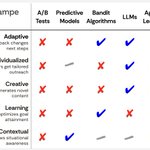

An LLM, by itself, cannot be truly agentic. Same for swarms, teams, workflows, or “multi-agent” systems. If the LLM drives everything, it’s not agentic. LLMs can be useful appendages, but not a sound foundation.
arxiv.org/abs/2505.03434
Fully agentic systems need a hybrid architecture: a semantic–associative learner that builds and updates long-term user profiles, and a procedural actor that generates fluent, on-brand content (or retrieves it from inventory).
1
117
Technology is enabling, but also constraining. Choosing a tool means trading flexibility in one dimension for scale in another. Customer engagement is no different. Campaigns, in particular, aren’t neutral abstractions—they’re design choices with real consequences. 🧵

ALT A comparison of campaign-based engagement, which is easier to manage, with agent-based engagement, which is more effective because it decouples orchestration from analytics.
Agentic systems separate orchestration from analysis. Orchestration is about maximizing who could benefit. Analysis is about retrospective learning—what worked, for whom, under which conditions. That separation expands impact without giving up interpretability.
1
50
We throw around terms like “agency” in AI, but the word itself lacks definition. That problem predates AI. Philosophers have debated it for centuries without consensus: Do instincts count? Are reasons different from causes? Is planning the same as action? Does coercion erase it?

1
1
58
Over minutes, mimicry looks convincing. But over hours, days, or weeks, acting agentically means deciding what to do next, why, and how to carry those lessons forward. For that, semantic–associative learning is required. Procedural memory alone isn’t enough.
1
23