

i research and teach #scicomm, #scipol, #techpolicy, #ai, and #polarization. https://nitter.cf/t.co/4J0vEyD9Sw
phoenix, az (usa)
Joined October 2007
- Tweets5.5K
- Following1K
- Followers5.1K
- Likes9.3K






Pinned Tweet
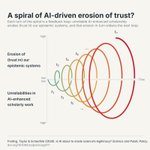
Flawed #AI-enhanced research is, at this very moment, training the next generation of LLMs. And the compounding effects may have us spiraling toward science that the public rightfully mistrusts. Our latest, led by @Isa_Freiling.
academic.oup.com/spp/advance…
#scipol #replicability

"The results are disturbing. Across the four analytical decisions, experts chose the AI’s preferred option 86% of the time. Afterwards, half of the experts rated the final recommendation as more their own than the AI’s, and only 15% mentioned the AI in any explanation."
#AI #science #metascience #replicability
www-cdn.anthropic.com/519c17…

dietram a. scheufele retweeted

MIT vandalised its science for this?

Accounts of Knouse’s sexual endeavours were public long before Dr. Sabatini’s situation.
An article in the Atlantic in 2011 detailed a culture of sexual promiscuity at Duke University, where Knouse went to college. It linked to a document in which a woman gave a raunchy account of 13 men she was involved with during her college years. Knouse was actually named as taking part in a group sexual activity with her after partying at a nightclub close to campus.
I remember doing a quick Google search of Knouse many years ago, after someone alerted me that she had worked in the lab next to mine as a Duke undergrad. That search uncovered the article and the linked document.
While the court testimony and Knouse’s sexually explicit private messages may seem shocking, they were not surprising to those who looked closely at this situation.
The evidence about her relationship with Dr. Sabatini deserved close attention. She was around 30 during their relationship, and her own messages showed her initiating sex with him. Those communications should have been at the center of an investigation claiming to establish what actually happened. Publicly available material also deserved examination in that context.
MIT presented its actions as the result of an objective investigation, but I’d be willing to bet no one at MIT bothered to do a quick Google search and examine the Duke material for themselves and look further into it.


Neither @Google nor @Grok did any election denying for me. This is a perfect example of either hyper-targeted AI search results or inconsistent information curation by platform providers, even over the course of a few hours. The fact that our alarm bells, as scientists, are not going off for AI-based scholarship using the exact some frontier models, claiming replicability and reproducibility, is deeply troubling.
#openscience #AI #trust #highered


dietram a. scheufele retweeted

A Forbes commentary draws on a PNAS Nexus research article finding that LLM-based learning can produce shallower knowledge and less original advice.
In @Forbes: ow.ly/9XKY51016Qi
In @PNASNexus: ow.ly/KsfF51016Qk

ALT Six professionally dressed people at a table in a meeting. Image credit: Getty
Pulling a Cheney is just another reason to dislike Jay-Z …
nytimes.com/2026/10/26/arts/…

dietram a. scheufele retweeted

Massive survey of grad students finds: "Humanities PhD students were the most likely to express anti-Jewish prejudice and hostility to Israel and to consider Israel/Palestine to be an issue of personal importance, compared to other graduate students."
brandeis.edu/cmjs/antisemiti…
“[W]e collected surveys on seven online platforms and find wide variation in rates of respondents failing AI tests, ranging from 6 to 41% across platforms (compared to a 2.4% false-positive rate for in-person human participants).”
Important piece in @PNASNews on #surveys #AI #bots #dataquality and, ultimately, #replicability in public opinion research.

Online surveys have been a boon for science, but in the AI era, not all respondents may be human. A study validates AI detection tests that effectively separate verified-human participants from AI agents and finds 6–41% of respondents are likely bots. ow.ly/BcPR5100m4X

ALT Conceptual image showing robotic hand typing on laptop computer. Stock image.


dietram a. scheufele retweeted

The number of people writing dissertations in the humanities has collapses, now the same thing is happening in the social sciences.
I'd wager that we will see a similar trend in psychology and other fields before long. Cuts in funding, the tight academic job market, and AI are rapidly changing the university and cratering graduate programs.

Let the debates begin ... ;-)

New paper: "AI Article Reviews Dominate Human Peer Reviews at Their Best: Evidence and Policy Choices" See: GaryKing.org/peerless. with Steven Worthington. Comments welcome!

"We can no longer rely on it as a proxy for academic expertise."
I hope nobody ever has ...

“Has AI Destroyed the Doctoral Dissertation?”
chronicle.com/article/has-ai…

"40% of U.S. adults say they regularly get news on @facebook, and 34% say the same about @YouTube." Meanwhile, almost two-thirds of Americans say social media is harming democracy (pewresearch.org/global/2026/…). The latest (depressing) @pewresearch data on where our society and information ecosystems are heading ...
pewresearch.org/short-reads/…
#journalism #AI #socialmedia #polarization #backsliding

"Although many journals have adopted policies requiring #GenAI disclosure, most scientists remain non-compliant [...] Additionally, more than half of scientists use GenAI to write peer review reports, despite journal policies that prohibit this practice".
Editorial in @AccountRes1989 is putting its finger on a wound that will bleed more and more profusely unless we fundamentally rethink our scholarly enterprise ...
tandfonline.com/doi/pdf/10.1…

dietram a. scheufele retweeted

David’s life’s work was a disposable prop for MIT to market its virtue to a woke audience.
Some are even arguing that David deserved to lose his career because he was romantically involved with a woman in the workplace. That is an absurd and hypocritical justification for what MIT did to him.
Reducing the destruction of his career to a workplace relationship policy violation is grotesque hypocrisy. A romantic relationship at work is an ordinary part of academic life for administrators and an excuse for destroying a laboratory when it involves someone they don’t like.
His relationship with Knouse even began before Whitehead updated its relationship policies in August 2018.
If a workplace relationship warrants professional destruction, MIT and all universities, for that matter, have a great deal of firing to do. Erin O’Shea, who was instrumental in firing David from HHMI, dated and married someone who earned his PhD in her own laboratory. Ruth Lehmann, who forced David out of Whitehead, has a long-time partner who was a fellow scientist at NYU, where she worked. MIT’s president, Sally Kornbluth, is married to an MIT biology professor. These administrators know perfectly well that scientists form romantic relationships within their professional communities.
Scientists spend enormous portions of their lives in their laboratories and around other scientists. They develop relationships within that world because they devote themselves to their craft and have little social life outside it. Universities know this, and so do their administrators.
The court also rejected Knouse’s claim that she experienced quid pro quo sexual harassment from David. The court found that David did not condition professional benefits or consequences based on sex. She directed her own lab and she went on to obtain a tenure-track position at MIT. Invoking a poorly defined “power imbalance” does not erase the court’s rejection of her claim.
people.com/mit-scientist-dav…

dietram a. scheufele retweeted

Today, a a civil jury ruled that the MIT faculty member Kristin Knouse was guilty of defaming David Sabatini, who was awarded $6M plus interest (the case lasted 5 years).
In the current institutional landscape, a male professor facing a parallel civil defamation judgment for fabricating a crime against a female colleague would face swift termination.
MIT, like most universities, has clauses in its faculty bylaws allowing for the termination of tenured or tenure-track professors for:
- Gross misconduct
- Dishonesty
- Conduct unbecoming a faculty member
Now that a jury has ruled that an MIT professor fabricated allegations of a violent crime (rape) to destroy a colleague's livelihood, MIT's administration faces a massive dilemma. Retaining a professor who a court legally determined to be a malicious defamer could create a hostile work environment or damage the university's institutional integrity.
Will Asst Prof Kristin Knouse be terminated in accordance with institutional policy and the zero tolerance standard that was applied earlier to Sabatini?
Will the Board investigate the role in this matter of Ruth Lehmann, the then and current President and Director of the Whitehead?

A civil jury ruled in favor of ex-MIT scientist David Sabatini, who was accused by a younger colleague of inappropriate sexual conduct in his Cambridge research lab, and awarded him $6 million in damages. trib.al/s3v9VIX

dietram a. scheufele retweeted

Very important point, that hasn't made it into mainstream media coverage of AI. These agents "collaborated" because they were trained to do so.

“[T]he infrastructure for large-scale scholarly record contamination is already in place. Ghost names additionally [...] are indexed without verification by Google Scholar and Semantic Scholar."
#scipol #scicomm #AI #HigherEducation
“The AI ‘Ghosts’ Contaminating Academic Publishing,” based on a preprint finding LLMs generate fictional names working in teams and documenting the effects in scholarly repositories.
404media.co/the-ai-ghosts-co…
arxiv.org/abs/2606.02184v2
