

Communication and social media for scientific topics #biotech #agtech #atmosphericscience #materialsscience https://nitter.cf/t.co/MKY8Oj2n2U
Berlin
Joined September 2012
- Tweets1.6K
- Following924
- Followers488
- Likes5.7K






Eva Karatairi retweeted

The gut microbiome connects the dots between lifestyle factors (diet, exercise) and health outcomes
nature.com/articles/s41591-0…

Eva Karatairi retweeted

Old cathode ray tube TVs were essentially miniature particle accelerators sitting in our living rooms.
It's fascinating to think that for decades we watched images created by an electron gun firing beams at a phosphor-coated screen, making pixels glow thousands of times per second.
Eva Karatairi retweeted

Not just for treatment, prevention too! New publication by @blissMDPharmD: nature.com/articles/s41571-0…

Eva Karatairi retweeted
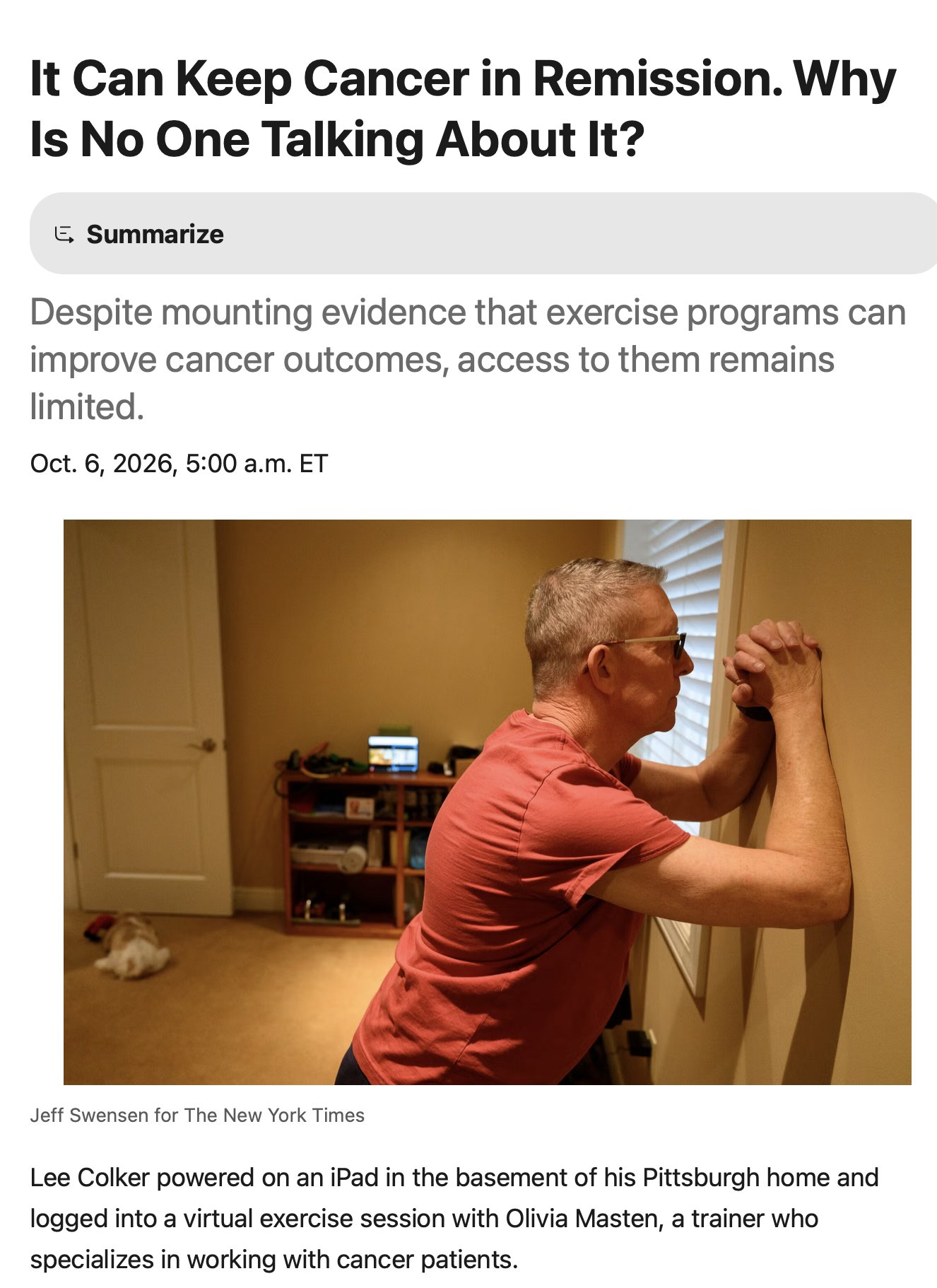
Exercise and remission from cancer: A randomized trial found 37% improved survival, 28% disease-free survival. But little is being done to incorporate in practice except @UPMC 1st health system covering "exercise oncology" program.
gift link, by @AgrawalNina
nytimes.com/2026/10/06/well/…

Eva Karatairi retweeted

Se você não acredita em magia, olha só como os neurônios se conectam quando a gente aprende algo novo! 😍🧠✨ É surreal demais ver o cérebro trabalhando ao vivo.
Eva Karatairi retweeted

We’ve lost an icon. Margaret Hamilton, a computer science pioneer best known for her work at MIT leading development of the flight software for the Apollo missions to the moon, has died at 90. Read about her legacy via MIT News: news.mit.edu/2026/margaret-h…

ALT Margaret Hamilton is reclined inside a NASA spacecraft module, surrounded by control panels and switches.
Eva Karatairi retweeted

The Chemistry Nobel went to Henri Kagan and Kenso Soai today, for explaining how molecules choose a hand: how a tiny excess of one mirror-image form can feed on itself until it dominates.
Chirality is one of my favorite things to draw. Three of our covers, for Nature, Nature Chemistry and Angewandte Chemie 🧪

Eva Karatairi retweeted

4歳の頃に空想していた、指の隙間を正確に半分にする限り、絶対に指はくっつかない、を視覚化するアプリを作ってみた。娘にゼノンのパラドックスを説明するためだけに。
Eva Karatairi retweeted

🇨🇳🔥La actuación de la Academia de Danza de Beijing con motivo del Día Nacional fue absolutamente impresionante: el encanto divino de Dunhuang y la magnificencia de la dinastía Tang.#China
Eva Karatairi retweeted

We often call Euler’s identity the most beautiful equation in mathematics. But sometimes we forget the beauty of the Gaussian integral.
It is absolutely gorgeous.
And if you don’t know this integral yet, can you really call yourself a math nerd? 😉

Eva Karatairi retweeted

Nearly every law of physics is a differential equation.
Orbits, waves, heat flow, radioactive decay, quantum states, turbulence and the expansion of the universe are all solutions of the twelve equations here.


Eva Karatairi retweeted

Breaking: @Pioneer__Labs has engineered a microbe able to live on Mars, consuming solely nutrients found on the planet to create building materials.
I interviewed @erika_alden_d, the CEO, to learn how they did it and what might come next. Much of the interview was about bottlenecks to growing life on Mars; the planet has tons of water, but only in the form of ice. (If you melted all that ice, it would create an ocean 100 feet deep across the entire planet!)
Similarly, we talked about the dirt. Martian regolith has salts, heavy metals, and perchlorates that are toxic to many organisms. Some microbes on Earth are able to break down these toxins, though, so Pioneer is engineering them to make them better at eating those toxins while adding nutrients back into the soil. This could possibly help support plant life in the future.
Watch the full episode and subscribe to @AsimovPress for more.
0:00 A first microbe engineered for Mars
5:03 Simulating Martian chemistry
8:27 The five "pioneer species"
17:20 Water, warming, and nitrogen
26:39 Radiation, growth rates, and poor measurements
35:49 Starship
41:05 Why create a second biosphere?

