

Lecturer at @UCBerkeley in ISF. Research on AI, algorithms, organizations, work, labor, and expertise. Writing at https://nitter.cf/t.co/HoZfMecSz6.
Berkeley, CA
Joined May 2008
- Tweets2.5K
- Following605
- Followers750
- Likes5.1K







Shreeharsh Kelkar retweeted

The environmental impacts of data centers is a complicated topic, and there are reasonable people on all sides of it, but this NYTs article has the dumbest f-ing frame you could possibly imagine.
You should always ask yourself what the comparator is. In this case, why are American data centers being compared either to very poor nations or to very small ones? (Example: Switzerland is only about 40% the size of Virginia. Per the article: the data centers in Virginia put out 7 million tons of carbon dioxide while Switzerland puts out 32 million. But we don't get that comparison. And, in fact, really . . . wtf are we even comparing here?)
And why are we not getting comparisons to other American activities with technologies like driving cars (~1 billion tons), flying in airplanes (~200 million), or producing metals (~80 million), to name a few?
It's because the headline is motivated, and it's designed to stir people up. This kind of "reporting" really does a disservice to our media landscape, our collective understandings, and our democratic processes. We can and should do better.
One thing I totally agree with in the article: Far too much industrial activity in the United States is secret, and we could use a lot more sunshine, openness, and public investigation. This applies not only to the environmental impacts of data centers but also to things like what social media companies actually *know* about the social effects of their platforms. We cannot reason well without knowing more, and we need legislators that will bust company books open.

Shreeharsh Kelkar retweeted

This is the tip of the iceberg in online education. Both tuition-paying students and institutions benefit from nobody paying attention. Students want the degree. Faculty want the cash. The people who sign the diplomas aren't held accountable. calmatters.org/education/202…

Shreeharsh Kelkar retweeted

🙏🙏

Great episode from @WSITYpod and a model for how contentious issues like the tradeoffs of non-pharmaceutical interventions should be conducted. Wish they had gotten to vaccines. This is going into my course readings. Watch it here: youtube.com/watch?v=ZCWQ-qJT…
Shreeharsh Kelkar retweeted

On Substack, I summarize my new book Gender Identity: The Career of a Category and reply to a mini-symposium on the book hosted by @dan_oppenheimer, with great contributions by @scritic and @BloggerGideon. substack.com/home/post/p-219…

Shreeharsh Kelkar retweeted
delighted by the very thoughtful review of my new book Gender Identity: The Career of a Category by Shreeharsh Kelkar @scritic
danieloppenheimer.substack.c…
Shreeharsh Kelkar retweeted
Has the Turing Test been rendered obsolete? It depends on how you interpret the test: as a test of second-order social norms (no) or as a test of language performance (yes). More in my latest blogpost: computingandsociety.substack…


Shreeharsh Kelkar retweeted
More on the Turing Test and the nature of computational machinery and intelligence: computingandsociety.substack…
LLMs' success shows that programs driven by *industrial machinery* are capable of a lot!
Shreeharsh Kelkar retweeted

GreenEarth is the first feed which gives you full control over the algorithm. Here's our new "post sources" control panel.
It's over on BlueSky, the only platform which supports algorithmic choice. Bonus: effectively filters out that platform's famous whining!
Have you tried it yet? go.greenearth.social/r/ptryi…

Shreeharsh Kelkar retweeted

On the 35th anniversary, I am thrilled to announce our oral history collection quarterbacked by @shreyasnarla: ~50 hours of recordings of the @mercatus team with the reformers and close witnesses to 1991. These conversations cover the decades before the crisis of 1991 and trace the reformers’ influences, education, careers, mentors, institutions, and the development of the ideas that later became policy. the1991project.com/oral-hist…
The collection also includes a 2016 interview with Dr. Manmohan Singh, generously shared by @ChaitanyaKalbag. 3/n

Shreeharsh Kelkar retweeted

You know what other tools know better than most instructors? Coursera and YouTube courses from top faculty, *the internet*, books from the library. How many students used those tools instead of formal ed? Very very few. How many will use Claude independently to learn the material? Probably the same amount.
I know it doesn’t sound glamorous, but the primary role of faculty is to get students in the seats and create incentives to actually absorb the information. This is your job. AI can help as a tool, I’ve seen some great harnesses of AI for education, but it will not do this.


Shreeharsh Kelkar retweeted

AI just killed higher education’s old teaching model. We need smaller classes and oral defenses for every paper—implying more faculty time, hence more professors. Since banning AI is unenforceable, written work alone can no longer be trusted.
Shreeharsh Kelkar retweeted

This is going to be long.
Last semester I suspected I had a major issue with use of AI in my survey courses, so I inserted what is known as a trojan horse (not the virus kind) into the directions of a paper assignment. As it turned out, I did in fact have a major problem, and a post on Threads about it accidentally went quasi-viral and ultimately became a Huffington Post article and an NPR interview. (Links at the end)
Shreeharsh Kelkar retweeted

At this point, it's hard to say anything too new about the "institutional neutrality" debates, but I think @JeffreyASachs does, here: it's about public relations, and that's just fine: chronicle.com/article/neutra…

Shreeharsh Kelkar retweeted

New publication:
Understanding China Through Digital Anthropology, Edited with Wang Xinyuan
A free download from UCL Press.
In the conclusion, we explain the profound differences in attitudes to the digital between China and the West.
uclpress.co.uk/book/understa…
Shreeharsh Kelkar retweeted

It is all too common for faculty and administrators to refer to a campus conversation or class discussion of public policy as causing "harm".
We must challenge the use of this language.

We must repudiate the idea that "speech can be violence" once and for all. @glukianoff and I wrote about the dangers of promoting this idea on college campuses back in 2017, in @TheAtlantic:
theatlantic.com/education/ar…

Shreeharsh Kelkar retweeted
A new post on The Conversation estimates that flushing the toilet equals the water used in 154 GPT-5 prompts and 1,714 GPT-4o prompts. I am wondering if anyone has seen analysis or pushback on the piece.
theconversation.com/ai-has-a…

Shreeharsh Kelkar retweeted

Bureaucratic science is already generously funded and does not need more private support.
Philanthropists should fund young outsiders, like during the Golden Age of Science.
Read the new article by @stuartbuck1 (link below):

Shreeharsh Kelkar retweeted
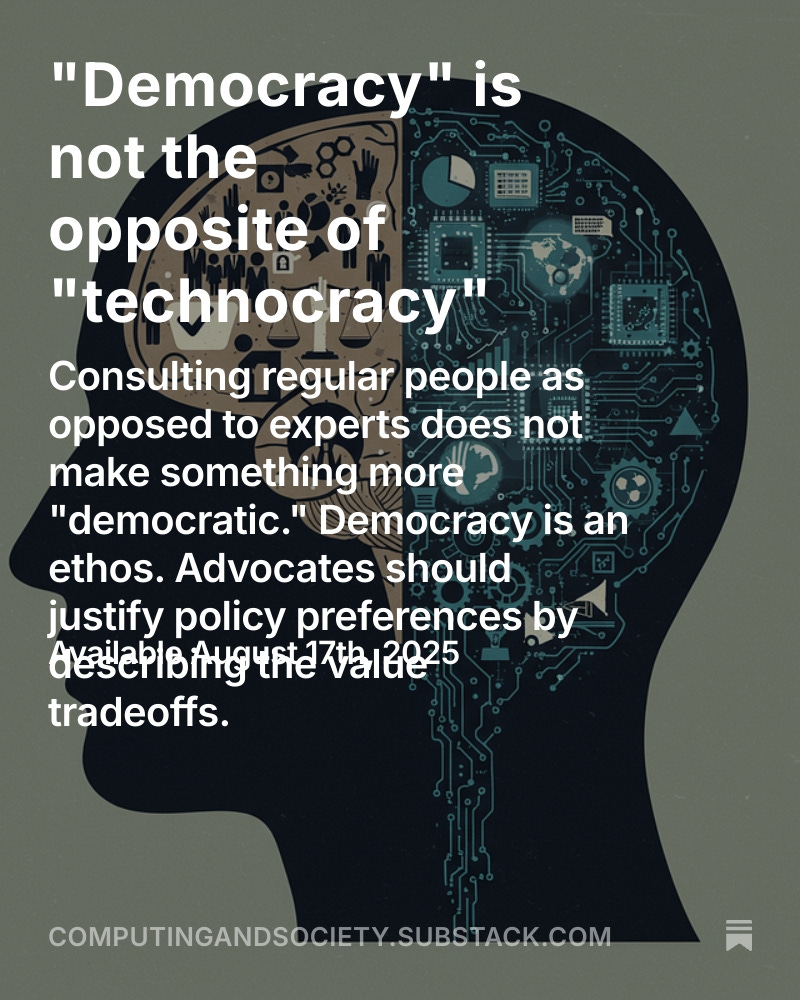
Advocates for policies and policy frameworks will often argue that their proposal is more “democratic” while the one they oppose is “technocratic.” But conflicts in many industrial societies today are NOT between publics on one side and experts on the other.
Shreeharsh Kelkar retweeted

Great, useful thread and post (linked in the thread)
New post where I use insights from the social studies of science and technology (#STS) to try to answer the normative question: on an issue where you don't know much about the science, how do you find the right experts to tell you what is going on? Link in the comments.
Shreeharsh Kelkar retweeted

I read Marx's Capital after many years and made a critical reading guide to help students get through it. Comments welcome. docs.google.com/document/d/1...