

20 • ahl ar-raʾy • eclectic
Joined May 2025
- Tweets5.8K
- Following73
- Followers1.7K
- Likes5.1K




Pinned Tweet
the server is back up and running again
discord.gg/MAVeRxfrsJ

يَقُولُونَ لَيْلَى بِالْعِرَاقِ مَرِيضَةٌ
فَأَقْبَلْتُ مِنْ مِصْرٍ إِلَيْهَا أَعُودُهَا
فَوَاللَّهِ مَا أَدْرِي إِذَا أَنَا جِئْتُهَا
أَأُبْرِئُهَا مِنْ دَائِهَا أَمْ أَزِيدُهَا
He says:
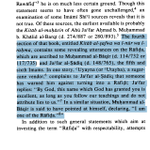
“I saw Shaykh al-Muwaffaq at the edge of the river, east of the school, on its southern side, performing ablution (wuḍūʾ). I stood beside the school and said to myself: ‘I shall not go down to perform ablution until he has finished.’
When he had completed his ablution, he took his wooden clogs (qabqāb), walked across the water to the other bank, then put his clogs back on and ascended to the school.
Then he swore to me by Allah that he had indeed seen this, and that he had no need to lie.
I kept this matter secret during his lifetime.
I asked: ‘Did he see you?’
He replied: ‘No, and there was no one else there. This was at the time of the noon prayer (ẓuhr).’
I then asked: ‘Did his feet sink into the water?’
He replied: ‘No. Rather, it was as though he were walking upon a padded surface’


/hail retweeted

My next fight is one of the last in my career.
They say Prates is too dangerous for me and Morales is too good for me.
So I want to face the best of them and prove to the world once again who is the best in world.

/hail retweeted

Dünyevî Aslah konusunda Ebu'l Hüseyn El-Basrî'nin görüşleri
Dünde yazdığım gibi Basrî, Râzî'nin düştüğü tuzağa düşmeyerek dâî ve sârif arasında git-gel olarak fiilin müterreddit olmasından dolayı husûlünün olmadığını iddia etmiştir.


omg my shaykh al-islam. he walked on water by the way.

They said: "May God have mercy upon you! What is your position concerning Abu Bakr and Umar?"
Zayd replied: "May God have mercy upon them both and forgive them. I have never heard anyone from my household repudiate them, nor have I heard anyone say anything about them except good."
They said: "Then why, in that case, do you seek vengeance for the blood of the members of this Household? Is it not because they seized your authority and wrested it from your hands?"
Zayd then said to them:
"The strongest thing I can say concerning what you have mentioned is that we were more entitled than all other people to the authority of the Messenger of God, may God bless him and his family and grant them peace. Yet those people appropriated it exclusively for themselves, to our exclusion, and pushed us away from it. But that did not bring them, in our estimation, to the point of disbelief. They assumed authority, acted justly among the people, and acted according to the Book and the Sunnah."
They said: "Then why have these people wronged you, if those [earlier ones] did not wrong you? Why, then, do you call [people] to fight against a people who are not wrongdoers towards you?"
He replied: "These people, however, are not like those people. These people are wrongdoers towards me, towards you, and towards themselves. We are only calling you to the Book of God and the Sunnah of His Prophet, may God bless him and his family and grant them peace; to the Prophetic traditions being revived, and to the religious innovations being extinguished. If you respond to us, you will attain felicity; but if you refuse, I am not your wakīl [one responsible for you]."
They then separated from him and broke their pledge of allegiance to him, saying: "The Imam has preceded us!"
They used to maintain that Abu Ja'far Muhammad ibn Ali, the brother of Zayd ibn Ali, was the Imam, although he had already died by that time. His son, Ja'far ibn Muhammad, was still alive. They therefore said:
"Ja'far is our Imam today, after his father. He has a greater right to the affair after his father, and we shall not follow Zayd ibn Ali, for he is not an Imam."
Zayd consequently called them al-Rāfiḍah (the Rejecters). Today, however, they claim that the person who named them al-Rāfiḍah was al-Mughīrah, because they had separated from him.
A group among them had, before Zayd's uprising, gone to Ja'far ibn Muhammad ibn Ali and said to him:
"Zayd ibn Ali is receiving pledges of allegiance from us. Do you consider it appropriate for us to pledge allegiance to him?"
He replied:
"Yes, pledge allegiance to him. For, by God, he is the best of us, our master, and the finest of us."
They then returned but concealed what he had instructed them to do.
— al-Ṭabarī, Tārīkh 7.180-181


genuinely laughed.

The Quran is ✅ a human work and ⛔ not a divine work protected by Allah.
Between 2020 and 2023, I created the book 100 Contradictions and Scientific Errors in the Quran, the world's largest database cataloguing the 100 most significant contradictions and scientific errors found in the Quran. Here is just one example (case 16/100 in my book).
⬇️
In surah 7 of the Quran, verse 27, Allah asserts that He made devils the allies of those who do not believe "O children of Adam! Do not let Satan tempt you as he caused your parents to be expelled from Paradise, and made them remove their clothing to show them their nakedness. He and his tribe see you from where you do not see them. Indeed, We have made the devils the allies of those who do not believe." And Allah clearly claims here to have created Himself the relationship of "allies" uniting "the devils" and "those who do not believe", a responsibility He takes on with the phrase "We have made (اَن ْ ل َجعَ / ja`alnā)". Allah uses the same expression, for example, in verse 16 of surah 15 of the Quran, when He designates Himself as the author of the celestial constellations, whose divine paternity Muslims probably do not imagine challenging "Indeed, We have made (اَن ْ ل َجعَ / ja`alnā) constellations in the heaven and beautified it for those who look."
Yet, in surah 7, verse 30, Allah claims that those who have taken devils as allies deserved divine misguidance "There is a group that He has guided, and another group deserved misguidance because they took devils as allies besides Allah, and they think they are rightly guided!" In verse 27 of surah 7, Allah says He is responsible for the relationship of allies uniting those who do not believe and the devils, but at verse 30 of this same surah 7, Allah asserts that He was right to bring about the misguidance on those who have chosen devils as allies. Who really made devils the allies of unbelievers? Can Allah then reproach the misguided for what He imposes on them?
Furthermore, Allah affirms that humans will find no allies besides Him. For example, in verse 17 of surah 33 "Say: 'Who can protect you from Allah if He intends to harm you or intends to show you mercy?' And they will not find for themselves, besides Allah, any ally or helper." Allah even dared to specify, regarding the unbelievers, that they would have no ally either on the Earth (surah 9, verse 74 "[...] there will not be for them on Earth any ally or helper") or in the hereafter (surah 33, verses 64 and 65 "Indeed, Allah has cursed the unbelievers and prepared for them a Blaze, abiding therein forever, they will not find any ally or helper."). Hence, when Allah states in verse 27 of surah 7 "We have made the devils the allies of those who do not believe", He thus admits to providing allies "besides Allah" those humans, something He previously claimed was impossible.


i restrain myself, while in my heart there is, from love, a burning anguish;
and one who abstains from love is not necessarily one who is free of longing.
whenever inclinations draw me towards the beloved,
i refuse; and humiliation has passed beyond the one who refuses.
others inhale the winds of passionate love,
and compose rhymes through the prolongation of their love.
and i endure from my beloved things which, were i to encounter them
from other people, i would set the sharp edges of swords and the elevated spear-points against them.
— al-sharīf al-raḍī [d. 1015]

/hail retweeted

”Kişiye imandan sonra verilen şeylerin en hayırlısı saliha kadındır.”
[ Hz. Ömer (r.a) ]
/hail retweeted

Peygamber Efendimiz (s.a.v.) şöyle buyurmuştur;
"Sadaka vermede acele ediniz, zira bela sadakanın önüne geçemez."
Fey’zül Kadir, 3/195


Zayd ibn ʿAlī [d. 740]:
No indeed! I swear by the One who sent the messengers: this is not the description of the Wisest of judges. Rather, He created them morally responsible, capable, with the proof established against them, subject to commands and prohibitions. He commanded us to do good and did not prevent us from doing so; He prohibited evil and did not incite us to commit it. He showed them the two paths—the path of good and the path of evil—and then said, “Act!”
Thus, each person is facilitated toward that for which he was created: performing acts of obedience and refraining from acts of disobedience. The Exalted says:
“He created him and proportioned him; then He made the way easy for him.” (Qur’an 80:19–20)
The Exalted also says: “As for the one who transgressed and preferred the life of this world, then indeed, Hell shall be his abode. But as for the one who feared standing before his Lord and restrained his soul from its desires, then indeed, Paradise shall be his abode.” (Qur’an 79:37–41)
And the Exalted says: “As for the one who gives, fears God, and affirms the best [promise], We shall facilitate for him the way of ease. But as for the one who is miserly, considers himself self-sufficient, and denies the best [promise], We shall facilitate for him the way of hardship.” (Qur’an 92:5–10)
And the Exalted says: “None shall enter it except the most wretched, who denied the truth and turned away. But the most God-fearing shall be kept far from it: the one who gives his wealth to purify himself.” (Qur’an 92:15–18)
And the Exalted says: “We did not wrong them; rather, they were themselves the wrongdoers.” (Qur’an 43:76)
And: “How evil was what they used to do!” (Qur’an 5:79)
And: “As a recompense for what they used to do.” (Qur’an 56:24)
And: “God would not lead a people astray after having guided them until He had made clear to them what they must guard against.” (Qur’an 9:115)
Thus, the proponents of compulsion and the anthropomorphists absolved themselves of every blameworthy quality, injustice, wrongful oppression, and foolishness, while attributing all of these to God, exalted is He, in every respect.
They said: “God created us wretched, then punished us with the Fire, yet He did not wrong us.”
What mockery could be greater than this? What injustice could be clearer, or what wrongdoing more manifest than that which they have attributed to God?
No indeed! By the Master of the Day of Judgement, this is not the description of the Most Merciful of those who show mercy, who commands justice and excellence and forbids indecency and wrongdoing. As He, glorified is He, says:
“God does not burden any soul beyond its capacity.” (Qur’an 2:286)
And its capacity (wusʿuhā) means its ability.
Rather, He imposed upon them less than they are capable of bearing, and granted them more than they deserve. He did not seek from them any pretext, nor seize upon any slip of theirs. He did not contradict His decree by His decree, His determination by His determination, or His judgement by His judgement. Exalted is He far above what the proponents of compulsion and the anthropomorphists say—high above it indeed!
For they likened God, glorified is He, to jinn and human beings, since injustice, ignorance, wickedness, depravity, disbelief, and foolishness can only originate from jinn and human beings.
Then, in addition to the fabrications and falsehoods they uttered about God, they compounded their wrongdoing by displaying hostility toward His friends and devoted servants: those who affirm His justice and His oneness, who are certain of His promise and His threat, who faithfully fulfil the covenant He made with them, and who cling firmly to the unbreakable handhold.
They attributed disbelief to these people and accused them of fabricating falsehoods. How beautiful is the effect of God's friends and devoted servants—blessed and exalted is He—upon people, and how ugly is the effect of people upon them!
Indeed, they suffer severe hardship at the hands of these people. If they remain silent in their presence, they call them resentful; if they debate them, they call them dissenters; and if they oppose them, they call them unbelievers.
Such has been their characteristic among the earliest generations and the later ones. Thus, He says: “If they see the path of right guidance, they do not adopt it as a path; but if they see the path of error, they adopt it as a path.” (Qur’an 7:146)
And He, majestic is His mention, said: “They rejected them, although their souls were convinced of them, out of injustice and arrogance. So behold what was the end of the corrupters!” (Qur’an 27:14)
And all praise belongs to God, Lord of the worlds. May God bless Muhammad, the trustworthy, and those messengers who preceded him, and the rightly guided imams who came after him. The final outcome belongs to the God-fearing, and you shall surely come to know its tidings after a time.


/hail retweeted

"Hak tecelli eyleyince her işi âsân eder
Halk eder esbâbını, bir lahzada ihsân eder."

may god forgive layla, even if she has spilled my blood;
for even if she does not grieve for me, i bear her no reproach.
i shall neither blame her nor voice any complaint against layla,
though one who suffers may indeed complain to every friend.
they say to me, “repent of mentioning layla and of loving her!”
yet my heart shall never repent of its love for layla.
— qays ibn al-mulawwah [d. 688]

ascended yet fails to grasp the point - what follows is a defense of ibn taymiyyah.
starting off, the hadith in question is:
يَا عِبَادِي إِنِّي حَرَّمْتُ الظُّلْمَ عَلَى نَفْسِي، وَجَعَلْتُهُ بَيْنَكُمْ مُحَرَّمًا، فَلَا تَظَالَمُوا.
“O My servants, I have forbidden injustice for Myself, and I have made it forbidden among you, so do not wrong one another.” The report is narrated by Abū Dharr from the Prophet, relating from Allah. [Ṣaḥīḥ Muslim, Hadith 2577]
god says that he has forbidden justice: [1] for himself and [2] among us (that is, we do not commit injustice)
ascended interprets this as him *willing* to not commit injustice. lets understand this. what does it mean for god to will the non-commitment of injustice in relation to himself? the obvious answer here is that this reading does NOT make sense. because the will qua attribute of god only relates to that which is possible by virtue of its essence whereas god is necessary. so it makes 0 sense to say that gods himself is an object of his will-attachment. the books of kalam establish:
متعلق القدرة والإرادة واحد وهو الممكنات دون الواجبات والمستحيلات إلا أن جهة تعلقهما بالممكنات مختلفة
“The object of both power and will is the same: contingent things, excluding necessary and impossible things; however, the respect in which they relate to contingent things differs.”
the correct reading, then, is that the phrase “i have forbidden injustice for myself” is a figure of speech expressing the impossibility of injustice proceeding from god, rather than a literal act of self-legislation whereby god wills not to commit an injustice that He could otherwise commit.
consider an example: you and your friend get into an argument. consequently, you stop talking to him. you say to him: "i have forbidden upon myself conversation with you". we should see that an act of conversation/speech was/is genuinely possible insofar as the bare speech is concerned except it is now governed by an additional factor that supervenes on it and prevents the occurrence. in this case, it is the fact of him being mad at him that serve as the sufficient reason/cause.
building upon this reasoning, we get into the the attribute of power. we often discuss the omnipotence paradox and often the standard answer we invoke is "power only relates to that which is logically possible" and since the example in the stone-paradox contains in its logical syntax p and -p in the same respect, the attribute of power does not extend to it. or in other words, its not under his power.
extend this same reasoning here. the fact is that all possible quiddities or state of affairs - qua logical possibility - are, in fact, under gods power. the same applies to injustice and what is morally ugly, provided that we are discussing acts that are logically possible rather than intrinsically contradictory descriptions. if an act is logically possible, its moral ugliness does not, by itself, transform it into a logical impossibility. logical possibility concerns whether a state of affairs is internally coherent, whereas moral ugliness concerns its moral character. if one claims that god possesses the power to commit injustice but has voluntarily prohibited it upon himself, then one is treating divine non-injustice as analogous to the case of the friend who refrains from speaking. the relevant act remains possible in itself, while an additional determination prevents its occurrence. in the human example, that determination is anger; it is the wisdom of god as an attribute that serves as the supervening factor.
he raised the point "he could have commited injusties" is blatantly incorrect. in all possible worlds and in his eternity, hes necessarily qualified with his attribute of wisdom that tracks the attribute of will (what to preponderate) so the fact is injustice - insofar as the bare possibility is concerned - is possible but becomes impossible when the attribute of wisdom is concerned.
on this issue, ive compiled a large thread of statements from the maturidi scholars affirming exactly what ive said - ill link it below this response.
more important point: the biggest proponents of moral realism - the mu'tazilites and twelvers/imami shia have likewise agreed that god *has* power over that which is ugly/bad/immoral/unjust.
1. qadi abd al-jabbar al-mu'tazili writes:
والدليل على صحة ما نقوله، هو ما قد ثبت أنه تعالى قادر على أن يخلق فينا العلم الضروري، فيجب أن يكون قادرا على أن يخلق بدله الجهل، لأن من حق القادر على الشيء أن يكون قادرا على جنس ضده إذا كان له ضد، والجهل قبيح.
"The proof that our position is correct is that it has been established that He, Exalted is He, is capable of creating necessary knowledge in us. It follows that He must also be capable of creating ignorance in its place, because it is a requirement of one who has power over a thing that he also have power over the kind of its contrary, if it has a contrary—and ignorance is morally ugly."
2. the imami theologian, al-hilli writes:
في أنه تعالى قادر على القبيح قال : مع قدرته عليه لعموم النسبة ولا ينافي الامتناع اللاحق . أقول : ذهب العلماء كافة إلى أنه تعالى قادر على القبيح إلا النظام ، والدليل على ذلك أنا قد بينا عموم نسبة قدرته إلى الممكنات والقبيح منها فيكون مندرجا تحت قدرته . احتج بأن وقوعه منه يدل على الجهل أو الحاجة وهما منفيان في حقه تعالى . والجواب أن الامتناع هنا بالنظر إلى الحكمة فهو امتناع لاحق لا يؤثر في الإمكان الأصلي ، ولهذا عقب المصنف رحمه الله الاستدلال على مراده بالجواب عن الشبهة التي له وإن لم يذكرها صريحا .
"On the proposition that He, Exalted is He, has power over the morally ugly
He [al-Ṭūsī] says: “Despite His having power over it, owing to the universality of the relation [of His power to contingent things]; and this does not conflict with subsequent impossibility.”
I say: All scholars held that He, Exalted is He, has power over the morally ugly, with the exception of al-Naẓẓām. The proof of this is that we have established the universality of the relation of His power to contingent things, and morally ugly acts are among them; therefore, they fall within the scope of His power.
He [al-Naẓẓām] argued that the occurrence of such an act on His part would indicate either ignorance or need, both of which are negated with respect to Him, Exalted is He.
The response is that the impossibility here is considered with respect to wisdom. It is therefore a subsequent impossibility (imtināʿ lāḥiq) that does not affect original possibility (al-imkān al-aṣlī). For this reason, the author—may Allah have mercy on him—followed the argument establishing his intended position with a response to the objection raised against it, even though he did not state that objection explicitly."
as for the case of maturidis, i wont cite any one particular since the thread ive linked below has plenty of them already.
back to the original point. we differ with him on the fact that the meaning of the hadith is completely rendered inexplicable and unintelligible under his meta-ethical framework.
under asharite DCT, every action that god performs is just - the just-ness qualification is attached to it consequently and not antecedently, then what sense does it make for god to *forbid* injustice upon himself? the apparent meaning indicates that there is some factor that prevents the issuance of injustice - analogous to our case of the human case. another analogy: i say to you that i have forbidden eating upon myself during the holy month of ramadan, this indicates that although eating is possible, it becomes impossible by virtue of some other temporal consideration. how much more exalted then is the matter of our lord - who is eternal and everlasting - forbidding injustice upon himself. he knows the reprehensibility of reprehensible action and likewise the goodness of good action. the procession of uglyness and injustice is then deemed eternally impossible.
on your account, the hadith holds no weight because if everything that god does subsequently aquires the label "just" then the very possibility of injustice (relating to his power) serves an evidence of moral duality (relating to justice vs relating to injustice). under your view, gods will ONLY relates to justice because whatever he does is just but the hadith clearly implies a dualist view of will-relation + a forbidden (which is rather symbolic of his attribute of wisdom that prevents his will relating)
a clarification for readers: gods attribute of *power* insofar as its relations are concerned, is not something under he has control over. meaning, gods power, by virtue of its very essential nature, relates to every quiddity that is possible - god can not simply revoke the relation of power over it. what god does is add the attribute of *will* over one relation of power and then the objection comes into actualisation. so gods power necessarily relates to all possibilia, god then preponderates/particularises/specifies one option that he wants by directing his will over it or to it. this act-of-direction is governed by the attribute of wisdom - what to actualise and what to not which serves as the ground of him being a moral agent. this is something agreed upon by the atharis, maturidis, mu'tazilites/zaydis and twelvers.
and god knows best.


the thread.
nitter.cf/selfsubsisting/status/…

Imām Ismāʿīl al-Kalanbawī [d. 1791 CE] said:
"the fact that falsehood (kadhib) in verbal speech (al-kalām al-lafẓī) is, according to the Ashʿarīs, a deficiency-attribute (ṣifat naqṣ) is for this reason.
Accordingly, al-Sharīf al-Muḥaqqiq said that it is among the class of possibles (al-mumkināt). The attainment of certain knowledge (al-ʿilm al-qaṭʿī) that it does not occur in the speech of God, Exalted is He, by the consensus of the scholars and the prophets (peace be upon them), does not negate its intrinsic possibility (imkānuhu fī dhātihi), just as is the case with the rest of the definitive pieces of ordinary knowledge (al-ʿulūm al-ʿādiyyah al-qaṭʿiyyah)."
— Ḥāshiyat al-Kalanbawī 1.499
