
Formerly HFT QT. Used to write at https://nitter.cf/t.co/v3Ue5zbXrM. Quant trading, prediction markets, crypto.
Joined November 2021
- Tweets934
- Following695
- Followers2.2K
- Likes1.4K




Above any other faults, Leopold does not understand path. He didn't in the summer and he still doesn't now. Nothing, whether pseudo-insider information or a manifesto, will save you from such a vicious conceptual lack.

50
Various people getting railed in the comments. The most common misconception here is that it depends on how many cards have been turned over - but this is a boring (and trivial) question and not what's being asked. We're averaging across all permutations to find an a priori!

A standard 52-card deck is shuffled. You turn over cards from the top, one at a time, until the first ace appears. What is the probability that the next card is also an ace?
46%Less than 1/13
33%Exactly 1/13
21%More than 1/13
58,493 votes • Final results 3
619
An underappreciated benefit of AI is that it will allow an intrepid interlocutor to wrestle free of the drowned-in-bullshit strategy to critiques of empirical work. Anyone with a full-time job could not have plausibly investigated whether e.g. Piketty misrepresented the data...

I've been pointing out since the early 2010s that Thomas Piketty, Emmanuel Saez, and Gabriel Zucman have a bad habit of biasing their data construction to fit their politics.
Whenever they make a suspect call in how to handle stats, it ends up showing that inequality is on the rise. They almost never go in the other direction. The errors are non-random and almost invariably reinforce their political claims about rising income and wealth concentration since 1980.
Piketty did this throughout his book Capital in the 21st Century.
Piketty and Saez did this throughout their famous 2003 paper on inequality in the US.
Piketty, Saez, and Zucman Saez and Zucman did this in their Distributional National Accounts paper that Auten and Splinter dissected.
Saez and Zucman did this in their 2019 book on tax incidence and inequality.
Saez and Zucman did this in their flurry of "studies" and white papers to support Elizabeth Warren's wealth tax proposal, California Prop 40, a new wealth tax in France, and dozens of other similar examples.
A new AI report (linked below) audited 138 papers by Saez and Zucman. It found thousands of errors, 194 of which were serious. A whopping 97% of the serious errors went in the same direction: they showed inequality rising faster or made it higher.
But there's a bigger scandal at play here. Despite these clear biases, Piketty, Saez, and Zucman have enjoyed a stream of praise and prestige within the economics profession. They get expedited and friendly reviews in top econ journals even though a more serious peer review should have caught many of these errors (the Quarterly Journal of Economics is a recurring offender in this regard). Journals regularly give them a pass after the errors in their old work come to light - they're never expected to correct any of it, and just keep on using it as if nothing changed. Their non-peer reviewed data claims are also treated as gospel by major media outlets such as the New York Times and the Washington Post. And they get showered with prizes - Saez and Zucman are both Clark Medal winners from the AEA, and Zucman got his prize in 2023 after evidence of major data shenanigans in his work came to light in 2019.
Until now, those of us who have been trying to correct the record have had to wade through the PSZ trio's cluttered, disorganized, and often non-transparent replication packages (almost all of which are convoluted piles of Excel spreadsheets) to find the problems. I did a line-by-line replication of Piketty and Saez's entire 2003 US income inequality series to use one example, and found it was riddled with errors - almost every single one of which biased their results in favor of their political story.
We had the means to catch this stuff as it was happening, but the economics profession failed to do its job. And it failed precisely because its elite ranks wanted to believe the Piketty-Saez-Zucman story for political reasons.
1
2
282


Great post, but even more fundamentally: "I am alive." That is an infinite consolation.

I had >200,000 stables in protocols that recently got exploited.
It's my fault. Mind in a dark place.
How could I have been so stupid? How could I not have scaled risk off when yield compressed? Why did I not redeploy capital such that management was in my hands as more hacks occurred?
--
I have friends that support me, a partner that loves me, and family behind me. I have a brain that adapts, legs to walk and hands to work.
I can read, I can write, and I can code. My story continues.
Assume that the mostly-guessing hypothesis is true, both for the Fable market and in general. In 1-2 sentences, how can one systematically profit off of this?

A lot of smug remarks here about "market makers should be neutral". This is an antiquated point. When market makers don't have an opinion they stay flat, but often they do have an opinion and almost always they have exposures. One counterparty can tell you everything about a bet.

Susquehanna International Group’s prediction market desk took its biggest sports loss making markets during the Knicks’ Game 4 NBA Finals comeback Wednesday, while Kalshi reported a record day for volume.
Susquehanna’s losses, a source familiar with the situation says, were almost entirely on the game-winner market.
2
6
1,506
If one is being honest, there have been zero interesting prediction market primitives introduced over the last 8 months. Not one. People have tried things ranging from cross-margining to leverage to borrowing against positions but then and now, none are resilient vs gap risk.
Without commenting on the post itself at all, it's just hilarious that the founder of DraftKings, who is now bagging on Kalshi, has a surname that is itself an anagram of Kalshi. Just hard to take him seriously on this when he's one letter movement away from being Matt Kalshi.
This quoted post is unavailable.
25
2,854
independent.co.uk/news/uk/ho…
An interesting article, less in the details than in the abstract lesson. The player was banned from the Hippodrome for constant hit and runs (leaving as soon as you win a little). This is technically allowed, but considered the lowest of poker etiquette.

1
3
560
A worrying statistic which strongly implies that they are not maximising, likely because a single down day is treated so harshly at Goldman that no head of desk is willing to size or risk in a way that could cause one. I can assure you Jane Street have lost their shirt many days.

"Goldman Sachs's trading floor collectively makes money 365 days a year."
"A stunning statistic when you think it through. They almost never lose money on a full day."
"The reason is they built a decision making structure that's always one step ahead of the competition in some small way."
"And they manage the risks between them well enough that the net result is a profit on virtually every day."
"One down day every third year or something."
"Goldman is not a particularly quantitative shop. It's still highly discretionary."
"In quantitative work, it's even more disciplined."
2
4
1,103
I think Josh is doing an admirable job being transparent: however it is nearly criminal that it has taken Poly this long for them to do basic customer outreach in terms of the UX.

We want to kill as many bugs on the @Polymarket UI as possible next week.. below report your issue with as much detail as possible and we will get it properly in the backlog and @louispolymarket and web team will get them fixed for you. Thanks in advance 💪
3
21
2,717
Really premium slop. Vintage stuff. It's the small details that matter here - flipping a coin for e4 vs d4, as opposed to for white vs black, making it clear that the author has never played chess in his life. The inexplicable inclusion of the train, meeting next to an ATM...

2012 Jane Street interview ruined me.
> was told to meet on Fulton St in FiDi, four blocks away from the World Trade Center, next to the BofA ATM.
> hopped on the A train with interviewer to Central Park.
> explained to me we’d be playing chess.
* with no board. all verbal. *
>Flipped a coin for 1 e4 or 1 d4.
If there’s no winner by 59 St-Columbus Circle, we’d play blitz until we reached Central Park.
Needless to say I lost by Times Square.
1
8
890
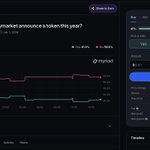
A useful test for the reader: does this PnL chart show that the trader has an unbeatable strategy? Does it show that it is even profitable in the long run? If it were not a profitable strategy, would we expect a streak like this to be possible? What information are we missing?


1
3
725
Incredible that MetaMask's UI has actively deteriorated from 5 years ago. From a colossal lead, they threw it all away via half a decade of degrading the product. Could just have copied Rabby but refused. Everyone who works for their team should be shot for criminal incompetence.
1
5
377
Total departure from my usual posting, but came across this interesting on Vladimir Kramnik playing the Open Catalan vs Morozevich (youtube.com/watch?v=K_RFQvl-…). I clearly see why beginners are dissuaded from the Catalan: the disparity in ease of play for White vs Black is colossal.
1
370

Very good development for prediction markets. Strictly speaking, insider trading at least marginally lessens the information being transmitted. But this marginal info loss is more than made up for by the reduction in toxicity, enabling broad liquidity improvements from MMs.

On Insider Trading.
Some say insider information can make prediction markets more accurate. But the same argument can be made for stock markets, where insider trading is banned.
Insider trading erodes trust. When people believe a market is unfair, they stop trading. Liquidity dries up, volume collapses, and the market dies. Also, allowing it could incentivize bad actors to leak information they shouldn’t.
So Kalshi bans insider trading.
How do we police it?
Just like stock markets. We spent years building a market surveillance system similar to those used by the NYSE and Nasdaq:
1. Detect: Our surveillance system (called Poirot, after the French detective) flags suspicious patterns in real-time by running trades through pattern recognition models. Insider trades stand out because they often are weird and are bigger in size: people don’t usually commit fraud for $25.
2. Investigate: We have a market regulation team that conducts investigations. They review KYC data, funding sources, prior trading history, and trade rationale. They contact traders when needed.
3. Enforce: If we find wrongdoing, penalties range from warnings and fines, to referrals to the CFTC (and sometimes DOJ) for civil/criminal prosecution.
Transparency helps.
All activity on Kalshi is public. We also report it to the CFTC daily. Because of that, our traders help by sending us whistleblower tips. To those traders, I know some of you are frustrated that we don't tell you what happens after you send a tip. I get the frustration. Legally, we need to keep our investigations private – but please know your help is super valuable.
In the past year, we ran over 200 investigations and froze relevant accounts. Of these, over a dozen have become active cases and several have been referred to law enforcement.
Today we go further:
1. Wharton Forensics Lab: We’re bringing Wharton Forensic Analytics Lab Director Daniel Taylor, one of the premier forensics experts in the country, to advise us. He will help us investigate intricate "cousin of the spouse of the dude at Tesla" insider cases.
2. Brian Nelson: We’re adding Brian, former Under Secretary of the Treasury for Terrorism and Financial Intelligence, to counsel us on financial compliance and market integrity.
3. Surveillance Audit Committee: We’re forming an independent committee of market integrity experts like Lisa Pinheiro to provide quarterly reports to Brian and publish relevant statistics.
4. System upgrades: We're partnering with Solidus Labs. Their institutional-grade behavior monitoring and pattern recognition tools will be added to our systems.
5. Robert DeNault as Head of Enforcement: Bobby is a force of nature and a self-professed financial crime nerd. He was a white-collar criminal attorney and spent law school studying presidential investigations and the Panama Papers. He’s also a great guy - we love Bobby.
All industries have bad actors and no system is perfect, Kalshi's included. But we are committed to improving daily. Lots of work ahead!
1
404
In light of the situation only getting worse, I am asking any followers who have already blocked idiots to add them to my "Retarded PM larp slop" public list in order to collectively work towards cleansing the timeline. Cheers everyone.


Fully 40% of my timeline is giga-simplified slop about how "THIS TRADER made $200k on Polymarket with this one simple trick". The writing style and analysis are pure drool. It's somehow the worst it's ever been. I am going to start reporting all these posts on principle.
4
379