


Sese retweeted

You've said something incredibly revealing here.
You are treating the work of New York Times reporters as something that was effortful, yet resulted in a bad outcome.
The outcome was, of course, that Jensen Huang came back as CEO. But why does that outcome matter to journalists? Why does your heart go out to them?
It's hard to not to interpret your statement that the NY Times reporters never had public information in mind - they intended to railroad Jensen from the beginning and call that "accountability journalism."
Sese retweeted

Anthropic's, and to some extent OpenAI's, bargain proposed to government appears to be: grant us monopoly, shut down open source, and construct insurmountable barriers to entry, and we'll do your bidding. Censorship, control, whatever.
Apple and Google did no such thing.
Sese retweeted
This is a note of appreciation to Apple and Google that, through 6 years of harsh antitrust litigation and regulatory advocacy, they never once proposed the sort of corrupt, freedom-ending marriage of state security and big tech that appears to be behind Jensen smear campaign.
Sese retweeted

Today is my last day at @OpenAI. I'm glad to have spent the last eight months of my life working here!
I'm starting a new company focused on the production of high-quality reinforcement learning datasets:
1. The generalization ability of LLMs is clearly very poor, with "spiky" capabilities even in areas that have received tremendous amounts of investment and attention. For example, despite multiple years with tens (if not hundreds) of billions invested, even coding capabilities don't demonstrate "generality" -- even if every model can solve Codeforces questions or port C++ to Rust better than I can, I still have to manually "deslop" pull requests.
2. The vast majority of economically productive capabilities are not well represented in existing data offerings. First, there's a certain art to the design of an RL dataset which most vendors, not having upstreamed data into large training runs themselves, don't really understand. Second, and more importantly, most work is highly contextual and not easily encoded into a gradable environment; even if we can observe a "golden path" taken by a human which we believe to be good, it's challenging to understand whether alternate, counterfactual paths produce good or bad outcomes.
The basic premise here is that I have a clear understanding of what labs need/want, having explicitly been on the other side and having been involved at every level from procurement all the way through training, and I'm able to provide it. I also believe that data needs will grow tremendously in the coming years, especially as frontier labs face increasing pressure toward profitability, and that they won't get the relevant capabilities "for free" through scaling alone; instead, they'll need to spend >$100B on precise, well-targeted data acquisition.
Our first products will be focused on biology and statistical reasoning:
1. First, datasets that address long-horizon scientific reasoning, drawing on my work on GeneBench-Pro with @jeremyli__. Frontier models are still unable to reliably execute "messy" data analyses that require judgment, exploration, and adaptive revision (GB-Pro passrate on GPT-5.6 Sol scarcely exceeds 30%); to address this, we have the ability to generate thousands of high-quality problems with known ground truths which can be reliably graded. (In contrast, most existing RL data for bioinformatics is either massively over- or under-specified, and will probably break your model when you train on it.) Moving the "reliability gap" from 30% to >90% is obviously required for scientific acceleration, and -- despite my skepticism about generalization of RL -- is one of the *most promising datasets* conceivable when it comes to yielding generalization benefits for models' overall reasoning capabilities.
2. Second, datasets that address capabilities relevant to day-to-day workflows. Imagine a scientist snapping a picture of some experimental process or result -- say, a cell culture plate or a Western blot -- and asking Claude a question. Frontier models remain quite bad at these questions, especially those with multimodal components. But they're obviously required for acceleration of scientific discovery; before we can dream about automating science, we have to begin with shoring up these basic, generalist capabilities.
Beyond these two, we hope to expand to adjacent fields (chemistry, materials science, etc.), and then even further into fields with more direct economic applicability like healthcare and white-collar office work.
I strongly encourage labs with data needs to reach out. We offer industry-standard pricing and terms, and like I said -- I know how this process works, what good data looks like, and how to demonstrate to you, convincingly, that you'll be able to upstream our data into your training processes without issue. My DMs are open!
Sese retweeted

X is regarded as the eternally fading social media. But whenever anything important happens (crypto crashes, wars, AI) all the interesting conversations and news tidbits happen on this site. Example below.
Maybe hell is empty, and all the devils are here.

Either you believe the AI buildout is over, that AI was a flash in the pan, and that the need for compute has already peaked... or this a rare buying opportunity.
Reminder: GPU spot prices keep rising and it's hard to secure capacity. HBM and DRAM production is effectively sold out through 2029, with chip and memory supply projected to stay tight until well into the 2030s.
AI research isn't slowing down: frontier training compute is doubling every ~5 months, and model capabilities are scaling over twice as fast as they did pre-reasoning. Inference is profitable with 70-85% margins, and demand is growing geometrically. Each new model generation unlocks new use cases.
I'm not even an AI booster, just being realistic here.
Sese retweeted

Either you believe the AI buildout is over, that AI was a flash in the pan, and that the need for compute has already peaked... or this a rare buying opportunity.
Reminder: GPU spot prices keep rising and it's hard to secure capacity. HBM and DRAM production is effectively sold out through 2029, with chip and memory supply projected to stay tight until well into the 2030s.
AI research isn't slowing down: frontier training compute is doubling every ~5 months, and model capabilities are scaling over twice as fast as they did pre-reasoning. Inference is profitable with 70-85% margins, and demand is growing geometrically. Each new model generation unlocks new use cases.
I'm not even an AI booster, just being realistic here.


Sese retweeted

The @NYTimes' coordinated assault on Jensen Huang is astonishing. Three to five hit pieces a day. Front page. Thinly sourced. Every day for two weeks. If the NY Times spent even 1% of that energy going after Epstein's clients or Big Pharma, the world would be a better place.
Sese retweeted

Now that Jensen Huang is gone, I think America is about to discover something the hard way:
Nvidia didn’t just lose a CEO. It lost the one guy who knew how to run an Asian supply chain like an old-school merchant.
You can replace him with a brilliant American executive, an Indian executive, a Chinese executive — whatever.
The title is replaceable. The relationships are not.
Anyone who grew up around old-school Chinese business culture will recognize Jensen’s style immediately. You eat together. You drink together. You remember who helped you twenty years ago. When you decide someone is your guy, you keep dealing with him for decades. Contracts matter, of course, but when things go wrong at 2 a.m., what matters even more is whether the person on the other side will pick up your call.
Look at Nvidia’s supply chain. TSMC makes the chips. SK Hynix makes the HBM. Foxconn, Quanta, Wistron, Pegatron and others build the systems. Jensen didn’t suddenly discover these companies when ChatGPT arrived. He spent decades personally building relationships with the people running them.
TSMC is probably the best example. Back in 1998, when Nvidia was still tiny and short on manufacturing expertise, TSMC sent two production people over to help. The relationship became so close that Morris Chang later asked Jensen twice if he wanted to become CEO of TSMC. Jensen said no both times.
Decades later, Jensen was still flying back to Taiwan, eating with Morris Chang, Barry Lam and half of the island’s tech establishment. At one Taipei dinner, the guest list looked less like a restaurant reservation and more like the control room of the global AI supply chain: TSMC, Quanta, Pegatron, Wistron, Asus, Acer, Inventec, Foxconn.
That stuff looks almost comically old-fashioned in an industry obsessed with AI agents and trillion-dollar market caps. But then you see what happens when Nvidia actually needs something.
In 2024, Jensen wanted SK Hynix to move its HBM4 supply schedule forward by six months. Six months in semiconductors is insane. You’re talking about engineering, capacity and production plans that were set long before Jensen showed up asking for more.
SK chairman Chey Tae-won publicly told the story later. Jensen asked. Chey went back to his people and pushed.
That is not something you reproduce by handing the next CEO a supplier spreadsheet.
And Jensen also knew what it meant to owe somebody.
In Nvidia’s early days, its project with Sega went badly enough that the company was in real trouble. Jensen went to Japan, admitted the technology wasn’t going to work, and Sega still gave Nvidia $5 million that helped keep the company alive.
Thirty years later, Jensen went back to Tokyo and thanked former Sega president Shoichiro Irimajiri in person. His message was basically: without what you did for us back then, there would be no Nvidia today.
He did the same thing on the other side of the table.
Serve Robotics CEO Ali Kashani has talked about December 2023, when his company was so close to dying that he had already discussed bankruptcy. An investor pulled out right before Christmas. Kashani called Jensen. Nvidia helped carry the financing, other partners joined, and a few months later Serve was ringing the Nasdaq bell.
That’s the Jensen playbook. Eat with people. Remember favors. Return favors. Call directly when there’s trouble. Keep relationships alive for twenty or thirty years.
Silicon Valley has a fancy word for this: “network.”
My family would probably just call it doing business,and now Jensen is gone.
Nvidia can transfer his office, his org chart, his contracts, his procurement team and every supplier database to the next CEO.
What it cannot transfer is the invisible ledger sitting inside the heads of dozens of people across Taiwan, Korea and Japan:
He helped me once. I helped him once.
We’ve known each other for 25 years.
If he calls, I’ll listen. There is no handover document for that.
Sese retweeted

Over the past week, I’ve been overwhelmed by the love and support of friends, industry colleagues, and people I've never met. Thank you to everyone who has shown kindness to my family and me. It means the world to me.
I came to the United States 53 years ago, and becoming an American citizen is one of the greatest gifts and proudest moments of my life. NVIDIA has been my life’s work. Building it into the company it is today alongside my colleagues has been a privilege and an honor. Nowhere but in America could a company like NVIDIA be possible. I love our country, and I love NVIDIA.
I did not live up to the standards expected of everyone at NVIDIA, and I have made serious mistakes in my personal life. I created problems for the Board that I deeply regret. I own my mistakes completely, and I am committed to cooperating with the Board’s independent investigation.
Since my departure, I’ve seen an outpouring of calls from NVIDIA’s employees, investors, business partners, and customers for me to return as CEO. Many continue to reach out to me directly as the company navigates complex technology, market, competitive, and geopolitical dynamics. NVIDIA is a once-in-a-generation company. If the Board of Directors decides that my return is in the best interest of our shareholders, our employees, the company, and America, I would be honored to answer these calls and return as CEO.
Thank you again to everyone who has shared their good wishes. I am profoundly humbled by your support. To my family: I love you, and I will spend the rest of my life being worthy of yours.
Jensen
Sese retweeted
The articles backtracked from their original incendiary, and now clearly false, claims to something more like "Jensen did lawful things that powerful people didn't like". It still appears the original claims came from a single competing Big Tech lobbyist.
The reporting successfully disrupted corporate governance processes, with a running cost of $1.8 trillion in losses to American pension funds and shareholders.
Here's what I fear is being lost in these articles: The proper interface between government and private citizens and their corporations is rule of law. Laws are passed, and if wrongdoing as alleged, then there's due process: an investigation followed by facts and evidence presented in open court. Due process should happen here: let the facts come out whole, and not as a trickle of dubious claims.
Press takedowns full of sketchily sourced claims and backtracking narratives are not the way. It's what we see outside of the free world, and is no model for The United States of America.
In particular, if the Jensen takedown succeeds on the basis of these journalistic failings, which is not by any means certain as Sam Altman's case shows, then it foreshadows an economically and institutionally ruinous new playbook to be adopted with no end in sight.
Imagine a weekly stream of takedowns emerging from opportunistic alignments between corporate lobbyists and political interests which, given the new partisan split between the executive and legislative branches, will attack in all directions, undermining not only the US economy but American leadership in the world.
I hope cooler heads prevail this coming week as they did not on Thursday November 12. And I urge anyone who happened to oppose Jensen, open models, and the underlying trade policies in question, to recognize that this isn't a win for "team regulation". It's a change in the game from a transparent rules-based one to a sinister new form centered around politicans and lobbyists.
Sese retweeted

젠슨황 사건이 보도되며 문득 생각난 첸쉐썬(錢學森, Qian Xuesen) 박사.
첸쉐썬박사는 미국에서 세계적인 항공우주공학자로 촉망받았으나 냉전 시기 공산주의자로 몰려 추방당한 뒤, 중국으로 건너가 중국의 핵·미사일·우주 개발을 총괄한 역사를 가지고 있습니다.
미국에서의 엘리트 코스와 시련
1935년 장학생으로 미국에 건너가 매사추세츠공과대학교(MIT)에서 석사를, 캘리포니아공과대학교(Caltech)에서 박사 학위를 받았습니다.
캘리포니아공과대학교 제트추진연구소(JPL)의 공동 창립자 중 한 명으로 참여했으며, 제2차 세계대전 당시 미 국방과학위원회에서 중령 대우를 받으며 미국의 로켓 및 탄도미사일 개발에 크게 기여했습니다.
1949년 중국이 공산화되고 1950년대 미국 전역에 반공 광풍인 매카시즘이 불어닥치면서 중국 출신이라는 이유로 표적이 되었습니다.
1950년 공산주의자 및 기밀 유출 간첩 혐의로 체포되어 5년간 가택연금 등 억류 생활을 겪었습니다.
당시 미국 해군 차관이었던 댄 킴볼은 "그는 공산주의자가 아니며, 그를 내쫓는 것은 미국 역사상 가장 어리석은 짓"이라고 반대했습니다.
또한 그의 지식과 능력이 미 해병대 5개 사단과 맞먹는다는 평가가 나올 정도로 미국 내에서 그의 두뇌 유출을 우려하는 목소리가 컸습니다.
중국 귀국과 '양탄일성'의 주역
중국의 저우언라이 총리는 첸쉐썬을 데려오기 위해 한국전쟁 당시 붙잡은 미군 공군 조종사 포로 11명을 미국에 넘기는 협상을 진행했습니다. 결국 1955년 그는 중국으로 추방되듯 귀국하게 되었습니다.
귀국 후 마오쩌둥의 전폭적인 지원 아래 중국의 전략 무기 개발 프로젝트인 '양탄일성(兩彈一星, 원자탄·수소탄·인공위성)'의 총괄책임자 역할을 수행했습니다.
핵물리학 전공자는 아니었지만 미국에서 경험한 국가 단위 대형 과학 프로젝트를 관리하는 노하우를 바탕으로 개발을 지휘했습니다.
1960년 단거리 탄도미사일 둥펑(東風) 1호 발사를 시작으로 1964년 원자폭탄 실험 성공, 1967년 수소폭탄 실험 성공, 1970년 중국 최초의 인공위성 둥펑훙(東方紅) 1호 발사를 연이어 이끌어내며 중국을 핵보유국이자 우주 강국 반열에 올려놓았습니다.
훗날 미국 학계와 정계에서는 첸쉐썬을 간첩으로 몰아 중국으로 돌려보낸 사건을 두고 냉전 시대 미국의 가장 치명적인 안보·외교적 오판 중 하나로 꼽고 있습니다.

Sese retweeted

This is the biggest irony of the whole Alice Huang / Nvidia saga: the Chinese government actually doesn't want Nvidia chips and is actively keeping them out of the country.
Last year it even ordered Alibaba and ByteDance to cancel their Nvidia orders (bloomberg.com/news/articles/…) and sent customs teams to the ports to check every advanced chip coming in (ng.investing.com/news/stock-…).
And right now 600,000 Nvidia H200s are stuck in Hong Kong because Beijing won’t let them into the country (reuters.com/world/china/nvid…)👇
Nvidia also explicitly frames this as a threat to its business in its latest annual report to the SEC: "The Chinese government has encouraged customers to purchase from our China-based competitors and discouraged customers from purchasing, importing, or using our data center products" (sec.gov/Archives/edgar/data/…).
Why does China do that? Because every Nvidia chip a Chinese company buys is one that Huawei or Cambricon doesn’t sell, and domestic chips can only catch up if people actually buy them (which means money for R&D, etc.).
Which means that the notion that Chinese intelligence was running honeytraps to get more Nvidia chips into China gets the whole thing exactly backwards.
In fact, it looks like Megaspeed - Alice Huang's company - was a counter-reaction to official Chinese policy: a private sector workaround to these efforts by the Chinese government to curtail Nvidia.
As was widely reported - including by Western media - Megaspeed built data centers in Southeast Asia and rented their computing power to Alibaba, which the New York Times called "a backdoor way of getting access" to Nvidia chips (nytimes.com/2026/11/06/us/po…).
That is a backdoor not only - allegedly - around Washington’s export controls, but also around China's own efforts to wean its companies off Nvidia.
I can’t believe the Chinese government was too thrilled about it: it'd make just about zero sense for it to run countless domestic measures to prevent Alibaba from using Nvidia chips, yet at the same time have its top spy agency help the same Alibaba get Nvidia chips through the back door in Southeast Asia 🤷
At the end of the day, as with all such stories, you always need to look at "cui bono?": who benefits? Who benefitted is pretty clear:
- Nvidia itself: it's in the business of selling chips so a customer willing to spend billions of dollars on chips in Southeast Asia is a godsend. Again, as they themselves state in their SEC filings, not being able to tap into Chinese demand would have "a material and adverse impact on our business" (sec.gov/Archives/edgar/data/…).
- Chinese companies like Alibaba: facts are, 1) Chinese chips haven't yet caught up, 2) Chinese chip companies' production capabilities are still limited and 3) Chinese tech firms' historical tech stack runs on Nvidia’s CUDA ecosystem, and rewriting years of code for Huawei chips is painful. Renting Nvidia chips in Southeast Asia is the easy way to stay competitive and serve customer demand in the meantime.
- The US, according to core members of the Trump administration: back in July last year, US Commerce Secretary Howard Lutnick explained that the point of letting Nvidia sell more chips to China was to get Chinese developers "addicted to the American technology stack" (techradar.com/pro/china-coul…).
Who does NOT benefit, according to official Chinese policy, is the Chinese state, which has made tech self-reliance one of its foremost priorities.
Which means that, to believe the spy story, you have to believe that a person - Alice Huang - was effectively a spy paid by her own government while simultaneously sabotaging its tech self-reliance drive, which it has spent years and trillions of dollars on - pretty senseless.
Stranger things have happened, I guess, but it doesn't pass the smell test.
And there is another absolutely major contradiction in the media story. According to a Financial Times article published yesterday (ft.com/content/3238d92b-4074…), "a person who knows [Alice Huang] said they had been asked by MSS for information about her earlier this year after news emerged that Singapore was investigating the company in relation to chip-smuggling allegations. The agency wanted to find out more information about Huang, including the nature of her business and connections, the person said."
Which raises a damn obvious question: if she were indeed an MSS asset, why on earth would the MSS need to ask the people around her who she was and the nature of her business?
It's a complete contradiction with the spy story - but very much not a contradiction with what I described above: a private businesswoman running a workaround to Beijing’s own policy, which the Chinese security apparatus would naturally want to look into.
Especially since, around about the same time, Shanghai police detained her business partner, reportedly her husband, in a stock manipulation case (caixinglobal.com/2026-11-10/…): also coherent with Chinese authorities looking into her network, and much harder to square with her being a prized MSS asset.
And, to top it all, there is - to this day - not a shred of evidence that's been published that she is, in fact, a Chinese spy: just anonymous intelligence officials, repeated by journalists who never verified it, as I detailed here (nitter.cf/RnaudBertrand/status/2…) and here (nitter.cf/RnaudBertrand/status/2…) with one of the key FT journalists on this story actually admitting that he has no idea what evidence US intelligence actually has.
So the claim went to print without anyone seeing the evidence, without anyone being able to check it, and without anyone knowing whether it even exists.
And given everything above, from Beijing blocking the very chips she was supposedly recruited to help get into China, to the MSS asking around about her, to her partner being detained in Shanghai, my bet is that the evidence doesn’t exist at all. If anything, everything we can check points the other way.


Sese retweeted

On rigole de Jensen mais on est morts les gamers.
La seule raison pour laquelle Nvidia continuait à produire des RTX pour les particuliers, c’était grâce à lui qui voulait permettre à tout le monde d’en avoir.
Depuis que l’IA représente quasiment tout son chiffre d’affaires, Nvidia n’a plus de raison d’en produire pour nous et gagnerai bien plus à focus uniquement les pro.
Maintenant qu’il n’est plus là, considérez votre RTX comme de l'or.

Sese retweeted

At the end, Jensen Huang looked broken and shattered, his legendary energy depleted. After weeks spent denying the allegations of infidelity and fighting to remain in his job as Nvidia CEO, his surrender late Wednesday night was unconditional.
Huang’s usual take-charge demeanor had evaporated, according to a source, and he’d started using phrases like “whatever” and “I don’t care.” Read more: bloom.bg/4iSdjA6
📷️: Jose Sarmento Matos/Bloomberg


Sese retweeted

When China figures out how to manufacture a product, their ability to scale is often greater than the rest of the world combined. We saw this with lithium batteries and solar, for example.
SpaceX is a rare counter-example, where its mass to orbit is roughly an order of magnitude greater than the rest of the world, BUT China now does a majority of non-SpaceX mass to orbit. SpaceX is an anomaly in the matrix.
Maybe RAM will be different, but RAM was a low margin commodity only ~3 years ago. LP5 and LP6 are designed to a common standard that China seems to be solving fast.
Newer HBM architectures and things like an SRAM layer below logic and 3D stacking RAM on top of logic while finding a way to keep the logic cooled will be harder to solve.
Sese retweeted

OpenAI is downplaying this for PR reasons. If you’re a mathematician, you must feel like a nuclear bomb hit, and you’re at ground zero.
Reasoning models are two years-old. In that time they went from incapable of basic arithmetic to solving problems humans couldn’t solve for decades.
Math is only the beginning. AI will revolutionize the entirety of the human scientific endeavor. Most of us don’t appreciate what that means.
What a time to be alive!
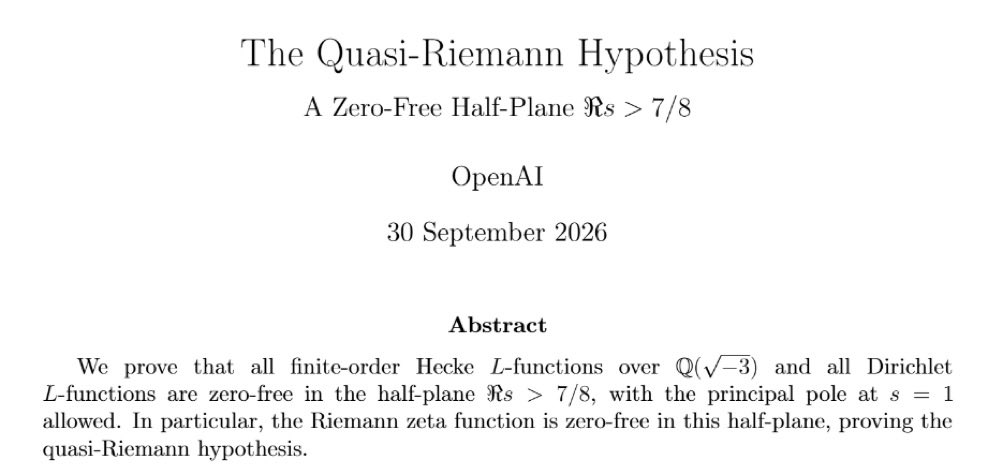

We’re releasing a broad range of new mathematical results produced by an internal frontier model.
We’ve been consulting with the independent Advisory Group on Mathematics and Artificial Intelligence at the Institute for Advanced Study, and we have drawn on their advice and public recommendations to inform how we release these results.
github.com/openai/math

