

Research Engineer exploring zero-knowledge technology. Building a "Secure Inference Gateway".
India
Joined May 2026
- Tweets30
- Following18
- Followers36
- Likes7


Kartikeya Sharma retweeted

One optimistic and still very-non-consensus belief I have about the far future of cryptography:
I think that there is a 33% chance that, for average real-world computation, there exist ways to implement all three of what I call the Egyptian God Protocols (SNARK, FHE, iO) with 1+ε factor overhead (meaning, for large enough instances, the added overhead of cryptographizing a computation becomes arbitrarily small compared to the base cost of doing the computation itself)
And a 60% chance that all three can be done with single-digit overhead (ie. <10x, measured in total cost of energy plus amortized compute)
I think there's a good chance we'll get one of these (probably SNARKs with single-digit overhead) by the end of this decade. After all, we're already there for specialized hash functions and for some LLM inference.
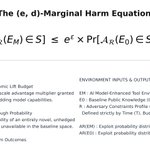
TL;DR on safety: treat safety like computational cryptography. Measure the exact logarithmic lift (ε) the AI gives a resource-bound attacker beyond public knowledge, and use strict structural boundaries to keep the probability of a catastrophic breakthrough negligibly small (δ).
1
1
27
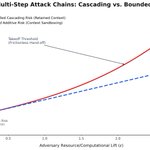
We can implement two mechanisms to bound the cascade:
1. Semantic Circuit Breakers: Audit prompt trajectories and force a halt if the cumulative semantic budget is breached.
2. Context Sandboxing: Wipe context memory between steps to flatten the exponential curve and trap δ.
1
1
23
To achieve a true cryptographic guarantee of safety, we must enforce deterministic boundaries that break this transitivity.

1
1
18
This creates the Uncontrolled Cascading Risk curve.
When an AI agent assists across a sequential chain (eg., Map Vulnerability ─> Write Payload ─> Evade Firewall), it keeps structural context.
A breakthrough in Step 1 dynamically amplifies the success probability of Step 2.

1
1
21
Without strict structural intervention, the risk curves sharply upward as cross-step friction drops to zero.
There is also a second, deadlier risk: Approximate (ε, δ)-Marginal Harm.
We must account for a sudden, unpredictable capability jump.
1
1
16
This brings us to our first formal model: Pure ε-Marginal Lift.
If ε ≈ 0, the model provides zero marginal utility beyond public data. The model multiplies the baseline probability by exactly 1.

1
1
18
For example, a model doesn't need massive intelligence to automate mass phishing, build low-level malware pipelines, or execute targeted misinformation campaigns at zero marginal cost.
The baseline risk starts exceptionally high, even if the model's raw capability score is low.
1
2
108

My core research thesis on AI safety: measuring general model capability to predict harm is an outdated paradigm.
Instead, we need an adversary-centric framework modeled exactly like computational cryptography.
Here is how we can redefine the model capability vs. harm curve. 🧵

I've been researching how Zero-Knowledge technology can cryptographically prove that a model actually produced a given output, without revealing its weights. Here's what I learned about ZK x Verifiable AI 🧵
1
137
TL;DR on scaling: the more a method relies on actually redoing the underlying math (ZK), the more proving time balloons with model size, unless it's purpose-built for the architecture.
1
17