

Spectroscopic spectrum to History's Spectrum. -/ Sharing my Experience regarding UPSC CSE and other Competitive Exams.
Joined December 2017
- Tweets2.2K
- Following124
- Followers3.6K
- Likes624




Pinned Tweet
🌀CYCLONE (from Prelims as well as Mains Perspective)
by @sid___dharth
✅Mains Expected Questions
1. Cyclone are forming in regions where it is unusual nowadays (eg. earliear in Arabian sea rarely cyclones are getting formed but now numerically it is increasing.
2. Factors affecting south-west Monsoon
3. Cyclone and Disaster Management
✋🏻For Prelims
1. Direction of Rotation
2. Condition Required
3. Trop vs Temp Cyclone
#UPSC #GPSC #UPPSC #BPSC #TNPSC #TPSC #MPSC #KPSC #HPSC #JKPSC #IAS #IPS #SSC #RAS #KAS #WBPSC #APSC #UPSCMAINS #CSAT #upscmotivation #CycloneBiparjoy #Cyclone #WTCFinal2023 #Monsoon


🏦 UPSC x Article 12
Whether IDBI Bank is a State or government authority under Article 12 of the Constitution.
The employees argued that IDBI Bank should be treated as a State under Article 12 because of its historical government ownership, continued government influence and LIC’s controlling stake.
IDBI, however, contended that it was an independent banking company managed by its Board of Directors and that government shareholding alone could not make it a State under Article 12.
Let’s examine the actual legal reasoning.
1. The governing constitutional test
Article 12 includes government authorities and other authorities that qualify as State instrumentalities.
In Pradeep Kumar Biswas (2002), the Supreme Court held that the decisive question is whether, considering all the facts cumulatively, an organisation is:
1. Financially dominated by the Government.
2. Functionally dominated by the Government.
3. Administratively dominated by the Government.
The control must be deep and pervasive, and specific to the organisation.
Merely exercising regulatory control is insufficient.
This was the principal test applied by the Bombay High Court.
#UPSC


UPSC x India Nepal Relations
10 Pillars of Viksit Bharat and Samunnat Nepal
1. Economic and Development Partnership
Trade and investment, transit connectivity, air routes, cross-border SEZs, industrial parks, IT parks and cross-border retail payments.
2. Physical & Digital Connectivity
Integrated Check Posts (ICPs), Jayanagar–Bardibas and Jogbani–Biratnagar railway lines, Siliguri–Jhapa gas pipeline and UPI connectivity..
3. Energy, Water Resources and Climate Resilience
Hydropower, multipurpose projects, disaster-risk reduction, early warning and post-disaster recovery.
4. Good Governance
Civil servant training, sharing best practices and cooperation between legislatures.
5. Technology, Space & Innovation
Star Partnership Network, Startup Centre of Excellence, Digital Nomads and Innovation Hub, digital parks and data centres.
6. Education & Skill Development
Indian higher educational institutions, IIT campuses, scholarships and training opportunities.
7. Sports
National Cricket Academy in Nepal, cricket infrastructure and access to Indian national training academies.
8. Culture and Tourism
Ramayana Circuit, Buddhist Circuit and Shiv-Shakti Circuit.
9. Health
National Medical Laboratory upgrade, India–Nepal Jan Aushadhi Kendras, medical institutional linkages and student-faculty exchanges.
10. Agriculture
Agro-Industrial Park in Chitwan, Work Plan 2026–30, ICAR cooperation and ICAR Centre of Excellence in Nepal.
#UPSC


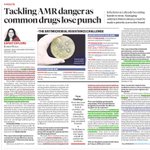
🧫🦠UPSC x Antimicrobial resistance
- AMR is a silent pandemic that threatens the effectiveness of modern medicine.
Key Take aways:
Q. What is an Antibiogram?
- An antibiogram is a report showing the susceptibility of bacteria to different antibiotics in a particular hospital or region.
ICMR Report :
1. Declining antibiotic effectiveness: Several antibiotics are showing low effectiveness against E. coli and Klebsiella pneumoniae.
2. Hospital acquired infections: Resistance to powerful antibiotics such as carbapenems is particularly concerning in hospital-acquired infections.
3. Resistance in common bacteria: Resistance to third-generation cephalosporins is very high, even in secondary-care hospitals.
4. Carbapenem resistance: It remains a major concern, particularly in larger specialised hospitals.
5. Vulnerable groups: Critically ill patients and newborns are particularly at risk.
#UPSC


Many UPSC history teachers use a general rule of thumb that temples in South India are associated with the Dravida style, while temples in North India are associated with the Nagara style. Although this is useful for basic understanding, it cannot be applied blindly in UPSC Prelims.
The Huchimalligudi Temple is an important exception to this geographical assumption. It is situated at Aihole in Karnataka (South India), but it has a Nagara-style Rekha prasada Shikhara. Therefore, a temple’s geographical location does not necessarily determine its architectural style.
Similarly, Pattadakal provides another example of this architectural diversity, as it contains both traditions. The Galaganatha Temple represents Nagara architecture, whereas the Virupaksha Temple represents Dravida architecture.
General rules help in elimination, but exceptions test actual conceptual understanding.
#UPSC


A Dik-Dik is a very small wild antelope found in the dry bushlands and savannas of Eastern and Southern Africa.
IUCN - Least Concern. (For UPSC as well)
The animal gets its name from the sound it makes when it feels threatened or frightened.
It produces a sharp, repeated whistling sound like “dik-dik” or “zik-zik”. This sound acts as an alarm call.
Male dik-diks have short horns, while females generally do not.

🛰️UPSC x Voyager 1
On November 18, 2026, it reached a distance of about 25.9 billion kilometres from Earth equal to ONE LIGHT-DAY!
This means a radio message from Earth takes 24 hours to reach Voyager 1.
Light-Day: The distance travelled by light in one full day (24 hours) through space is called one light-day.
1 light-day ≈ 25.9 billion kilometres.
#UPSC
🌏UPSC x QUAD
Five Key Outcomes of the Recent QUAD Summit (2026)
1. Quad Business Leaders’ Forum: The first forum will be held in Mumbai in early 2027, bringing together business leaders from India, the US, Japan and Australia to boost investment and economic cooperation.
2. Maritime Security (IPMSC): Launched the Indo-Pacific Maritime Surveillance Collaboration to improve maritime surveillance and information sharing. The four countries will also conduct their first joint maritime patrol-aircraft exercise in 2027.
3. Critical Minerals and Supply Chains: Agreed to strengthen critical mineral and rare earth supply chains to reduce dependence on China and improve economic security.
4. AI and Cybersecurity: Announced the Super Intelligence Accelerator to promote AI cooperation, along with measures to tackle cyber threats and strengthen digital security.
5. Cable Connectivity: Agreed to expand undersea cable projects in the Indian Ocean and electricity cable connectivity to improve digital infrastructure and regional connectivity.
#UPSC


🌏UPSC x ASEAN
Association of Southeast Asian Nations (ASEAN) is a regional organisation established to promote economic cooperation, political dialogue, regional peace and security among Southeast Asian countries.
It was established on 8 August 1967 in Bangkok through the Bangkok Declaration by five founding members; Indonesia, Malaysia, the Philippines, Singapore and Thailand.
#UPSC


Mapping :
Important Straits and Seas of Southeast Asia
1. Strait of Malacca: Located between the Malay Peninsula (Malaysia) and Sumatra (Indonesia). It connects the Andaman Sea with the Singapore Strait.
2. Singapore Strait: Located between Singapore and Indonesia's Riau Islands (Batam and Bintan). It connects the Strait of Malacca with the South China Sea.
3. South China Sea: Bordered by China, Taiwan, Vietnam, the Philippines, Malaysia, Brunei and Indonesia's Natuna region.
4. Andaman Sea: Located west of Thailand and Myanmar, and east of India's Andaman and Nicobar Islands.
5. Gulf of Thailand: Bordered by Thailand, Cambodia and Vietnam, with Malaysia at its southern end.
6. Strait of Sunda: Located between Sumatra and Java (Indonesia). It connects the Indian Ocean with the Java Sea.
7. Strait of Lombok: Located between Bali and Lombok (Indonesia). It connects the Indian Ocean with the Bali Sea.
🚰 UPSC x Water Security
Water security is not merely an environmental concern; it is a fundamental pillar of economic growth and development.
UPSC has previously explored the link between water security and food security.
With the growing importance of semiconductor manufacturing and data centres, future questions may examine the broader economic implications of water security, particularly its role in industrial competitiveness, investment and technological development.
#UPSC


🥷🏻UPSC x Birsa Munda
Born in Ulihatu Khunti district, Jharkhand in 1875 with birth
name Daud Munda.
He came under Christian missionary influence and was baptised, acquiring the name Birsa David. But this association did not last.
Founded a new sect known as the Birsait. It believed
in one God, and aimed for reforming tribal society by observing a code of conduct.
Took up a campaign against alcoholism, witchcraft and sorcery.
Under the movement, Birsa Munda mobilized tribes
belonging to Chhotanagpur, Bengal and Odisha against
the Dikus (outsiders) and Europeans (referred to as
Ravanas) from 1895 onwards to establish an independent
Munda Raj.


📌Major causes of the Munda rebellion:
A. Introduction of the Zamindari system
- Traditional Mundari Khuntkatti system was replaced.
- Khuntkatti represented community ownership of land.
- Tribal people were reduced from landowners to landless labourers.
B. Forced labour
Changes in colonial policies contributed to:
Veth Begari – Forced labour.
Bandhua Majdoori – Bonded labour.
C. Exploitation by Dikus
- Colonial land revenue arrangements introduced outside intermediaries called Thikadars.
- Exploitation through taxation and forced cash payments.
- Excise controls and other levies increased tribal discontent.
D. Religious and cultural interference
- Missionaries criticised traditional tribal culture.
- This contributed to resentment among tribal communities.
✔️Outcomes of the movement:
A. Chhotanagpur Tenancy Act, 1908
- Prohibited the transfer of tribal land to non-tribals.
- Provided protection to tribal landownership rights.
- Recognised the importance of customary landholding systems.
B. Abolition of forced labour
- The government abolished the forced labour system known as Veth Begari.
C. Tribal consciousness
- Strengthened tribal identity and political awareness.
- Exposed colonial exploitation.
- Inspired subsequent struggles for tribal rights and self-governance.
1
132
⚖️ UPSC x Judiciary
📌Issue:
1. Huge backlog of pending cases: By the end of 2025, the Supreme Court had 92,318 pending cases. In 2025, it received 75,410 new cases but decided only 65,615. As a result, people have to wait longer for justice.
2. Lack of focus on constitutional matters: The Supreme Court spends too much time hearing ordinary appeals and less time on important constitutional cases. Constitution Benches decided around 134 cases per year in the early 1960s, but this number fell to fewer than 10 cases per year in the last decade.
✅ Proposed Reforms :
1. Create a separate Constitutional Court: Establish a Constitutional Court in Delhi with around 11 judges. It will focus only on important constitutional cases and major questions of law.
2. Establish four or five Regional Courts of Appeal: These courts will handle ordinary appeal cases and bring justice closer to people. The 229th Law Commission Report (2009) also recommended this idea.
3. Select only important cases: The Constitutional Court should hear only cases that have major legal or constitutional importance. For example, the US Supreme Court accepts only around 1% of the petitions it receives.
4. Organise the court’s workload: Instead of simply increasing the number of judges, the government should divide the work properly between constitutional and regional courts.
#UPSC
