

AI-native engineering simulation powered by distributed GPUs
Joined November 2025
- Tweets301
- Following0
- Followers1.1K
- Likes2.7K







interFoam - the first multiphase solver we've ported to CUDA.
Dam break, 4.9 M cells, 6 s simulated:
• 28 min on one H100
• 5 h 37 min with OpenFOAM on 26 CPU cores 12× faster.
brae.sh/solvers/interfoam
Your GPU, earning while you sleep.
Brae turns your NVIDIA GPU into income. One command to join. Renters pay by the minute, you keep 80%. Paid to your bank or in USDC.
Early access is open → app.brae.sh
Settlement in SIMD comes after our smart contract audit.
InjectorPipe gasMixing ⛽️
2.58M cells · 100 SIMPLE iterations
Brae, 1 GH200: 21.5s
Brae warm: 5.0s
OpenFOAM, 64 Grace cores: 33.8s
Matches OpenFOAM v2412 to 1.2e-11.


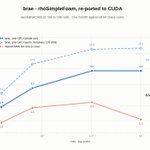
A transonic 180° U-bend
Mach 0.999 on the inner radius, 960K. converged in 3.4 seconds.
112,000 cells. Brae: OpenFOAM’s rhoSimpleFoam, ported to CUDA. The run stopped on the tutorial’s own residualControl at iteration 154 - not a hand-picked iteration count.

93 million $SIMD tokens locked again until January 2027.
We're here to build: GPU-native simulation infrastructure and real utility for the SIMD ecosystem - starting soon.
Live Roadmap: simd.space/roadmap
SIMD on top!


Brae is heading to the supercomputer 🚀
We’ve secured access to LuxProvide’s MeluXina platform, including NVIDIA A100s GPU infrastructure.
We’ll use this pilot to accelerate BRAE’s development, benchmark it in an HPC environment, and advance our goal of building large, multiscale simulations.
Thank you to @luxprovide for the support!

Delta wing at 30° AoA, 3.8M cells, SA-IDDES, 2000 timesteps, solved in 63 minutes on a single Nvidia GB10.
Standard OpenFOAM case, unmodified, running entirely on the GPU in brae.
And you can find the case link in the reply.
A full F-16 at 32° angle of attack, deep stall, resolved on one GPU.
25M cells. SA-IDDES. 50 m/s freestream, 1.5 s of physical time, five convective passes over the airframe, solved in 4.4 hours on a single H100.
For comparison, SPUMA would be ~4.5× slower on the same case/hardware (~19.8 hours)
Solved with brae.
1/ orbit view
SIMD is getting an experimental GPU network via brae.
Lend an idle GPU. It runs real OpenFOAM cases.
More details soon
brae.sh/live
So much learning.
reddit.com/r/CFD/s/SgeIEC5fu…

A full F-16 at 32° angle of attack, deep stall, resolved on one GPU.
25M cells. SA-IDDES. 50 m/s freestream, 1.5 s of physical time, five convective passes over the airframe, solved in 4.4 hours on a single H100.
For comparison, SPUMA would be ~4.5× slower on the same case/hardware (~19.8 hours)
Solved with brae.
1/ orbit view
A full F-16 at 32° angle of attack, deep stall, resolved on one GPU.
25M cells. SA-IDDES. 50 m/s freestream, 1.5 s of physical time, five convective passes over the airframe, solved in 4.4 hours on a single H100.
For comparison, SPUMA would be ~4.5× slower on the same case/hardware (~19.8 hours)
Solved with brae.
1/ orbit view
- Numerical methods ported: Euler, backward, Crank-Nicolson
- Turbulent models ported: RAS + DES/LES · device-resident coded BCs.
Compressible solvers are the next - and the most demanded.
github.com/simd-ai/brae
simd.space/blog/introducing-…

Brae, our GPU-native OpenFOAM solver, on one H100. Same case, matched <1% on the fields.
brae is faster by:
- 2.5x vs OpenFOAM, 24 cores
- 3.9x vs SPUMA
- 26x vs OpenFOAM + AMGX
- 30x vs OpenFOAM + PETSc
The whole solve stays on the GPU.
github.com/simd-ai/brae

SPUMA from exaFOAM just landed on the benchmark table!
It is 4x slower on the same hardware Grace Blackwell GB10.
At 35M cells mesh, it diverges.
Link: github.com/simd-ai/brae/blob…

Independent benchmark (not ours): a user ran brae on a single RTX 5090.
- 4.89M cells: 21s vs OpenFOAM 768s CPU / 564s AMGX / 643s PETSc. ~30x.
- It beats even GPU-accelerated OpenFOAM, because AMGX/PETSc only offload the solver while brae runs it all on-GPU.


SPUMA from exaFOAM just landed on the benchmark table!
It is 4x slower on the same hardware Grace Blackwell GB10.
At 35M cells mesh, it diverges.
Link: github.com/simd-ai/brae/blob…
1/ The benefit is that the token is tied to the compute layer.
SIMD is not only an AI agent. The goal is to let engineers run simulation workloads faster — first through SIMD Agent, and now through brae, our GPU-native solver for OpenFOAM-style cases. Engineers we spoke don't want to change their workflow.

SIMD Agent showed us what engineers want:
easier setup, fewer workflow mistakes, and faster execution.
brae is the execution layer.
Same direction. Bigger ambition.
GPU-native CFD, built for real OpenFOAM users.
