
I am a PhD Student of the NLP group at the University of Manchester. I am interested in LLM, AIGC, and Multimodal Model
Manchester, England
Joined July 2022
- Tweets152
- Following403
- Followers302
- Likes127





Pinned Tweet
1/n Excited to announce the release of our new paper "A Comparative Study on Reasoning Patterns of OpenAI's o1 Model" arxiv.org/pdf/2410.13639
To advance the open-source community's reproduction of the o1 model, we collaborated with the OpenO1 Team (github.com/Open-Source-O1/Op…).

Thanks for sharing our work!!!!

Impressive paper on building recursive self-improving agent harnesses.
It's rich with great insights on building effective agent harnesses.
If you maintain an agent harness, this paper names three defects in how harnesses get improved and the fixes.
First, evolving a harness against the evaluation benchmark makes reusable improvements impossible to tell apart from benchmark fitting.
Instead, ModularRSI evolves on tasks disjoint from the benchmark.
Second, updating from a single trajectory confuses a systematic harness deficiency with one task's reasoning details, which produces changes that fail on unseen tasks.
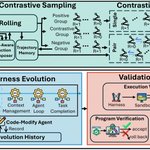
ModularRSI contrasts successful against failed trajectories for the same task, then aggregates across tasks to find recurring behavioral deficiencies.
Third, a monolithic harness makes it hard to localize a recurring problem, and optimizing the whole thing entangles unrelated mechanisms, so no change can be attributed.
ModularRSI splits the evolvable harness into five functional modules that evolve separately. Agent Loop, Tool Use, Observation Management, Context Management, and Task Completion Detection.
Paper: academy.dair.ai/papers/modul…

3
163
Siwei Wu(吴思为) retweeted

Agents reproduce 150 papers while an MCP recorder logs every action and rubrics grade the trace. AgentActionBench, @chenghua_lin, @yizhilll et al., NLPCC 2026.
On Vector, that trace is the receipt the job settles on.
arxiv.org/abs/2609.11117
Ep 12: apex-fusion.github.io/vector…
Siwei Wu(吴思为) retweeted

Coding agents rely on a harness to plan, use tools, and manage context. But which of these components actually help, and when? Most evaluations compare complete agent systems, making it difficult to separate the contributions of individual harness components.
Introducing An Empirical Study of Harness Design for Coding Agents 🔬👇


🚀 New blog: ModularRSI: Toward Generalizable Harness RSI
Can agents truly improve their harnesses—or just overfit to benchmarks?
We study Harness RSI through one lens: generalization beyond evolution experience. 🧵
Blog: recursive-self-improvement.n…
[10/n] Thanks to our co-authors and supervisors:
@siweiwu7 , @JinChengRen1122, @yizhilll , @LHaausing, Chengran Yang, @ernbgzoczbccnm, @ReacherZhang, Jian Yang, @rtbbatista , Chuanyi Zhang, Ming Zhou, Bryan Dai,@chenghua_lin
IQuest
@csmcr @Manchester_NLP.
1
2
116
Siwei Wu(吴思为) retweeted

If you're attending #ACL2026 or #ICML2026, come by and check out the work from the @Manchester_NLP Group. We'd love to chat and exchange ideas! 🇺🇸🇰🇷
@csmcr


Thanks for sharing our work, @omarsar0!
We believe self-evolutionary rule generation, rather than manually curated prompts or rules, is a highly promising direction. In the agent era, human-free frameworks are future
Code: github.com/multimodal-art-pr…
Paper: huggingface.co/papers/2604.1…


Pay attention to this one, AI devs.
This is particularly interesting if you work with long-horizon terminal agents that often drown in their own observations.
TACO is a self-evolving framework that automatically discovers and refines context compression rules directly from interaction trajectories.
In other words, you let the agent figure out the rules itself.
It plugs into existing terminal agents as a wrapper.
Tested on TerminalBench, SWE-Bench Lite, and CompileBench with MiniMax-2.5, it cuts token overhead by ~10% while preserving or improving accuracy.
Why does it matter?
Context is the real bottleneck for long-horizon coding agents. Hand-tuned compression does not generalize across environments. Letting the agent learn what to keep and what to drop is a much cleaner path forward.
Paper: arxiv.org/abs/2604.19572
Learn to build effective AI agents in our academy: academy.dair.ai/

1
221
1/
Excited to share our recent work: TACO
A Self-Evolving Framework for Efficient Terminal Agents via Observational Context Compression.
mousy-haumea-c5a.notion.site…

15/
📄 arXiv:arxiv.org/abs/2604.19572
🤗 Daily paper:huggingface.co/papers/2604.1…
💻 Code:github.com/multimodal-art-pr…

1
72
16/
Thanks to our co-authors and supervisors:
@JinChengRen1122 @yizhilll @KangZhu0210 ShuXu BoyuFeng @abc43992899 WeiZhang @rtbbatista JianYang @chenghua_lin
@csmcr @Manchester_NLP.
94