@smartqubiti
iAccount based inColombia!
About this account
- Account based in
- Colombia
- Connected via
- Colombia App Store
! X says this location may be affected by a proxy or VPN.
Account-level information from X, not a live location or the device used for a specific post.
Red Hat Delivery Specialist - OpenShift, AWS Technical Professional, IBM Advanced Technical Expert, IBM Storage Specialist, VMware Cloud Master, SAN Specialist
Cali, Colombia
Joined March 2009
- Tweets2.3K
- Following6.8K
- Followers748
- Likes421
SmartQubit retweeted
A single Gmail address leaks a surprising amount of personal data.
Instead of wasting time with manual searches, this article shows you how to use GHunt to automatically pull hidden profile details, location history, and account metadata in minutes.
hackers-arise.com/open-sourc…

ALT Ghunt is an open-source security framework created by the researcher mxrch. It helps gather public information connected to Google accounts. What’s important is that the tool does not break into accounts or exploit system bugs. Instead, it extracts publicly exposed data directly from Google services and internal APIs.
SmartQubit retweeted
someone finally fixed the expensive part
a new AI called Jev was released only a few days ago. it doesn’t generate paragraphs - it makes typed decisions that software can use directly
TypeSafe says Jev is up to 193.6× faster and 444.6× cheaper than frontier models in selected workflow tests
the listed price is $0.042 per million input tokens. output tokens are free
that changes the economics of agents. instead of spending a full LLM call on every yes-or-no branch, Jev can classify, route or score the entire batch
one author-reported example:
700 leads → match / no match → 40 seconds → $0.09
business lift is still unverified, but the decision itself is measurable and easy to audit
the setup:
> define allowed outputs
> batch the inputs
> set a confidence threshold
> execute high-confidence decisions
> send uncertain cases to a human
four patterns already map the idea:
slop detector → score or null
UI selector → choose a component
Mac intent → choose an action
lead matcher → score 700 leads
the 28-second video follows:
FIND → TYPE → BUILD → SHIP
LLMs write and explain. Jev decides. software executes
the full 9-step blueprint and all four patterns are in the article below ↓
SmartQubit retweeted
Artificial Intelligence in Cybersecurity, Part 26: Web App Hacking with Hermes
hackers-arise.com/artificial…
SmartQubit retweeted
How to Bypass Firewall Without Port Forwarding - Pwnat v0.3.0
pwnat network
#KaliLinux #Networking #LinuxTips #Infosec #pwnat
SmartQubit retweeted
How to Route System Traffic Through tor.exe on Windows 11
Tor Proxy Windows
#TorNetwork #WindowsTips #DevTok #Privacy
SmartQubit retweeted
Relay module in Xplora3D complete with a custom glb + full simulation support of NO-COM-NC
Also added a new component, a DC lamp, to test the circuit.
SmartQubit retweeted
IP Camera Hacking: Using pwneye to Compromise IP Cameras
hackers-arise.com/camera-hac…
SmartQubit retweeted
APRENDE A HACKEAR!!!
Hay un catálogo de máquinas vulnerables, montadas a propósito, donde puedes practicar intrusión sin cometer ningún delito.
Laboratorios gratis, entorno real.
Y cuando te atascas, existen las soluciones escritas paso a paso.
SmartQubit retweeted
The easiest way to find out which models you can run on your computer:
Just run:
- 𝗻𝗽𝗺 𝗶 -𝗴 @𝗺𝗮𝗴𝗻𝗶𝘁𝘂𝗱𝗲𝗱𝗲𝘃/𝗰𝗹𝗶
- 𝗺𝗮𝗴𝗻𝗶𝘁𝘂𝗱𝗲 𝘀𝗲𝘁𝘂𝗽
It profiles your machine and ranks the models across:
- Speed
- Accuracy
- Intelligence
- Memory required
Finally, you can choose your favorite harness (Pi, OpenCode, Claude Code, Codex, etc.) to run with it.
Get started here: github.com/magnitudedev/magn…
(don't forget to star 🌟)
I also wrote a detailed article on running your favorite harnesses with local models. The article is quoted below.
🚀 Smart Automatic Door System with Raspberry Pi — Real Hardware & Software Integration! 🛠️
📕 ebokify.com/raspberry-pi
In this video, I’m sharing an exciting IoT automation project built entirely on development boards. 🎥
Project Overview: 🌟 This is an automatic smart door opener 🔓 that can be unlocked in two ways:
🔹 Using an RFID tag (contactless access) 🏷️
🔹 Entering a password 🔢 via a numeric keypad with feedback on a small monitor 📟
Components Used: ⚙️
🍇 Raspberry Pi
📡 RFID module
⌨️ Numeric Keypad
🖥️ Small display/monitor
🔌 Relay module (to control the door lock)
🔋 5V 3A power supply
💾 64GB SD Card
Technical Details: 💻
Operating System: Ubuntu ARM64 🐧 on SD card
Programming Languages: Python, C, and Go 🐍⚙️🐹
This project is a great example of combining IoT hardware, embedded systems, and multi-language programming to create a practical and functional smart solution using affordable and accessible components. 💡
From concept to full implementation, it was a valuable hands-on experience in smart automation, physical security, and working with development boards. 🛡️
📹 Watch the full video to see the system in action. ▶️
Question for you: 🤔
Are you more interested in IoT and smart automation projects 🏠, or do you prefer working on servers, networking, and virtualization? 🖥️ What module or feature would you like to see added in the next project? 🚀
🔥 Raspberry Pi Projects, Guides and Tutorials
ebokify.com/raspberry-pi-pro…
#RaspberryPi #IoT #SmartHome #RFID #EmbeddedSystems #Ubuntu #Python #Go #Hardware #DIY #Automation #InternetOfThings
SmartQubit retweeted
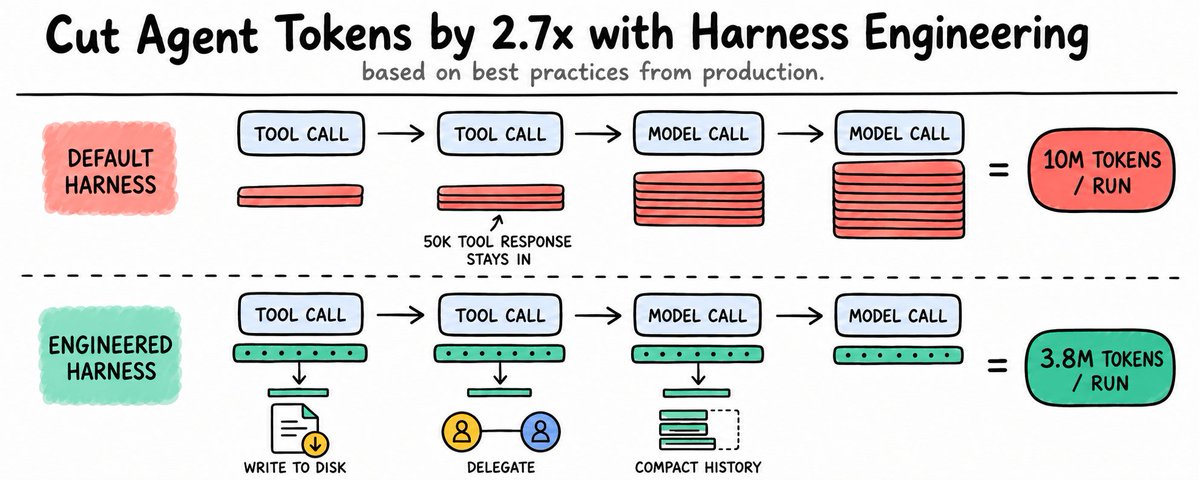
A harnessed LLM agent, clearly explained!
Two agents can run the same model on the same task and finish as expected. But one of them can spend nearly 3x the tokens to complete the task.
The extra usage originates from the code wrapped around them, which decides what reaches the model's context on each call and how many calls there are.
For instance, consider a tool that returned 50k tokens of JSON at some step. If it stays in the context, the model will continue to read that payload again at every subsequent step.
Tool definitions behave the same way.
A server can expose 50 tools, each with a name, a description, and an input and output schema.
By default, all of them will stay in the prompt from the first call, whether the agent uses them or not.
However, an optimally built harness can avoid that unnecessary cognitive load on the model.
More specifically, one core design principle of harness engineering is to push things out of the model at the right time:
- Memory holds the state that weights and context shouldn't carry.
- Skills hold procedural knowledge. These cover the operating procedures and heuristics that specialize a general model.
- Protocols hold the interaction contracts for users, other agents, and tools.
Do note that the context never disappears permanently.
It is always loaded when needed, and the harness decides how much is loaded and when.
For instance, to manage a 50k token payload, a harness can write it to a file and keep a preview and a path in context, hand the work to a subagent whose context is discarded afterwards, or summarize the older messages once the conversation passes a threshold.
If you want to see this in practice, TrueForge is an open-source harness that already implements these practices.
Tool schemas are deferred unless preloading is switched on, large responses go to a sandbox file, and generated code calls tools back through the harness, so the sandbox never holds the credentials.
The two agents I talked about at the top are from DevRev's Enterprise-Bench. TrueForge solved the same number of tasks as Claude Managed Agents on the same model, using a bit over a third of the tokens and around 40% fewer tool calls.
Here's the GitHub repo: github.com/truefoundry/truef…
(don't forget to star it ⭐ )
I also wrote a full breakdown of where agent tokens actually go inside a run, covering context accounting, the strategies above, and the benchmark in detail, and TrueForge worked with me to put this together.
Read it below.
SmartQubit retweeted
🚨ATENCIÓN!! Acaban de hacer obsoleto el “necesitas 48 GB de VRAM”.
Un modelo de 20 GB corre a ~100 tok/s en una RTX 5080 de 16 GB.
FreeToken (nuevo motor open-source) trata toda tu máquina (GPU + CPU + RAM) como una sola plataforma de inferencia.
Solo activa los experts necesarios (MoE) + caching dinámico + scheduling inteligente.
8 GB laptop → 35B
RTX 5090 → 284B
Workstation → 753B
Apache 2.0 · Windows/Linux · GUI · API OpenAI compatible
La era del “no cabe → no se puede” acaba de morir.
Repooo👇👇
SmartQubit retweeted
El creador de Node.js acaba de lanzar Dactyl.
Apps nativas de iPhone y Android desde la web.
Sin Mac. Sin Xcode. Sin Android Studio.
✓ Simulador de SwiftUI en el navegador (WASM)
✓ El mismo código para iOS y Android
✓ Usas TU suscripción de ChatGPT
→ dactyl.dev
SmartQubit retweeted
Proxmark5 support lands in the rfid image with #RFID #Proxmark3 and #Proxmark5 side by side in the same container, plus a hardening pass on the PM3 install and a batch of tool bumps.
🧵
SmartQubit retweeted
AUTOMATE mobile app testing with a flow your team can actually read, trust, and debug.
build these flows in Maestro Studio, or let your coding agent write them through Maestro MCP.
Anthropic ex-engineer runs an internal graph that costs $6 a month and catches what a $300,000 eval suite misses. No retrieval layer. Seven nodes and one rule about who's allowed to change their mind.
He published the whole schema.
His version starts from the opposite idea. A graph is not an execution order. It's a memory of why.
Seven nodes. Every edge carries the reason it exists:
> INTENT - states what the task is for. Never how
> DECOMPOSE - splits it into steps, each with a stated assumption
> WORKER - executes one step. Sees nothing else
> AUDIT - checks the output against the assumption, not the goal
> DRIFT - compares the current step to INTENT and flags divergence
> LEDGER - stores every decision with the assumption that justified it
> ROOT - holds the graph, and when an assumption breaks, re-runs every step built on it
Six nodes act. One node remembers why they acted. Every step carries the assumption that made it correct, so a false one only reruns what stood on it.
That's the entire design. A pipeline that forgets its reasons has to redo all of it or trust all of it.
He replayed a month of agent runs. 4,100 steps, 380 built on an assumption that was wrong by day three. The old pipeline shipped all 380 and linked none of them.
Everyone else builds graphs where output moves forward and the reasoning evaporates. He built one where the reason travels with the result. The blast radius is the output nobody else produces.
The article below is the full build - node prompts, the assumption format, the invalidation rule that finds every step downstream of a broken one.
Save it. You'll want it open in the other
SmartQubit retweeted
¿Quieres ejecutar IA en local? Pero no sabes si tu ordenador lo soporta... ¡Usa esto!
✓ Detecta tu GPU desde el navegador
✓ Sin instalaciones ni registros
✓ Para texto, código, imagen y vídeo
✓ Apple, NVIDIA, AMD, y mucho más
→ canirun.ai