

An independent human rights organization founded in June 2011, documents HR violations in Syria, supporting the transition towards democracy [email protected]
The Hague, Netherlands
Joined October 2012
- Tweets43K
- Following78
- Followers74.1K
- Likes1.8K




A child, Abdul Karim al-Uthman, was killed by the explosion of a landmine—a remnant of the conflict—in the vicinity of the city of Halfaya, in the countryside of #Hama Governorate, on October 26, 2026.
Details: news.snhr.org/?p=157473
#SNHR #Syria

The Syrian Network for Human Rights (#SNHR) received, at its office in #Damascus, Ms. Huma Khan, Head of the Office of the United Nations High Commissioner for Human Rights (OHCHR) in Damascus, along with her colleagues, within the framework of enhancing cooperation and coordination between the two sides.
@FADELABDULGHANY
@OHCHR_MENA
View full statement:snhr.org/?p=78949
#SNHR #Syria

Daily Report on Civilian Casualties in Syria On October 28, 2026
Details: news.snhr.org/?p=157466
#SNHR #Syria

.@FADELABDULGHANY, Executive Director of the Syrian Network for Human Rights(#SNHR), wrote an opinion piece for the website @syr_television, titled: Beyond the Judicial Rulings: The Role of INTERPOL in the Efforts of #Syria to Achieve Criminal Accountability
On August 11, 2026, the Fourth Criminal Court for Transitional Justice Cases in Damascus issued, under Decision No. 1 of 2026, death sentences in absentia against Bashar al-Assad, Maher al-Assad, and a number of other fugitive former officials.
According to what was published by the Syrian Arab News Agency (SANA), the decision provided for maintaining the arrest warrants issued against the defendants who remain at large, and directed the competent authorities to pursue international cooperation procedures in order to apprehend them. On October 22, the President of the Court, Judge Fakhreddin al-Aryan, stated, as reported by SANA, that the judgments issued in absentia are being transmitted to the International Criminal Police Organization (INTERPOL). These judgments demonstrate the willingness of the Syrian courts to exercise their criminal jurisdiction over the former leaders of the country; however, whether they can serve as a basis for activating an effective international cooperation remains a separate question. A state can prosecute crimes falling within its jurisdiction, but it cannot enforce its judicial orders on the territory of another state without the cooperation of that state. INTERPOL facilitates this cooperation; however, it does not remove the legal constraints that govern it. Moreover, the ability of other states to cooperate, and the extent of their willingness to do so, depend to a large degree on the credibility of the Syrian judicial proceedings.
Read the full article at the following link: snhr.org/?p=78941

Daily Report on Civilian Casualties in Syria On October 27, 2026
Details: news.snhr.org/?p=157460
#SNHR #Syria

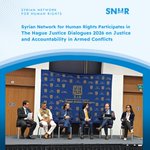
The Syrian Network for Human Rights (#SNHR) participated in “The Hague Justice Dialogues 2026,” an international gathering on justice, human dignity, and the protection of victims of war, which was organized by the International Criminal Law Foundation (Stichting Internationaal Strafrecht, S.I.S.) at the Hilton The Hague, the Netherlands, on October 14 and 15, 2026. The gathering brought together legal experts, human rights advocates, diplomatic representatives, journalists, and voices from civil society.
On Thursday, October 15, @FADELABDULGHANY, the Executive Director of SNHR, spoke at a session titled “When War Tests Justice,” which was moderated by Mr. Parwiz Kawa. The session addressed the challenges of justice and accountability in armed conflicts, and how international law can respond at a time where civilians are subjected to serious violations, institutions are under pressure, and victims struggle to obtain recognition and justice.
View full statement: snhr.org/?p=78935
#Syria

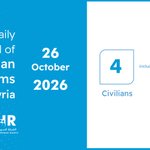
Daily Report on Civilian Casualties in Syria On October 26, 2026
Details: news.snhr.org/?p=157448
#SNHR #Syria

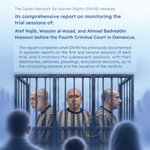
The Comprehensive Report on Monitoring the Trial Sessions of Atef Najib, Wassim al-Assad, and Ahmad Badreddin Hassoun before the Fourth Criminal Court in Damascus
The Syrian Network for Human Rights (SNHR) has released a comprehensive report documenting its monitoring of the trials of Atef Najib, Wassim Badie al-Assad, and Ahmad Badreddin Hassoun before the Fourth Criminal Court in Damascus.
The report examines the proceedings, from the third session through the conclusion of each trial, including witness testimonies, defense submissions, legal arguments, and judicial decisions.
Based on its monitoring, SNHR identified several fundamental procedural guarantees, including legal representation for the defendants, the submission of defenses and memoranda, the hearing of witnesses, and the examination of certain technical and medical evidence. However, the proceedings also raised questions regarding the level of publicity, the scope for independent monitoring, timely access to case materials for the defense, and safeguards surrounding witness protection.
SNHR emphasizes that these trials mark an important step toward judicial accountability in Syria, while stressing that the transfer of documented information into judicial proceedings does not, in itself, establish criminal responsibility.
The report also underscores the need for continued judicial oversight throughout the transitional period and for a comprehensive approach to transitional justice that goes beyond criminal convictions to include truth-seeking, the rights of victims and their families, clarification of the fate of missing persons, and reparations.
SNHR recommends expanding judicial accountability based on individual responsibility and available evidence, ensuring that all victims can access justice and effective remedies, and upholding fair trial guarantees for every defendant.
Read the full report:snhr.org/?p=78922
#SNHR #Syria


The Comprehensive Report on Monitoring the Trial Sessions of Atef Najib, Wassim al-Assad, and Ahmad Badreddin Hassoun before the Fourth Criminal Court in Damascus
The Syrian Network for Human Rights (SNHR) has released a comprehensive report monitoring the trial proceedings of Atef Najib, Wassim Badie al-Assad, and Ahmad Badreddin Hassoun before the Fourth Criminal Court in Damascus.
The report documents the proceedings from the third session through the conclusion of each trial, examining witness testimonies, defense submissions, legal arguments, and judicial decisions.
The three trials represent an important step toward judicial accountability in Syria. However, SNHR emphasizes that the transition from documentation to judicial proceedings does not, in itself, establish criminal responsibility. The process must be accompanied by continued judicial oversight, transparency, and respect for fair trial guarantees.
SNHR also stresses that transitional justice must extend beyond criminal convictions to include truth-seeking, protecting victims’ rights, clarifying the fate of missing persons, and ensuring reparations and effective remedies for victims and their families.
The report further recommends expanding accountability to cover all individuals responsible for violations based on individual criminal responsibility and available evidence, while safeguarding the rights of all defendants and ensuring that transitional justice does not become a framework for collective responsibility.
Read the full report: snhr.org/?p=78922
#SNHR #Syria


The Syrian Network for Human Rights (SNHR) released today a comprehensive report on the trials of Atef Najib, Wassim Badie al-Assad, and Ahmad Badreddin Hassoun before the Fourth Criminal Court in Damascus. The report covers the course of the three trials, starting from the third session of each trial up to the issuance of the verdicts on August 11, 18, and 24, 2026, respectively. The court sentenced Najib and al-Assad to death, and Hassoun to life imprisonment. The three verdicts were issued in the presence of the accused, and they remain subject to appeal before the Court of Cassation. SNHR documented a number of procedural guarantees during the sessions it monitored; it also observed issues that call for further scrutiny, related to the publicity of the sessions, the timing of enabling the defense to access the technical expert report, and the guarantees associated with the measures of concealing the identity of witnesses.
This report comes as a continuation of the previous reports of SNHR, which addressed the first and second sessions of each trial, and which were published on July 19, August 26, and September 22, 2026. The report distinguishes between four categories of information: the facts observed by the team of SNHR assigned to monitor the trials; the allegations presented by the Public Prosecution, the civil claimants, and the witnesses; the pleas raised by the defense; and the findings reached by the court in its verdicts. SNHR stresses that it does not undertake to adjudicate the criminal responsibility of the accused, and that its presentation of the verdicts issued does not mean that it adopts the assessment of the court of the evidence, its legal classification of the acts, or the penalties it imposed.
View the full report: snhr.org/?p=78922
#SNHR #Syria

SNHR Condemns the Killing of a Civilian with Disabilities by the Gunfire of the Israeli Occupation Forces during a Ground Incursion in Daraa Governorate.
SNHR Documents the Deployment of Snipers on the Rooftops of Residential Homes in Jamla Village for the First Time since the Fall of the Assad Regime, and Calls for an Independent Investigation and the Accountability of Those Responsible
The Syrian Network for Human Rights (SNHR) condemns the killing of the civilian Moaz Salama al-Bair, from Jamla village in the western suburbs of Daraa governorate, a person with disabilities who had Down syndrome, after he was shot by the Israeli forces during a ground incursion that they carried out in the village on Thursday, October 22, 2026.
SNHR stresses that the information it has documented regarding the incident raises serious concerns that a violation of the right to life has occurred, and therefore necessitates an independent and effective investigation in order to determine the circumstances of the use of lethal force and its lawfulness, and to ensure the accountability of those responsible for any violations that are proven to have been committed.
SNHR also condemns the continuation of the Israeli military incursions into Syrian territory, and warns of the additional risks resulting from the deployment of snipers on the rooftops of residential homes during the same incursion, which is a new development within the pattern of operations that SNHR has monitored since the fall of the regime of Bashar al-Assad on December 8, 2024.
Read the full statement: snhr.org/?p=78913
#Israeli
#SNHR #Syria

Two children, Muhammad and Sanaa al-Latif, were killed by the explosion of a remnant of the conflict in the village of Kafr Nasij, in the countryside of #Daraa Governorate, on October 21, 2026.
Details: news.snhr.org/?p=157439
#SNHR #Syria

Daily Report on Civilian Casualties in Syria On October 22-23, 2026
Details: news.snhr.org/?p=157432
#SNHR #Syria

Daily Report on Civilian Casualties in Syria On October 20, 2026
Details: news.snhr.org/?p=157413
#SNHR #Syria

Documentation of the killing of four Road Security personnel by unidentified gunmen on the Salamiyah–Athriyah road in the #Hama countryside on October 13, 2026.
Details: news.snhr.org/?p=157405
#SNHR #Syria

.@FADELABDULGHANY , Executive Director of the Syrian Network for Human Rights, wrote an opinion piece for the website @alaraby_ar , titled: Mezzeh Military Airport… Investigate Before You Build
n September 23, the General Authority of Civil Aviation and Air Transport announced the start of preliminary rehabilitation works at the Mezzeh Military Airport in #Damascus, with the aim of reclassifying it as a civilian facility of limited use for private and executive aviation. However, the problem is that the airport also houses the Investigation Branch of the Air Force Intelligence Directorate. Some of the works planned for implementation, including demolition, rubble removal, excavation, and land leveling, may bring about changes that cannot be reversed or whose effects cannot be remedied. Therefore, the essential issue relates to the sequencing of steps, as the site may still contain information and evidence connected to detention, disappearance, and death, in addition to the unresolved rights of the owners of the lands on which the airport was built. The question, thus, is whether this information and evidence will be documented and verified before the features of the land and the buildings are altered, or whether they will only be searched for after such changes have taken place.
The Syrian Network for Human Rights (#SNHR) has documented the use of the branch in operations of arrest, detention, interrogation, torture, and enforced disappearance from 2011 to 2024 under the Assad regime. This includes thousands of arrests that ended with the detainees being held in the branch or transferred to it. For varying periods, the detainees were denied access to a lawyer, contact with their relatives, and the possibility of appearing before a judicial authority. In documented cases, the authorities concealed the place of detention of the person, or denied that he or she had been detained at all.
The deaths connected to the branch require two separate tracks of investigation. The first relates to deaths in custody which occurred in the context of torture, ill-treatment, and the conditions of detention. As for the second, it relates to executions. There is information and testimony confirming that death sentences issued by the military field courts were carried out secretly at specific locations inside the airport compound. These also indicate that the bodies were transferred without the families being informed of the fate of their loved ones or of the place of their burial.
Read the full article at the following link: snhr.org/?p=78868

Daily Report on Civilian Casualties in Syria On October 14, 2026
Details: news.snhr.org/?p=157398
#SNHR #Syria

SNHR's report calls on:
• The Syrian authorities in the transitional phase to adopt a national rubble removal policy and standard operating procedures, and to place mass graves and former detention facilities under forensic supervision
• The judicial and prosecutorial authorities to coordinate with the IIIM
• Civil society to refer sites of forensic significance to relevant authorities, not intervene independently
• UN agencies to integrate explosive ordnance risk assessment and documentation into all rubble removal programs
• Donor states to link funding to evidence-based safeguards, without delaying life-saving operations
View the full report: snhr.org/?p=78857
#Syria

.@FADELABDULGHANY , the Executive Director of SNHR, said: “The manner in which the rubble is removed in Syria will affect what the investigators, the prosecutors, and the families of the missing will be able to prove regarding the violations committed since 2011. Over more than fourteen years of documentation, we have learned that removal carried out without proportionate documentation may lead, irreversibly, to the destruction or contamination of evidence, even though that evidence could have contributed to uncovering the truth, identification, and achieving accountability.”
View the full report: snhr.org/?p=78857
#Syria
