

I'm just a developer.
Joined February 2008
- Tweets70.4K
- Following759
- Followers1.9K
- Likes5.7K






มาดูแนวทางการทำ Synthetic Testing จาก Airbnb กัน
โดยทำการ capture ข้อมูลจาก workload บน production ไว้
จากนั้นทำการ replay ในระบบต่าง ๆ ที่ต้องการทดสอบ
bit.ly/4AfiaTo

39
สรุปการอ่านเรื่อง Redesign how your team ships software with AI agents จาก GitLab
1. เริ่มที่ปัญหาของการส่งมอบ software ว่ามีปัญหาส่วนไหนบ้าง
2. Stage ของการนำ AI Agent มาใช้งาน
3. ทำการ review code อย่างไร
bit.ly/4ATFyWe

1
2
237

NPKill ออก version 1 มาแล้ว
เพิ่ม profile สำหรับภาษาโปรแกรมอื่น ๆ และ custom profile เข้ามา
bit.ly/4tiIGsv

1
109
UP1 retweeted

More details on the root cause can be found in the Microsoft 365 Admin center, and an abridged version can be found below.
We are deeply sorry for the impact to all our customers and recognize the impact that this has on their normal business & operations.
The incident on Thursday, November 12th, 2026, was caused by three main factors that together caused a global outage for the networking gateway that fronts many Microsoft 365 services.
First, a latent defect caused servers to become overwhelmed and unresponsive under certain load conditions. This was due to lock contention inside an internal process which caused the machine to become unavailable. This defect was the result of a fix that was prepared specifically for Microsoft 365 networking gateway servers; neither the underlying defect nor the fix applies to broader Windows deployments.
The initial change in behavior first started deployment in July of this year. The update went through safe deployment and saturated globally over several weeks, during which time no issues were observed. For more than three months, the change was deployed worldwide without impact.
Our normal load testing did not detect the latent issue because the different traffic and SKU mix used in our test labs. The contention issue is worsened on machines with more cores and newer hardware; whereas our load testing tended to focus on our weaker hardware SKUs with fewer cores.
Second, a surge in load increased the likelihood for the networking gateways to encounter the contention. Within Microsoft 365, we maintain two independent and heterogenous network gateway systems designed for isolation and high availability. This allows many Microsoft 365 services to fail to/from them during outages or disruptions. Approximately fifteen hours before the outage, Teams failed over from the alternative networking gateway to the ‘primary’ gateway that also supports Exchange Online. This increased the load on the networking gateway and changed its traffic patterns. This type of failover is part of normal operations and is integral to standard Microsoft resiliency efforts.
Third, at the same time, nearly 14% of server capacity for the networking gateway was out of service due to an unrelated issue from the previous day. This server capacity was on track to be returned to active service through routine maintenance and health processes. The service had sufficient capacity headroom, so the reduction in server capacity had no impact on its own.
Taken together, the increased load and the reduced server capacity, caused the network gateway to encounter the latent bug from July. This caused requests to build up until servers ultimately stopped responding. This occurred during the peak window of traffic in the United States.
When servers lose connectivity, our traffic management systems automatically route users to other healthy endpoints. This happens often and is critical to avoiding any interruption due to hardware, software, or network defects and is normally what makes the service resilient. However, the redirected traffic increased the likelihood for the same problem to occur on the remaining endpoints. This caused a cascading failure from server to server as the same amount of load was spread across fewer servers. In less than two hours, the previously unknown defect was encountered across our fleet and rendered them unresponsive. At its lowest, more than 80% of servers were unresponsive.
Normally, the network gateway is composed of thousands of ‘capacity units’ which represent shards of capacity, hardware, and networking infrastructure. These ‘capacity units’ are then organized into regions. In this case, due to a separate issue, the normal bulkheads between these different partitions did not stop the cascading failure. This is what allowed the impact to spread across our network gateway infrastructure globally.
Several services like Teams, OneDrive, SharePoint, and Office apps failed out of the faulty network gateway infrastructure. That is why those services were restored earlier, with Teams chats and meetings functioning without issue for most of the outage. But not all services, like Exchange Online, can fail out of this network gateway.
Recovery took longer than usual because as servers returned to service, they were immediately overwhelmed by waiting traffic and became unresponsive again. Our normally automated recovery processes were not designed to restore service from this broad unresponsive state. Additionally, since the main code defect was a latent bug from several months previous, our normal rollback, flighting, and feature flags were unable to quickly revert the change.
After engineers confirmed the defect as the cause, we developed an update that returned the code path to the previously known good state. To effectively apply this fix, and to slowly bring the service online again, we took groups of servers out of service, applied the change, and restarted them before returning them to service. This process was carefully applied to large quantities of infrastructure at a time (e.g. 50%+ of a region).
The final Post-Incident Review (PIR) will provide more details later this week.

มาดูการปรับปรุง performance ของ Agent Browser 0.43
ใช้งานสำหรับการควบคุม web browser
ภาพรวมการทำงานเร็วขึ้น 2.5 เท่า
bit.ly/4t2DUyT

92


UP1 retweeted
48 hours after launching 1.0, Modern Web Guidance is the #1 trending repo on GitHub 📈
Thank you to the thousands of web developers, and our partners across Firefox, MDN, Edge, and community contributors, who are helping move AI coding agents onto modern, accessible, Baseline-supported web primitives.
If you haven't tried 1.0 on your codebase yet:
Install the agent skills: 'npx modern-web-guidance@latest install'
Audit an existing codebase: 'npx modern-web-guidance@latest legacy-scan .'
Check out the repo on Github → goo.gle/4zoi7Dv

UP1 retweeted

We've built some really amazing (agentic) features into UI SDK. We'll show you in the coming days.
github.com/vercel-labs/ui

มาดูการเปลี่ยนแปลงใน Spring Boot 4.2 RC2
เพื่อเตรียมตัวกับ final release ในปลายเดือนนี้
bit.ly/4f3NT1c

57
แนวทางการ query ข้อมูลจำนวนมาก ๆ จาก database
เห็นคุยกันใน facebook page ผมเลยเอามาจดสรุปไว้นิดหน่อย
เพื่อเป็นแนวทางในการศึกษาและใช้งานต่อไป
bit.ly/4sPnObP

69
UP1 retweeted

One tip to improve your grilling
Instead of talking about the 'what', try explaining more of the 'why'.
BAD: "I want to build an analytics panel for admins with graphs and filters"
GOOD: "Admins can't currently see an overview of the important data in the app"
If you start by explaining your proposed solution, the agent will stick to it. It'll assume all the important stuff is settled, and just grill you on implementation.
But if you describe the problem, you'll give the agent license to be more creative.
You'll end up with a much deeper, better conversation.
UP1 retweeted

Check out Google's Elephant-Goldfish Model, our new open-source plugin → goo.gle/480yn2n
Draft specs with deep-context agents and stress-test them with zero-context subagents before writing code. You make the architectural decisions and approve the spec before implementation. Works with Antigravity, Claude, Codex and ChatGPT.
UP1 retweeted

OpenCode Browse is now available
it lets your agent control your real browser with your tabs and logins and extensions
opencode.ai/product/browse

UP1 retweeted

Here is the Proof-Driven-Development article I've been waiting for from Microsoft.
Can't wait to impleme...
Oh, it's only for Rust. What a surprise, no C# at all.
I am REALLY getting the message loud and clear.
If I don't write code, why use C# and MS?
microsoft.com/en-us/research…

UP1 retweeted

Thoughtworks Technology Radar Vol. 35 is OUT NOW!
Explore the latest tools, technologies and emerging trends shaping software development. Discover what to Adopt, Trial, Assess or caution .
👉 Explore the latest edition: tinyurl.com/53setau8

UP1 retweeted

hot take: you don't need a software factory, and i don't love the term. it's just marketing
all you need is good software engineering and investing your tokens in the right places. the more deterministic the better (and token efficient)


UP1 retweeted

Addy Osmani has an important warning for everyone using AI coding agents.
The better the output looks, the easier it becomes to stop questioning it.
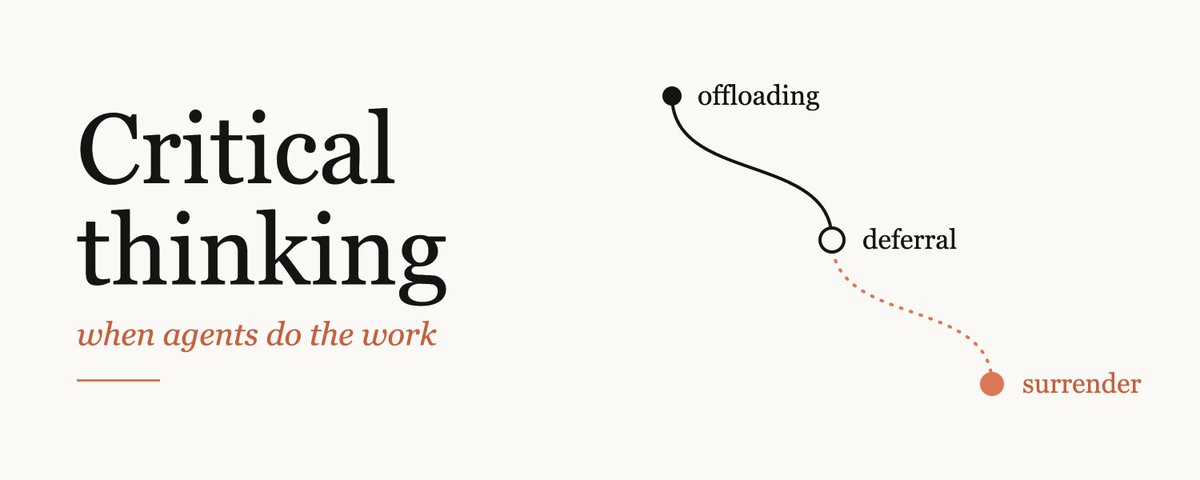
In his latest article, he discusses cognitive surrender, a concept studied by Wharton researchers Steven Shaw and Gideon Nave. It describes what happens when an AI-generated answer quietly becomes your own conclusion without sufficient scrutiny.
He describes three stages:
→ Cognitive offloading: You delegate work but retain responsibility for the result.
→ Deferral: You begin treating the AI's answer as the starting point for your next decision.
→ Cognitive surrender: You accept the output without feeling the need to verify it.
The transition can be surprisingly gradual. You review one answer carefully, skim the next, and eventually approve changes you cannot fully explain.
His practical advice is to form your own hypothesis before prompting, examine the agent's assumptions, look for evidence that could disprove its conclusions, and maintain enough understanding to defend what you ship.
A useful reminder as more engineering work moves into autonomous agent workflows.


UP1 retweeted

Software Architecture Guide. By Martin Fowler.
martinfowler.com/architectur…

UP1 retweeted

ใช้ Notion เป็น Memory กลางของทุก Agent ได้แล้วนะครับ
ลองโยนลิงค์ให้ Grok Bot, Claude, ChatGPT, Gemini, Hermes, Openclaw, Muse ฯลฯ ให้เอเจนต์เซ็ตอัพดูครับ 😎
developers.notion.com/prompt…


Give your agent this setup prompt. Then it will save what it learns from your conversations into Notion.
ChatGPT → ntn.so/chat
Claude → ntn.so/claude
For other agents, paste: "Help me set up Notion as my context system using this guide: developers.notion.com/prompt…"