






Pinned Tweet
My 2023 snapshot:
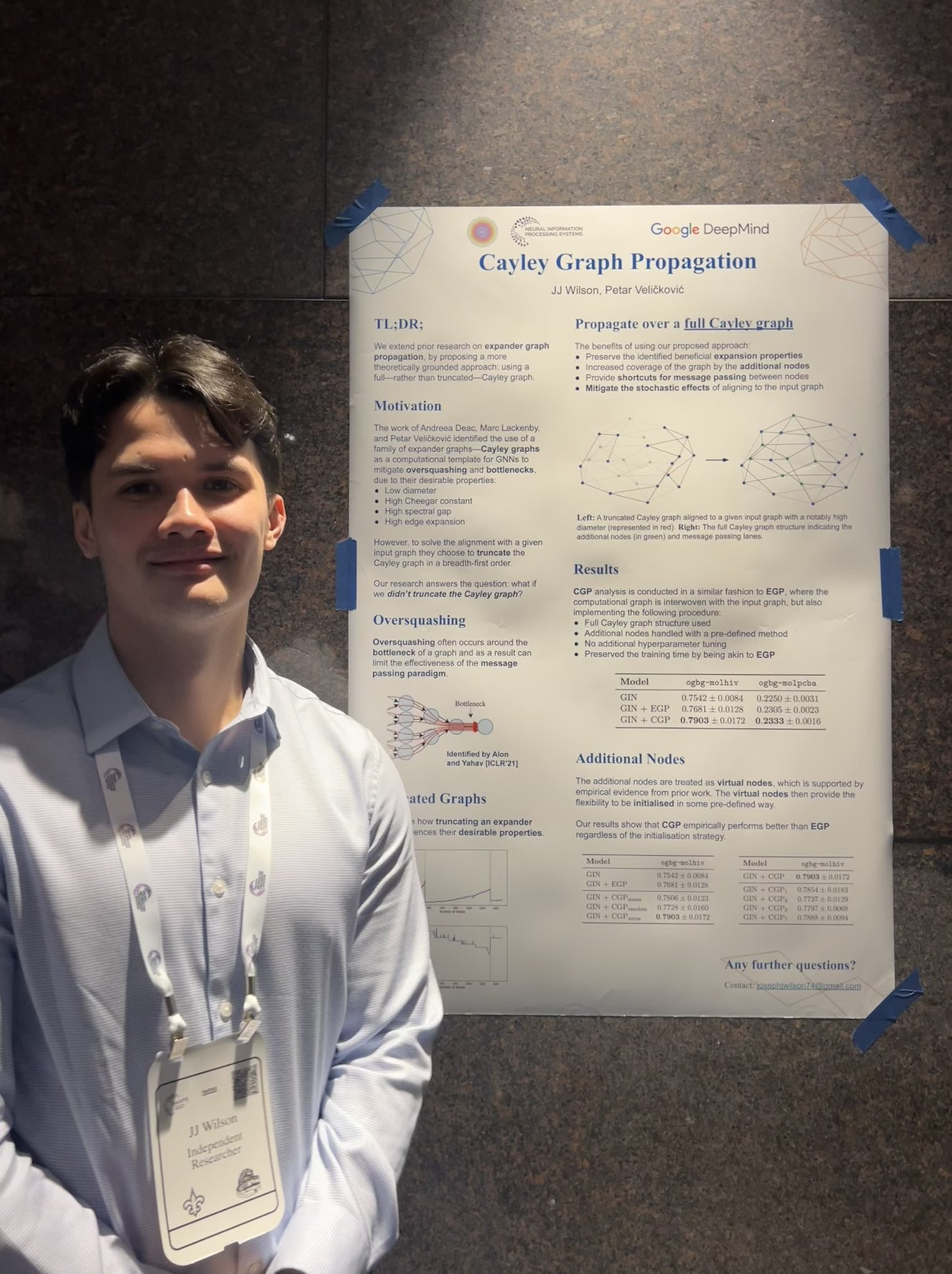
* I went from zero AI experience to writing my first research paper thanks to @PetarV_93 📝, presenting it @neur_reps (📸 @heyu0208).
* I’ve visited some wonderful places 🇺🇸 #NeurIPS2023 & 🇭🇷.
I also wanted to shoutout @gordic_aleksa and his community members! – at New Orleans, LA
JJ Wilson retweeted

the full geometric deep learning book draft is now complete.
all chapters available online on our website (link in thread).
🫡
@mmbronstein @TacoCohen


JJ Wilson retweeted

Our Cayley-Encoder for improving LLMs' final representations was accepted to NeurIPS 2026, together with 3 new workshop papers! 🎉
🎥 Main track: Improving LLM Final Representations with Inter-Layer Geometry.
Most LLM-based predictors use only the final layer, but the intermediate layers carry useful, complementary signal. We introduce the Cayley-Encoder, a lightweight GNN that treats the LLM's layers as nodes in a Cayley graph over SL(2, ℤₙ), vand produces improved final representation for the LLM.
Across 13 tasks and 9 LLMs, the Cayley-Encoder:
📈 improves accuracy by up to 40 points over the last layer, adding at most 0.1% extra parameters,
🔬 lets a 14M-parameter LLM beat the last layer of a 200× larger one,
🎯 beats full-data baselines with just 8 labeled examples per class,
⚡ outperforms LoRA fine-tuning in 32 of 39 settings, with 6–12× fewer trainable parameters.
📄 Topology-Injected Masked Fine-Tuning for Graph-Conditioned Language Models, NeurIPS Workshop on Symmetry and Geometry in Neural Representations.
TIM-FT is a new method for aligning GFM embeddings into LLM sequences. It places graph embeddings directly at the token positions where an entity is mentioned, keeps the sequence length the same, needs no vocabulary expansion, and improves performance when only 15% of entities have a graph embedding. (Available soon 👀 )
📄 Graph-Conditioned Language Models for Security Systems, NeurIPS Workshop on ML Systems.
SecBFF brings TIM-FT to security monitoring, where graph builds always lag behind the live event stream. It adds a single 530K-parameter projector and leaves the serving path unchanged. (Available soon 👀 )
📄 Predicting Cable Dynamics with Physical Attention Bias, NeurIPS Workshop on Symmetry and Geometry in Neural Representations.
A cable has two distances between any two points: along its length and through space. Adding both as attention biases cuts prediction error by 15% and more than halves length drift on cables the model has never seen.
Congrats and thanks to all my collaborators!
#NeurIPS2026


JJ Wilson retweeted
i think we can't get more eastern european than the venue of eeml'26 🫡
hellooooo Cetinje 🇲🇪 - our home for the week!


JJ Wilson retweeted

HE’S DONE IT!!! 🤩
LEWIS HAMILTON WINS THE BARCELONA-CATALUNYA GRAND PRIX!!! 🏆🎉
#F1 #BarcelonaGP

JJ Wilson retweeted
we really have reached peak mech interp when I am going to give a seminar at my old uni and there's a seminar in the same building the hour before that would have plausibly shared ~1/4 of the content

JJ Wilson retweeted

Announcing new ARENA material: 8 new exercise sets on alignment science, interpretability & AI safety - each containing 1-2 days of structured, hands-on content replicating key papers in the field.
All open source on a public GitHub, and available for study. Here's what's in it:

JJ Wilson retweeted
started teaching geometric deep learning at cambridge for the fifth year running!
no pics were taken this time, but kind messages from our students are even better 😊

JJ Wilson retweeted
Another year of 'Machine Learning with Graphs' at the School of Computer Science and AI at @TelAvivUni has come to an end, and here’s a short summary video of me explaining Graph Neural Networks with my hands 👐
This year I had around 80 students from across Computer Science, Math, and Electrical Engineering who came to explore the magic of Graph Learning.
We wrapped up with nearly 30 final research projects, and it was truly inspiring to see students come up with novel, creative ideas, combining graph methods in diverse domains and leveraging their own unique expertise.
It’s always fascinating to see how graph modeling can enhance performance or solve challenges in almost every field. While some ideas didn’t fully work out (as research often goes!), many did, and I genuinely hope to see some of them published soon. Well done to all the students!!!
Once again, I have to say that TAU students are simply brilliant, curious, and incredibly hard-working.
Next year, I’ll continue lecturing as a Teaching Fellow at CS@TAU and I’m already excited about the many updates I plan for the course (Graph Foundation Models are coming 👀).


JJ Wilson retweeted
affiliated lectureship @Cambridge_Uni extended for a fifth consecutive year!!
perhaps @pl219_Cambridge and i can do sth special for this year's geometric dl course... 🧑🏫

Did okay at Undergrad; then SWE in industry for 4 years. Did some soul searching and decided I wanted to do something _impactful_!
Fell in love with education again, and start self-learning AI/ML.
Cold-emailed @PetarV_93, and he kick started my research journey. ❤️
(1/3)


1
2
381
I ended up doing a NeurIPS 2023 workshop paper w/ @PetarV_93 in a month!
Then, whilst balancing my full-time job, over the past 2 years, I published 2 research papers with these amazing people: @PetarV_93, @mayabechlerspei, @DobrikG @DBuffelli @pl219_Cambridge. 📝
(2/3)
1
2
409
JJ Wilson retweeted

Exciting, mechanistic interpretability has a dedicated lecture in the syllabus of a Cambridge CS masters course! The field has come so far in the past few years ❤️

JJ Wilson retweeted

Check out this blogpost from @ffabffrasca and the GLOW reading group on the future of graph learning!
I’ve also contributed and my main take is - its actually working and its an exciting moment to work on applications!

JJ Wilson retweeted
> - im working up the courage to say hi to yann lecun
just do it! i sent a cold email to yoshua bengio and it was literally career-changing.
whether you're just starting out or a turing award winner, we're all people :)
Lots of great resources on getting started in AI, but not as many on how to turn projects into papers!
I wish I had this blogpost when I wrote my first workshop paper—hoping this helps others getting started. I know this will help me with my future papers! 📝

After supervising 20+ papers, I have highly opinionated views on writing great ML papers. When I entered the field I found this all frustratingly opaque
So I wrote a guide on turning research into high-quality papers with scientific integrity! Hopefully still useful for NeurIPS

4
254
JJ Wilson retweeted
Nice work on this position paper everyone! Sorry I couldn't contribute!
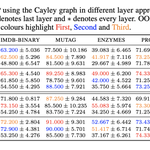
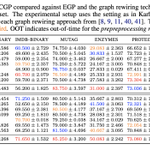
And great to see EGP/CGP results here @andreeadeac22 @sonjj74 @mayabechlerspei 🕸️ I've been bullish on these graphs for a very long time, precisely because of how absurdly good they are at "just letting the data flow".
Though I would say that these results do not support what @michael_galkin wrote (i.e. "often it should not be"). Indeed, the Deep Set baseline is never matching the top graph model performance, which would have been indicative that graphs (as such) are overkill.
What it does say though (IMHO) is that, for most graph datasets we typically use nowadays, the given graph isn't the best structure to use, and we really should re-think when these graphs are to be trusted.....
( Maybe future graph foundation models could use general-purpose expander graphs to some extent? 🚀 )

