

Researcher, Open Source & Open Weights | Funding Coordination @ethereumfndn
Noord-Holland, the Netherlands
Joined April 2020
- Tweets1.5K
- Following950
- Followers1.2K
- Likes25.5K






Pinned Tweet
1/ gm! big news to share - i'm joining the @ethereumfndn funding coordination team ✨
🧵👇
Sofia | sonki.gwei | 🇪🇺 eu/acc retweeted

The Tech Job Market in the AI Era at @EFDevcon 🇮🇳
Get insights from great panelists on how candidates can stay competitive in an evolving tech market!
> @nainasachdev11 - Dev3pack India
> @kashvi - Boundless
> @sonkiski - EF
> @zeeshan_utd - Eigen Labs
See you on 6 Nov 👇


Sofia | sonki.gwei | 🇪🇺 eu/acc retweeted

Why are these new privacy primitives essential? Going forward, AI inference will only play a more and more integral part of daily life. Once that regular dependence on a technology sets in, access becomes essential. A free society cannot persist when intermediaries retain the threats of censorship and surveillance. It is naive to assume their prolonged benevolence.
But even with responsible gatekeepers, AI hacks have already shown non-privacy to be untenable. It's not about trusting model providers not to read or sell identity-linked data, but the indefinite lingering question "How safe is that data?" Improving the security of those systems is not enough. We would rather exit the AI-cybersecurity arms race than trust a frontier paced on our behalf. This is the end goal of all efforts in private communications—don't create in the first place a digital footprint that can be held against you. This is why privacy must be a default primitive. And that is why the EF will continue collaborations like this one with @OpenAnonProject to further our mandate.
Thanks @l2beat for the shout

Would you like privacy with frontier AI models? Yes? Well, right now it’s impossible, because we don’t know how.
But we can try to get closer, which is what @ethereumfndn and @OpenAnonProject have been trying to do by co-developing zkAPI!
zkAPI is now listed on our Privacy page. It is a service that offers short-lived OpenRouter keys for ETH through an intermediary called Open Anonymity. You deposit into a shared pool, but your API key request to them contains only a proof that you have deposited, unlinking your specific deposit from the key.
nitter.cf/ethereumfndn/status/21…

Sofia | sonki.gwei | 🇪🇺 eu/acc retweeted

CHAT CONTROL 2.0 BLOCKED AGAIN, THANKS TO YOU!
What happened yesterday: the @Europarl_EN blocked the deal pushed by the @EUCouncil.
The Council wanted:
(1) "voluntary" scanning of all private chats under "search plans" approved automatically unless an authority vetoes;
(2) administrative authorities, not courts, ordering providers to scan private messages, not limited to suspects, using AI with massive false positive rates;
(3) making the failed Chat Control 1.0 mass scanning regime permanent, while admitting it is not effective, as we discussed in my previous posts.
Your voice to parliamentarians made a huge difference again: the Parliament refused scanning of private communications, stating it must remain limited to persons linked to child sexual abuse, not everyone by default or under a blanket licence, as Council proposed.
The Parliament also closed the back door where "risk mitigation" rules could force providers into scanning under threat of fines.
What did pass: a preliminary agreement on scanning publicly accessible content for known child abuse material. This was proposed by the Parliament as the effective, targeted alternative.
We still wait for the text to see what this means and will inform you in the coming weeks.
This defense proves again: our voice matters when it is vocal, with your support!
And we will need it again in November, so please follow the updates.
Now, it is important to call or write to your MEP and your government to say thank you to those who stand on the side of privacy.
They need to see you are watching their move. Please repost.

Sofia | sonki.gwei | 🇪🇺 eu/acc retweeted

Last week in Sofia, our Senior Policy Lead @VyaraSavova took part in two conversations during @BWBulgaria, that approached the ecosystem from different directions. The first was about the principles the network is built on, and the second about the rules crypto firms in Europe are now licensed under.
At @ETHSofiaBG, Vyara moderated a panel on the Ethereum Foundation's mandate. Published in March, it names four principles the Foundation will not trade away: censorship resistance, open source, privacy and security, or CROPS. With @sonkiski (@ethereumfndn), @sajidazouarhi (@get_optimum), and @0xmikemcc (@0xbowio), the discussion asked what building under these principles looks like once users, investors and regulators are in the picture. The panellists considered what it means for the Foundation to step back as Ethereum grows, and where censorship actually happens today, across builders, relays, RPCs and front ends. They also discussed how privacy and compliance can work together in practice.
At the Future Finance Forum (F3), Vyara joined a panel on MiCA in Bulgaria, moderated by Damyan Leshev (@ESgloballaw), alongside Ivan Takev (@AlaricSec) and Dimitar Stoyanov (Financial Supervision Commission). Bulgaria issued its first MiCA licence in early 2026, and the transitional period ended on 1 July. The panel brought together the views of a licensed firm, the national supervisor and policy on what licensing has actually required, from incomplete applications to the treatment of e-money tokens and outsourcing. It also looked at whether tokenised stocks sold to retail investors are crypto-assets or financial instruments.
Thanks to the teams behind both events for opening their stages to these questions, to our fellow panellists for the perspectives they brought.


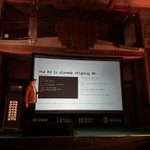
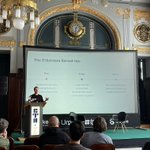
last but not least: I also had the chance to be on a panel at @ETHSofiaBG: "Building Under CROPS: What the Ethereum Foundation's Mandate Means for Developers and Institutions," moderated by @VyaraSavova (European Ethereum Institute), alongside @sajidazouarhi (Optimum) and @0xmikemcc (Privacy Pools).
what I talked about
– our team's mission: to understand and create funding mechanisms for the Ethereum ecosystem. I focus on positioning Ethereum as critical infrastructure in the broader open source ecosystem so that we can attract funding from outside crypto: from governments, organisations that support open source, and other funding and grant opportunities
– subtraction as success: the Mandate's goal is for Ethereum to work even if the EF disappeared. from our team's perspective, subtraction succeeds when funding flows into Ethereum public goods from multiple sources, not only or primarily from the Foundation. one entity sitting at the center, even one without revenue, crowds others out. if people know the EF will handle something, they don't step up
– open-weights AI: open weights sit in a grey zone. the models are free to use but you don't know what data trained it. the harder question is verification - how do you know an inference provider is actually running the model it claims to run? I'm exploring how Ethereum can become a trustless coordination layer for open frontier AI, combining payment rails, identity, and the ability for distributed actors to verify claims about one another without a central controlling body
– EU Cyber Resilience Act: compliance is becoming a real challenge for open source. the CRA introduces security and reporting obligations that touch open source projects directly, and the tension is how do you comply without introducing centralised gatekeepers? in this workstream, I'm exploring how Ethereum as an attestation layer can allow open source projects to make verifiable claims about their compliance without relying on a single authority
the rest of the panel
– Sajida spoke about whether CROPS values can travel beyond the Ethereum ecosystem to the broader blockchain space, and where censorship is actually happening today across the stack: builders, relays, RPCs, front ends
– Mike spoke about compliant privacy in practice, and why privacy and censorship resistance matter at the application layer, not as abstract principles but as concrete infrastructure choices
full recording will be available soon
for me personally, I'm glad I could give a sneak peek into the workstreams I'm working on. Ethereum should definitely serve a purpose beyond crypto: for example, becoming infrastructure for trust and verification in the broader open source ecosystem.

Panel: MiCA in Bulgaria: Lessons from the First Licensed CASPs at @BWBulgaria F3 Future Finance Forum
Damyan Leshev (Eversheds Sutherland, moderator)
Ivan Takev (Alaric Securities)
Vyara Savova (European Ethereum Institute)
Dimitar Stoyanov (Financial Supervision Commission)
context
– MiCA came into force 1 July, and Bulgaria now has five licensed CASPs - per capita comparable to Germany, ahead of France and Italy
– the rulebook is already being rewritten. the European Commission's MiCA review consultation closes 30 September
what it actually took to get the first license
– Alaric Securities (first MiCA CASP license in Bulgaria) already had a trading business dating back to 2011. crypto had to be incorporated into existing systems as a new asset class with no friction against traditional instruments
– technically: integrations with executing venues, clearing brokers, custodians. on the licensing side: adapting existing rules so crypto fits, aligning operational resilience, IT security, business continuity
– the challenge was meeting all requirements within very strict MiCA timeframes while the regulator was also navigating new ground
why applications fail: the regulator's perspective
– Stoyanov (FSC): the main problem is a "lack of the necessary mentality": applicants not understanding they now operate in a regulated environment
– two directions of failure: flawed internal policies and procedures (many legacy VASPs produced something, but it wasn't serious), and staffing - key function holders (compliance officers / AML officers) who don't meet the requirements
– "we want to see well-developed procedures, not something generated by AI with a bad prompt. we've seen such cases"
– policies can be fixed during the authorisation process. staff can't - replacing a key function holder restarts the assessment
what MiCA review has to fix
– Savova (EEI): the white paper notification period is currently 20 days, roughly a month total delay before an asset can be listed. other jurisdictions have no such delay. Europe is losing users and competitiveness. the evaluation could happen while the asset is already listed
tokenised securities
– Takev: substance should take precedence over form. if something is a tokenised security, it should be treated as a security with full shareholder rights. currently it's not, you can't vote with your token at a general meeting
– Nasdaq plans to launch tokenised trading in Q2 2027, with full shareholder rights and DTCC clearing. "that will be the real revolution in tokenisation"
– Savova: the EU needs a common definition of what a digital DLT-based financial instrument actually is, rather than leaving it to member states. decades of discussion about the lack of a common "financial instrument" definition, and adding DLT on top only adds complexity
the DLT pilot regime
– Savova: the DLT pilot regime should become permanent. current caps should be removed or increased, and many more assets should be included in scope
– Takev: there's no turning back; several authorised market infrastructures already operate under the pilot across Europe. the question is how to make it attractive
e-money tokens and dual authorisation
– a CASP wanting to provide transfer and custody for e-money tokens currently also needs payment services authorisation from the national bank. dual authorisation that the EBA itself said wasn't intended
– Stoyanov: "there is nothing Bulgaria can do before there is a broader European approach"
– Takev: one of the grey areas and big drawbacks of MiCA, hopefully fixed in one to two years
ESMA direct supervision: tiered model
– the Commission proposed ESMA supervise all CASPs directly. the discussion is converging on ESMA supervising only significant CASPs, with smaller ones remaining at member-state level
– Savova: this is an opportunity: smaller CASPs don't have the same risk or resources, and a tiered model could give them a more streamlined regime
– Stoyanov: observed the Binance authorisation process first-hand on ESMA's Digital Finance Standing Committee. "without getting into details, it was a very tedious and torturous process". for global CASPs there's sound logic for pan-European authorisation. for local players, national-level is more efficient. the challenge: where to draw the line
is Bulgaria crypto-friendly?
– Stoyanov: "friendly and unfriendly are a bit emotional". five authorisations, per capita comparable to Germany, one of ten EEA jurisdictions with a Class 3 CASP. "we are friendly toward good business"
– Savova: "I want to scream it from the rooftops: I'm extremely impressed by what our supervisory authority is doing, including speaking in public and answering questions. that is not the rule in Europe"

panel on Building Post-Quantum Trust for Interconnected AI at @ETHSofiaBG
Georgi Kirov (Crisp Labs, moderator)
Kiril Kalchev (BRAIN++ AI Factory)
Petar Nikolov (Equisect, PhD in Quantum Algorithms)
Prof. Angel Marchev (UNWE / Sofia University)
biggest misconception about post-quantum trust
– Nikolov: post-quantum cryptography is one of the hardest problems we're solving right now, even though we don't know if it's an imaginary problem or a real one. we're solving something for the next 10-20 years
– Kalchev: the biggest misconception is that when you choose the best post-quantum algorithm and implement it, you're done. it's a journey. exploits will be found. your system needs to be able to adapt
– Marchev: first, if things go sour, they change fast, but adoption of countermeasures takes a long time. that's a contradiction we have to deal with. second, we're not yet in a post-quantum world but we're already in an AI world. the superintelligence misconception (that it's coming and breaks everything) is exactly that type of a misconception
quantum computing vs. post-quantum cryptography
– Nikolov: quantum computing has nothing in common right now with post-quantum cryptography. PQC is about classical computers developing new encryption algorithms (hash-based, lattice-based) it's all classical
– there are 4–5 algorithms proposed as post-quantum resistant, but nobody has tested them on actual quantum hardware. the underlying hard problems (shortest vector, closest vector) can't be tested on classical machines
– the biggest immediate threat is harvest now, decrypt later. organisations are harvesting encrypted data today, planning to decrypt it once quantum hardware becomes affordable
– the algorithms we're developing now may have nothing in common with what we'll need in 10–15 years. Shor published his factoring algorithm in 1994 but nobody ran it on real quantum hardware until about 10 years ago. someone will develop something far better than Shor's algorithm, we should expect the unexpected
the arms race
– Marchev: imagine the future of cryptography as an arms race. people advancing on one side with current technology, people advancing on the hacking side. this goes on forever, new technology doesn't end it, just shifts the terrain
– on education: globally there are very few established quantum/PQC programmes. the US leads on education, Europe on academic research, China is always present. the market isn't treating post-quantum as seriously as other current topics, but research is flourishing, mainly in lattice cryptography
– physics is contributing in unexpected ways: researchers working on side-channel attacks through power consumption and temperature changes, and on methods to spoof those signals
– AI will shorten production times dramatically. the half-life of implementation is going to get shorter and shorter
what to do today: Kalchev's three steps
– first: catalogue your data, understand your security posture, decide what needs to be secured
– second: categorise. start with data that's important for long periods: we're in the harvest-now-decrypt-later era
– third: start implementing hybrid algorithms where they exist. and don't pick just one post-quantum algorithm and stop: it won't be your last choice. rotate algorithms, make policies, everything else follows
AI goes quantum first
– Nikolov: AI will go quantum before cryptography does. LLMs are probabilistic, quantum computing is probabilistic; there's a natural synergy. research already shows quantum computing could speed up AI development by orders of magnitude, not percentages
– after post-quantum cryptography, the next step may be quantum cryptography itself, using quantum properties for encryption, not just for breaking classical encryption
the business case
– Marchev: don't treat post-quantum as a prediction problem. it's an adaptability problem. NIST already recommends starting migration now
– the key shift: from trusting objects to trusting processes. this was reflected in Kalchev's earlier presentation: it's the central point from a business perspective
– it has to be a systematic process, not a patch job. every moving part reflects changes in every other part. and since it's an adaptability problem: the quicker you move, the better the competitive advantage
timing
the day before this panel, the EU's three financial supervisors (EBA, EIOPA, ESMA) published their autumn 2026 risk assessment (esma.europa.eu/press-news/es…). they warn that quantum computing could undermine cryptography securing communications, transactions, databases, and blockchains, and that the threat could materialise before quantum computers are commercially useful for anything else. encrypted data stolen today can be decrypted later. the NIS Cooperation Group has recommended member states adopt a post-quantum migration strategy by the end of 2026, three months from now.

at @ETHSofiaBG, Kiril Kalchev from BRAIN++ AI Factory gave a keynote on Polymorphic Crypto Chains, a design model for chain client developers:
the problem
– every blockchain is built on cryptography that will eventually need replacing. quantum computing is one reason, but not the only one: algorithms get broken, standards evolve, new attacks surface
– today, changing the cryptographic primitives in a chain usually means a hard fork and a coordinated network-wide cutover. that doesn't scale, especially when you're federating data across organisations
the idea
– what if every block just declared which hash and signature scheme protects it? then swapping a primitive becomes a registry operation - no fork, no re-signing history, no forcing every client to upgrade simultaneously
– the actual change is minimal: one new field in the block (cryptographic metadata) and one substitution in the link function. everything else follows from there
why it matters
– hybrid post-quantum signatures (e.g. secp256k1 + ML-DSA) work as just another table entry, no client code change needed
– retiring a compromised algorithm is recorded in the chain itself, auditable and enforceable by policy
– per-account key migration works cleanly on top of this; each account registers a suite alongside its public key, so migration becomes per-account rather than network-wide (photos show this as an EIP-8141-style verifier frame in a few lines of Python)
– the test suite (see photos attached) is basically a specification written as executable failure modes: 20 tests covering suite coverage, tamper detection, Ethereum-native suites, verifier frames, anchoring, and ledger semantics
what exists: reference implementations in Python, C++17, and Rust, with 61 tests. GPL-3.0. EU-funded through BRAIN++ / EuroHPC Joint Undertaking


Sofia | sonki.gwei | 🇪🇺 eu/acc retweeted

Onchain security is everyone’s problem and nobody’s job.
ETHSecurity Initiatives is how we are changing that.
Propose the work. Fund the work. Build the work.
initiatives.thedao.fund/

Sofia | sonki.gwei | 🇪🇺 eu/acc retweeted
The @ethereumfndn is sponsoring the first Workshop on Privacy-Preserving Technologies, affiliated with Asiacrypt 2026 in Hong Kong this December.
The programme covers zero-knowledge proofs, multi-party computation, fully homomorphic encryption, private information retrieval, anonymous credentials and blockchain privacy, alongside attacks and real-world deployments.
If you work in this area, or know someone whose research belongs here: privacypreserving.tech
The call for presentations is open until 25 September.

Sofia | sonki.gwei | 🇪🇺 eu/acc retweeted

What does the @ethereumfndn's new mandate mean for the people building on Ethereum?
At ETHSofia 2026, we’re bringing together four perspectives for a conversation on where Ethereum is heading and what its priorities mean for developers and institutions.
Moderated by @VyaraSavova, Senior Policy Lead at the European Ethereum Institute.
Joining her:
@0xmikemcc, Product Lead, @0xbowio
@sonkiski OSPO Researcher, Ethereum Foundation
@sajidazouarhi , Chief Product Officer, @get_optimum
A conversation about the direction of Ethereum, the evolving role of the Ethereum Foundation, and what it means for the ecosystem building on top of it.
24 September | Sofia Tech Park. See you at ETHSofia 2026.

privacy is normal y’all

We're thrilled to announce @RogerDingledine, co-founder of @torproject, will be joining us for Devcon 8!
He’ll take the stage to dig into network privacy, metadata, censorship resistance, Tor as critical infra & what it takes to keep the internet open, private & permissionless.

Sofia | sonki.gwei | 🇪🇺 eu/acc retweeted
In March 2026, the @ethereumfndn published its CROPS mandate, hardcoding censorship resistance, open source, privacy, and security as the non-negotiable principles guiding its work going forward. What does that actually mean for the people building on Ethereum, and for the institutions putting it to work?
At @ETHSofiaBG, during Blockchain Week Bulgaria (@BWBulgaria), EEI Senior Policy Lead @VyaraSavova moderates the panel "Building Under CROPS: What the Ethereum Foundation's Mandate Means for Developers and Institutions."
The conversation brings together on stage Mike McCabe (@0xmikemcc - Head of Product @0xbowio), Sofia Sukhinina (@sonkiski - Funding Coordination, OSPO Researcher @ethereumfndn), Sajida Zouarhi (@sajidazouarhi - Chief Product Officer @get_optimum) on what CROPS looks like in practice: sustaining open source development, and reconciling privacy-preserving infrastructure with institutional compliance and censorship resistance, two demands that don't always pull in the same direction.
🎟 ethsofia.com/
The @EuEthInstitute is proud to be part of @BWBulgaria, where Vyara also serves as Strategic Advisor, helping connect the ecosystem's builders with the institutions putting the technology to work.

babe wake up, first speakers are getting announced at @EFDevcon
We are thrilled to announce our first Devcon 8 speaker: @audreyt! 🎤
After an unforgettable conversation in Bangkok, Audrey Tang is joining us again in Mumbai to explore Civic.AI, collective decision-making and how technology can help communities protect their rights & govern themselves.
Welcome back to Devcon, Audrey 🇮🇳

Sofia | sonki.gwei | 🇪🇺 eu/acc retweeted

This could be you on the Devcon stage in Mumbai👀
The ideas shared at Devcon can shape what Ethereum builds next. Bring your work, your questions and ideas to the global Ethereum community.
Only a few days left to apply - apps close Aug 6!
devcon.org/en/speaker-applic…


Sofia | sonki.gwei | 🇪🇺 eu/acc retweeted

Today we’re announcing our second open call for @RenPhilanthropy's Frontier Research Contractors Launchpad.
Last year, we launched this programme with @ARIA_research to bring together elite researchers and engineers to accelerate breakthroughs and translation in ARIA’s opportunity spaces.
renaissancephilanthropy.org/…
1/5
