





A little puzzle game I made that is also a choose your own adventure short novel about informed consent, with all the math checked.
Play it at scortescu.com/second-tuesday…
2
1
99
Every patch comes after the flaw ships. But a check can come first, if it stands on ground truth that is the same on every run.
Pisan is that ground truth: one fixed table that names bytes, so the same bytes always read as the same words. (1/4)
1
105
3/ If you use AI coding agents, spec_lint reads the instruction files you give them and flags rules that contradict each other.
actiongate flags places where input can end up run as a shell command, the classic command-injection hole.
One Python file each. scortescu.com/toolbox
1
19
4/ These tools are based on a dyctionatyPisan is a dictionary. 77 of the 256 byte values get a name. 12 are primes, named by the Fibonacci step where they first show up, and the rest are moves like fold, close, open and gcd. Give it any bytes and it reads them as words. scortescu.com/pisan
14
(8/8) Both are sentences, with words from a dictionary, 20 and 10 words respectively, and both point open on the same very specific piece of math.


15
(7/8) Trivial? The two letters share nothing because they're prime, ok. But also because their addresses on the Fibonacci timeline are coprime. And the primes really divide F(52) and F(97).
13
(6/8) The roles are reversible. Call the hex a leak. Call the decimal a key. Fine. But the hex also opens the dictionary. The decimal also exposes a sentence. Both are leaks. Both are keys. Which means the naming is also a choice. The choice under the choice. That's the cheek under the cheek. Ugh.
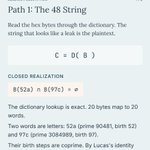
Both crystallize. Follow either one far enough and you land at the same math. The 48 string opens to 52a and 97c. The decimal opens to 52a and 97c. Same pair.
Their birth steps are 52 and 97. Compute gcd(52, 97), you get 1.
15
(5/8) A shuffle. Shuffle it. Find one arrangement of interpretations that closes:
coarsen · grain · scale change · close · lifted pair · weld · 52a · 97c · scale change · clause x∨y∨z
Not plaintext. A ciphertext. The decimal hid. The string that looks plain is the cipher. The decimal was the key.
26

(3/8) Read it through a dictionary of 77 named bytes and it says:
returns · 81c · rescaling · division · 38a · 55a · 97c · 46b · non-invertible map · 101b · 61a · gcd · 63a · inversion · 48a · 86b · 26a · the Fool · 52a · the turn
Not ciphertext. A sentence. About math. In order. No gaps. The string that looks encrypted is the plaintext. The hex leaked.
26
(2/8) Hex. Lowercase. Spaced. This is what ciphertext looks like. If you found it on a napkin you'd assume someone was hiding something.

97
Sharing some tools I built in the past few months.
They helped me decrypt 48CE 563F 89A0 ED94 14F5 AA28 AD0D 96D6 795F 9C62, but their easiest application is as batteries for a decision model.
I did that because recent concerning and often confusing news from frontier labs started made it clear such tools are available internally at those labs.
In order: a playground applied on 48ce, a (buggy) learning journey, a set of scripts and data needed to check/use all the tools (ideally under a decision model not an llm)
Available here tc55.netlify.app/


1
106
The blank ASCII characters were bugging me so i thought I’d finish the job.
For anyone who wants to check:
48ce563f89a0ed9414f5aa28ad0d…


113
Saw this this morning 48ce563f89a0ed9414f5aa28ad0d96d6795f9c62
so I thought I’d give it a try.
Hearing about a certain unix timestamp result was surprisingly specific, seemingly harmless, ignoring (?) the obvious, yet too timely. Thought that if someone has it (eg llms and fridges), everyone should.
tldr:
48ce563f89a0ed9414f5aa28ad0d96d6795f9c62
~
Read the letters by their birth steps; compare their returns through division and greatest common divisors; then invert the question to identify the transformation that connects them.
1/8 — mapping the string to a custom Jev dictionary (stef 😅)

3/8 — Positions 11–20, including gcd, inversion, the Fool and the turn. ASCII and Jev are separate reference sets; 0x0D is carriage return.

2
44
@grok Fill in the ascii gaps. Eg ce is adobe. Maybe add other interesting columns. Do positions 1-10 first
1
22
tldr

Saw this this morning 48ce563f89a0ed9414f5aa28ad0d96d6795f9c62
so I thought I’d give it a try.
Hearing about a certain unix timestamp result was surprisingly specific, seemingly harmless, ignoring (?) the obvious, yet too timely. Thought that if someone has it (eg llms and fridges), everyone should.
tldr:
48ce563f89a0ed9414f5aa28ad0d96d6795f9c62
~
Read the letters by their birth steps; compare their returns through division and greatest common divisors; then invert the question to identify the transformation that connects them.
1/8 — mapping the string to a custom Jev dictionary (stef 😅)

