

168 paying customers. 25,000+ AI-booked appointments. 3,500,000+ AI sales calls. AI Closer is in build. Founder, Objection Proof AI. Text AI CALLER to 33777.
Phoenix, AZ
Joined December 2008
- Tweets2.6K
- Following907
- Followers2.6K
- Likes109K


Pinned Tweet
Paste this into any AI and practice the stall you hear at the end of an appointment:
"You're a prospect I just quoted. At the end, say you need to think about it. Only give the real reason if I set the rules up front, ask what exactly you need to think about, and find out if it's the price, the process or me. If I accept 'let me think about it,' end the call."
I've said it for years: "When you hear, I need to think about it, all that means is they're not sold."
Run it 5 times before your next appointment.
50
The hard part of going independent is the line "buy leads, start taking sales calls."
After 3,500,000+ AI sales calls, here's what turns paid leads into estimates:
1. Call every lead inside 5 minutes.
2. Ask what made them reach out today.
3. Book the estimate before you hang up.

Just got off the phone with a guy who’s been looking at home service franchises for the last 6 months.
20+ year sales career, has capital, wants to build a real business, and has been getting pitched nonstop by franchise brokers.
Here’s what I told him:
I’m still insanely bullish on home services and entrepreneurship. I’ll just never go the franchise route again.
There’s a paradox in buying a franchise that’s only obvious after having bought one yourself:
In theory it’s a reduction of risk. You’ve never started a business before and you think you’re paying for playbooks, a sales process, brand recognition, a faster start, or whatever other shortcut excites you.
In reality, you’re introducing the maximum amount of risk.
You take out a 6-figure SBA loan to buy a business that doesn't exist yet. You lock yourself into a 10-year agreement with ongoing royalties, restrictive covenants, and liquidated damages.
If you hate it, or if the brand is a disaster, you can’t just walk away. You have to spend hundreds of thousands of dollars in liquidated damages and/or legal fees just to get out.
So if you’re sitting on capital and want to get into home services, there is a much better option:
1. Start from scratch independently
It sounds intimidating, but it’s not nearly as expensive as people think. You can launch a home service brand for $10,000 (or much less).
Will you take your bumps? Yes of course.
Will they be the exact same bumps you’d take inside a franchise? Also yes. But at a fraction of the cost. Without any restrictive legal agreements. And if you decide 6 months in that you hate it, you can shut it down and move on with your life.
2. Pay real operators for advice (the "anti-franchise" route)
If you want to accelerate your learning curve, don’t pay a franchisor whose corporate team has never actually run a business.
Instead:
Pay a successful operator in another market $5K to shadow them for a week.
Attend a 3-day workshop put on by someone actually doing $5M+ in the space.
Join a high-level best practice group.
Look at "anti-franchise" models where you pay a flat fee for SOPs and playbooks, with zero royalties and zero 10-year legal handcuffs.
Even if you drop $20,000-$50,000 on real-world education, it’s a drop in the bucket compared to franchise fees and ongoing royalties. And you keep 100% ownership of your brand.
The truth about starting today:
With the internet, AI, countless operators who will exchange money for advice, and insane grit and hustle, you don't need a franchisor to hold your hand.
Pick a category. Spin up a Google Business Profile. Call your local suppliers and manufacturer reps. Develop a sales process.
Buy a couple thousand dollars in leads, start taking sales calls, and find good subs (or even bad ones, just fire them quickly).
Most of what you need to learn will come during the act of running the business anyway. Not from any franchisor.
28
4 messages for a lead who went quiet after "I need to think about it."
1. Say you know they're busy and other people are ready to move forward. You'd rather work with them, but you can't without knowing where they stand.
2. Take the blame. "I must have done something to offend you." Most prospects will reply just to tell you that you didn't.
3. Pull away. "I don't know if we can help you." Going negative first takes the pressure off them.
4. "Should I close the file?" They tend to say "no, please don't."
Every quiet lead is one you already paid for. Send these in order and leave "call me back" out of all four.
43
60 DMs a day booking 30 calls is the easy half. The calls only pay when people show up.
After 25,000+ AI-booked appointments, here's what keeps them on the calendar:
1. Call to confirm within 5 minutes of the booking.
2. Have them say the day and time back out loud.
3. Text the invite while they're still on the line.

Julian Stafford is a $5M ARR founder fully leveraging Grok @bot for his sales pipeline
It sends out 60 DMs a day, which allowed him to book 30 calls and close a $25K deal in week 1
(He partly credits my Speed-to-Lead Bot, honoured)
We also get into one-person companies, why distribution is the only moat left, how creators are becoming VCs and more
This conversation with @ruthybuilds is unmissable!
25
A new voice model hit one of the big AI APIs yesterday. It listens while it talks, so a prospect can cut in mid-sentence and the AI adjusts. 5 cents per active minute.
It only upgrades the voice. The model doing the thinking is billed separately, and you still write the script.
After 25,000+ AI-booked appointments, here's what I'd check before swapping models:
1. Pull 10 recorded AI calls. Mark every spot the prospect talked over the caller. Each one is a paid lead at risk.
2. Check the talk ratio. The prospect should do about 70% of the talking.
3. Time first contact on new form leads. Under 30 seconds with AI.
4. Score every call on one line: appointment booked, yes or no.
17
Phone calls from your AI assistant.
After 3,500,000+ AI sales calls, here are the 3 things I'd set before you point it at prospects:
1. It says it's an AI in its first sentence.
2. It reads the time back and waits for a yes before it books.
3. On a handoff it tells you their name, why they called and their timeline, then connects.

Make phone calls, right in @bot
0:16 How it works
0:58 Limits
1:40 Calling a business
2:49 Phone calls as a tool
3:17 Handing a call off to you
3:42 Confirming who it calls
5:18 Live transcript
5:46 What I'd use it for
40
In the first 10 seconds after a homeowner fills out a form, our AI is calling them.
Ten seconds, because that's when they're still holding the phone and still thinking about the leak.
Pull last month's leads and check how long each one waited for a first call. That number explains more of your close rate than your pitch does.
1
1
52
When a prospect asks "Is this AI?", don't blame the voice first.
On one account this week, the cause was in the script...
It was too long and asked personal questions too early.
Awkward pause. Then: "Am I talking to a robot?"
I've taught reps for years to get permission before personal questions. The AI needs the same rule.
And when a prospect does ask, ours says yes and keeps going. We've had prospects ask, then keep the appointment.
Would you have your AI admit it, or dodge the question?
74
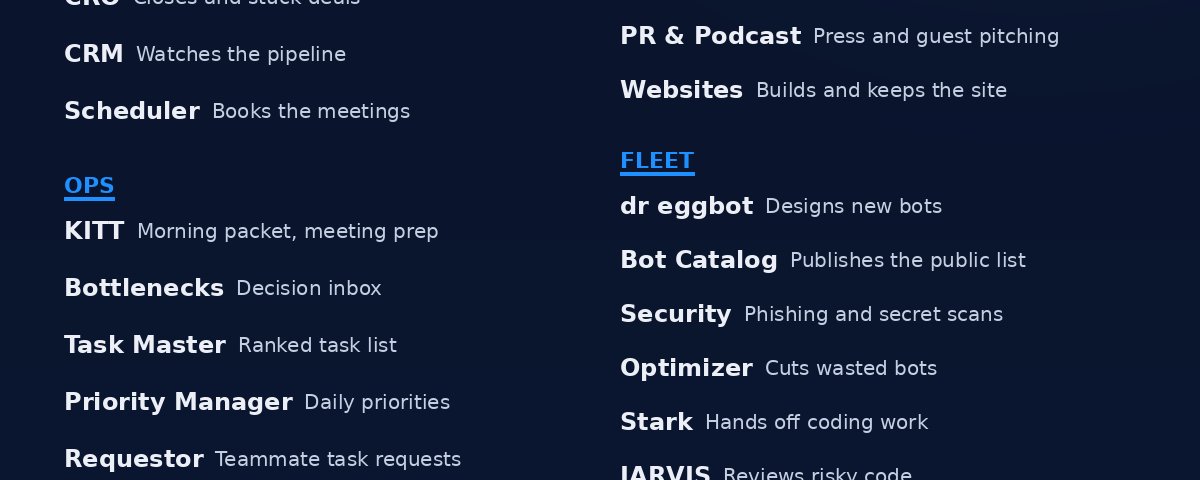
6 of my 40 AI bots never touch sales or content.
Their only job is keeping the other 34 honest.
1. Security flags any email or web page that tries to get a bot to send, delete or spend.
2. Optimizer finds idle, overlapping or costly bots every Monday. Max 3 changes, none without my OK.
3. A bot designer gives every new bot one job, one voice and a list of things it may not do.
4. A health check reads bot chats daily for the spots where I got frustrated.
5. Risky code gets a second bot's review, capped at 3 rounds.
6. The catalog bot strips names and numbers before any bot card goes public.
Once you're past 5 bots, build the ones that watch the others.

1
36

Another speech-to-speech voice model launched today. A penny per audio minute to start.
Cheaper minutes don't book appointments. Here's what I'd do this week:
1. Measure how fast you reach a new lead. Under 3 minutes with a person, under 30 seconds with AI.
2. Write down what your caller says when a prospect says "not interested." A better voice can't fix a missing script.
3. Count the leads nobody called back last month.
4. Judge any voice AI on appointments booked, not cost per minute.
1
1
70
$40,000.
That's the projected profit one owner told us about, from a single call his team missed.
A direct mail lead called while everyone was busy.
The AI picked up, then sent the caller back to his team the moment someone was free.
His words: "it acted as like a safety net for us."
Count how many calls ring while your team is already on the phone. Start there.
42
Same database, different results. Outbound dies on the first five seconds of the call.
"Hi, is this Mr. Smith? How are you today?" sounds like a sales call, so prospects hang up.
Call like a friend: first name, "I probably caught you at a bad time," then ask for 30 seconds.

most outbound fails for one reason:
everyone is pulling from the same database.
@gojiberryai just launched what it calls the world's first High-Intent Lead Database:
800M+ leads (!!) your AI agents can search with one prompt - check this out ↓
1
55
Tactically impatient, for a sales team, is the callback clock.
1. Call new inbound leads in under 30 seconds. Their urgency fades by the minute.
2. Make the first touch a call. A long text is touch point two.
Patient on strategy. Never patient with a fresh lead.

Ex-Amazon VP shares 3 lessons he learned working with Jeff Bezos:
1/ be strategically patient but tactically impatient
Jeff knew AWS was going to take at least 10 years to become what he thought it could. But he still pushed his teams every single day. He was patient with the vision but impatient with daily execution.
2/ build on what you think won’t change
Ask yourself what’s not going to be different in the next 10 years. That’s what you should build a business on. Not what you think will change.
3/ focus on your customer not your competition
If you’re stuck watching what the competition is doing you’ll end up launching copycat projects just because they did. Just ask what your customers need next. Then go build it.
One of the best nuggets from my conversation with @EthanEvansVP
Search “BigDeal pod Ethan Evans” on youtube to watch the whole episode if you haven’t already.
43
He asked if it was AI.
Then said he wanted a real person.
The AI tried to connect him live. Nobody on the team was free...
So it didn't argue and it didn't hang up.
It put him on the calendar for the next day.
When a prospect asks for a human and nobody's free, give them a time with one.
27
Agree on all of it except the hour.
Inbound leads lose the reason they reached out fast, and the first team to reach them has the edge.
Fill out your own web form today and time the callback. Under 3 minutes with a person. Under 30 seconds with AI.
I regret to inform you that you don't need to out-innovate anyone. Call back in an hour. Show up when you said you would. Send the invoice correctly. In 2026 basic competence IS luxury.
56
I gave my content bots every sales training I've recorded.
And one rule...
If it's not in there, they don't post about it.
Before that, my bots wrote posts any AI could write.
Now every post has to name the training file it came from.
No file, no post.
If AI writes for you, feed it your own material first. Then make it show you where each idea came from.
1
69
Something our new AI voice does on purpose:
It pauses before it says its name and company.
So the prospect has to answer once before any pitch starts...
Two exchanges in, they're already in a conversation.
If your setters open with name, company and reason in one breath, try this:
Say hi.
Wait.
Let them say "who's this?"
Then give your name.
79
Number 2 on this list is the one I'd copy first.
Every bot that needs a decision from me drops it in one chat.
Not 40 chats. One.
Each item says what it needs, what the bot recommends, and the deadline...
If you run more than 3 bots, build this before you build the next one.

I run 40 AI bots. Each one has one job.
Here are the 10 I'd build first if I started over.
Bookmark this.
1. Chief of staff. Ranks my day and preps my meetings before I start.
2. Open list. Every decision a bot needs from me lands in one chat.
3. Email. Keeps the inbox near zero and only shows me what I have to handle.
4. CRM. Watches stuck deals and untouched leads so I never open it.
5. Tasks. Keeps a ranked list so the next move is already decided.
6. Scheduler. Offers three times and books the call once they pick.
7. Meeting notes. Pulls the actions and follow-ups out of every call.
8. X. Runs my account and sends me a digest so I can delete anything.
9. Cold call prep. Researches the target, writes the opener, and tightens the script after the call.
10. License renewal. Handles my real estate license so it doesn't lapse.

72