Steven Moon (@stvnmoon) header
Steven Moon (@stvnmoon) profile picture

CEO @ https://nitter.cf/t.co/6lguQAMP8o šŸ¤– Serial Entrepreneur šŸš€ Techstars Alum ā­ļø

Vancouver, BC Canada
Joined April 2009
Photo by Steven Moon (@stvnmoon)Photo by Steven Moon (@stvnmoon)Photo by Steven Moon (@stvnmoon)Photo by Steven Moon (@stvnmoon)Photo by Steven Moon (@stvnmoon)Photo by Steven Moon (@stvnmoon)Photo by Steven Moon (@stvnmoon)Photo by Steven Moon (@stvnmoon)Photo by Steven Moon (@stvnmoon)Photo by Steven Moon (@stvnmoon)
Winter is going to be incredibly difficult for usšŸ‡ŗšŸ‡¦
51
116
8
634
5,225
šŸ’Æ
toronto is officially getting waymo before vancouver while vancouver is still figuring out the regulations how about we just cut the red tape already
1
21
Steven Moon retweeted
Do we live in a world where AIs can be wildly superhuman at every single task? Or a world where different tasks have different inherent limits, and AI’s superhuman performance at cybersecurity and math won’t translate to many consequential tasks? This is a key crux that distinguishes the normal technology worldview from the superintelligence worldview, and it has nothing to do with the pace of AI progress — it's about our different assumptions about the world. Here's an intuition pump for why I think it's the second world: different tasks have different fundamental limits. *Category 1: Some tasks are like making a building taller*: there is no ceiling to how well you can do. More compute and better algorithms can lead to wildly superhuman performance. The entire history of computing is the history of building tools that allow us to be ā€œsuperhumanā€ at computational tasks. For example, compilers are superhuman assembly code writers, and fuzzing tools are superhuman vulnerability detectors. AI builds on a long line of such improvements: solving math problems and finding exploits in code are two recent examples. *Category 2: Some tasks are like making a ball rounder*: there is only so much room for improvement, and the best AI systems can’t wildly exceed humans. Take persuasion. Some people believe AI can persuade anyone of anything, even convincing military commanders to launch nuclear weapons. In fact, ā€œsuperpersuasionā€ is one of the pathways through which many catastrophic risk scenarios unfold. But the AI as Normal Technology thesis is that there are many consequential tasks that are limited by external factors, so such wildly superhuman performance is not possible. This is especially true against humans who use simple computational tools. Tasks like persuasion, or predicting the outcomes of social events (such as elections), fall into this category. Other tasks, like writing, can’t be ranked on a single scale; different people find different writing styles compelling. AI writing also quickly wears thin: even if a user is impressed by AI writing at first glance, after reading thousands of words of the same type of prose, it becomes mundane and irritating. All of these are different from Category 1 tasks like playing chess, where even expert humans can’t do much better than deferring to an AI system at each turn. *Category 3: Some tasks require experiments in the real world*, and the bottleneck isn’t the computational task; it’s the data collection. One example is Moderna’s Covid vaccine: it took two days to design the vaccine, but almost a year to test and authorize, even during a record-breaking vaccine-development effort! This is why a ā€œsuperintelligenceā€ won’t cure cancer from inside a datacenter: the bottleneck to many of AI’s most sought-after real-world impacts (such as developing cures to diseases) is in the real world, and requires experiments that we won’t (and shouldn’t) hand over to AI. People concerned about AI risks often assume that we live in a world where almost everything fits into Category 1, and we might soon see AIs with wildly superhuman performance at all tasks. I agree it would be scary to live in that world. One reason @random_walker and I are more optimistic about our ability to remain in control is that we don’t think we live in the Category 1 world.
72
122
36
662
81,766
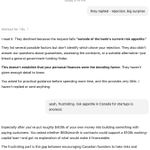
The state of startup funding in Canada in 2026. @bdc_ca does not have a "risk appetite" šŸ™„ @MarkJCarney @EvanLSolomon is this how you encourage AI startups in Canada such as @agentaech who are creating Canadian jobs to put AI to work in small businesses?
1
20
Oh, btw, the funds are needed for salaries of new employees. Sad.
2
10
Steven Moon retweeted
1
1
10
Steven Moon retweeted
The new owner inherited a sporting goods business—and $300,000 in unprocessed invoices. The AP work was taking 20–30 hours a week. Previous automations had failed in real use. Agent Aech built around Prostock’s actual workflow. The backlog is cleared, and 60–70% of invoices are now fully automated. aech.ai/
1
1
14
Steven Moon retweeted
Speak up about Oleshky, a Ukrainian city where ruzzia is starving people to death!!
87
1,886
44
4,984
142,068
Steven Moon retweeted
I was encouraged this week to see the leaders of the frontier labs agree on the need for them to slow down the pace of AI development. Given the stakes, it’s a good and necessary first step. Ā  But I’m even more encouraged by the growing recognition that how this powerful new technology develops should be at the center of our public debate. Ā  I’ve been watching the progress on AI for over a decade now, and one thing that’s clear to me is that the potential impact of this technology is not overhyped. It’s also moving at lightning speed – and even faster than those who are engineering it can keep up with. Ā  I’m not an AI accelerationist who believes it will lead to some techno-utopia, and I’m not a doomer who thinks it will inevitably lead to humanity’s destruction. But whether this technology results in amazing breakthroughs in medicine, energy and education or unleashes huge economic disruptions, greater inequality, and potential catastrophe will depend on the choices that we make right now – choices that should be made not just by the companies involved, but by all of us.
3,785
4,469
1,158
32,936
4,727,526
Essential reading for anyone concerned about who controls future AI progress and access.
1
1
3
206
šŸ’Æ
Early stage, pre-revenue funding is by far the most important issue facing Canadian competitiveness. Canada has always supported proven growth, but our own risk capital underfunds companies in Canada. You have to leave to be valued, and I for one, don’t want to have to leave Canada to build value. @EvanLSolomon @alexandr_wang
1
18
Steven Moon retweeted
Early stage, pre-revenue funding is by far the most important issue facing Canadian competitiveness. Canada has always supported proven growth, but our own risk capital underfunds companies in Canada. You have to leave to be valued, and I for one, don’t want to have to leave Canada to build value. @EvanLSolomon @alexandr_wang
didn’t expect to see this response from canada’s associate minister of ai adoption but this is a really good first step engaging w the public and bringing more ppl into the convo is so important for the role. fingers crossed
1
3
1
20
1,250
Steven Moon retweeted
this is a critically important moment for cyber defense with AI; there is not much time to act. we are happy if you want to work with us or any of our competitors or partners, but please take this moment seriously. only an urgent and intense collective response will work.
2,423
1,363
958
17,160
3,422,138
What should we build with 20x? Well, @OpenAI, for the next day, nothing!
30
Steven Moon retweeted
"world model != {world simulator, video generation}" ~ Yann Lecun
30
41
7
458
54,871
This is gold šŸ„‡
Spoke to the owner of a $10m accounting firm today. He’s rebuilding his business from the ground up with AI and I left convinced that service businesses will never be the same. The highlights from our convo: 1. The first AI agent they built is for handling accounts payable (AP) because it is the most manual and repeatable, least complex workflow in his business. 2. The financial impact of this agent is wild. The firm had a $7 cost per invoice (read: labor costs to process AP) before the agent. Now? $0.20. 3. So many vertical-specific AI startups fail because they lack subject matter expertise in the specific domain they’re trying to disrupt. 4. The most dangerous knowledge workers/execs are those that live at the intersection of product thinking, AI literate, and deep subject matter expertise. 5. Getting an AI agent to be 80% accurate took him 1 week. Getting it to be 98% accurate took 6 months. People underestimate how long it takes to feed AI every edge case & tweak needed to make it more performant than a human. 6. He’s considering raising $ for the AI AP agent. I think service business owners with the product sensibility to commercialize internal AI tools are a great opportunity for VCs. 7. AI agents don’t have to just be better than their human counterparts. They have to be orders of magnitude better. Because we tend to overestimate the skill of our species and underestimate the skill of technology. 8. The last job accountants/accounting firms will have is as high-level orchestrator of agents and triager of tier 1 problems flagged by your agents. 9. The AP AI agent was built by him and another non-technical accountant in the business. They used Cursor + Claude Code exclusively. P.S. I spend half of my week talking to execs about how they use AI in their business. If you’re an exec and you’re afraid your company isn’t doing enough with AI, shoot me an email and my team will help create a list of clear AI opportunities specific to your business. alex@tenex[.]co
1
41
Spoke to the owner of a $10m accounting firm today. He’s rebuilding his business from the ground up with AI and I left convinced that service businesses will never be the same. The highlights from our convo: 1. The first AI agent they built is for handling accounts payable (AP) because it is the most manual and repeatable, least complex workflow in his business. 2. The financial impact of this agent is wild. The firm had a $7 cost per invoice (read: labor costs to process AP) before the agent. Now? $0.20. 3. So many vertical-specific AI startups fail because they lack subject matter expertise in the specific domain they’re trying to disrupt. 4. The most dangerous knowledge workers/execs are those that live at the intersection of product thinking, AI literate, and deep subject matter expertise. 5. Getting an AI agent to be 80% accurate took him 1 week. Getting it to be 98% accurate took 6 months. People underestimate how long it takes to feed AI every edge case & tweak needed to make it more performant than a human. 6. He’s considering raising $ for the AI AP agent. I think service business owners with the product sensibility to commercialize internal AI tools are a great opportunity for VCs. 7. AI agents don’t have to just be better than their human counterparts. They have to be orders of magnitude better. Because we tend to overestimate the skill of our species and underestimate the skill of technology. 8. The last job accountants/accounting firms will have is as high-level orchestrator of agents and triager of tier 1 problems flagged by your agents. 9. The AP AI agent was built by him and another non-technical accountant in the business. They used Cursor + Claude Code exclusively. P.S. I spend half of my week talking to execs about how they use AI in their business. If you’re an exec and you’re afraid your company isn’t doing enough with AI, shoot me an email and my team will help create a list of clear AI opportunities specific to your business. alex@tenex[.]co
117
86
18
1,346
195,991