

Cell and developmental biologist / Studying developmental control of cell division using C. elegans 📽️ ~~~ ... / I post preprint 🙂
Vancouver, British Columbia
Joined December 2010
- Tweets5.1K
- Following319
- Followers390
- Likes1K





Pinned Tweet
New paper from the lab! Many animal cells exhibit chiral cell surface dynamics, which are proposed to drive left–right asymmetric patterning. However, the molecular mechanisms linking these events remain unclear. authors.elsevier.com/a/1l%7E…
2
2
276
The established chiral cadherin patch interacts asymmetrically with the contractile ring, likely driving its rightward closure, the first detectable left–right asymmetry in C. elegans.
1
70
Only 2 weeks left to apply for the Assistant Professor position in Cell & Developmental Biology in Zoology, UBC!
Open to all areas and systems. This is a fantastic department with supportive colleagues academicjobsonline.org/ajo?j…

we are recruiting a faculty in the department of zoology at UBC!!!
Assistant Professor in Cell and Developmental Biology.
academicjobsonline.org/ajo/j…
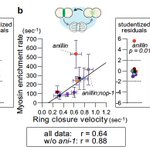
Our analysis revealed that a previously proposed, cortical flow-dependent positive feedback in ring assembly (ref: Reymann et al., eLife 2016, Khaliullin et al., eLife 2018), is responsible for mechanosensation. (6/8)

1
1
383
Lastly, we found that anillin is required for this mechanosensation and that anillin is required for the maintenance of this positive feedback loop. How? We don't know at this point. (7/8)

1
2
296
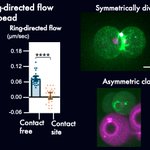
Ring-directed cortical flow during cytokinesis has been known for decades, but we were able to track it from the cell surface into the division site, probably for the first time. And yes, it delivers cell cortex materials to the ring, promoting cytokinesis. (4/8)
1
4
259

We used asymmetric ring closure in C. elegans zygotes as a model (ref Maddox et al., Dev Cell 2007) and found that the cell cortex moves differently between the leading and lagging edges. At the leading edge, there is a ring-directed flow. (Movie: myosin) (3/8)
1
1
279
Check out our latest paper, out now in @NatureComms
In epithelial cells and animal zygotes, the cytokinetic contractile ring closure is often asymmetric and plays critical roles in tissue integrity. How is it regulated? (1/8)
nature.com/articles/s41467-0…
Before moving on, I would like to mention that this work was conducted by graduate student Christina Hsu and undergraduates Gagan Sangha, Wayne Fan (@WayneFan17), and Joey Zheng. Gagan, who generated several terabytes of imaging data, is also a co-first author. (2/8)
1
2
253
Didn't get to tweet about this preprint but
we've identified the mechanism by which the cytokinetic contractile ring senses tissue mechanics in C. elegans, and found that anillin is key in tuning this mechanosensitivity. biorxiv.org/content/10.1101/…
Check out our lab’s work at #CellBio2022 !
Dec 4: Minisymposium: Room 146B, Cytokinesis-driven embryonic chirality (Rain Xiong)
Dec 5: P1904 Asymmetric contractile ring closure (Christina Hsu)
Dec 6: P2431 Cortical dynamics during asymmetric cell division @TaherSagor
Kenji Sugioka ~ retweeted

Reconvening at 1:45 for #moermansymposium @ubclifesciences with @gary_ruvkun @harvardmed #celegans @sugi05 @Auld_Fly_Lab @LMatsuuchi
livestream ubc.ca.panopto.com/Panopto/P…

Kenji Sugioka ~ retweeted

NEW BIORXV is out:
We studied the molecular architecture of the C. elegans #centriole by combining #UExM with #ElectronMicroscopy.
We mapped the known centriolar components onto their ultrastructural #EM features.
biorxiv.org/content/10.1101/…
