

A rational mind with an adventurous soul.
Joined June 2021
- Tweets2.1K
- Following389
- Followers599
- Likes7.6K






Pinned Tweet
21 Logical Reasons Why Patience in $RFD Could Be Extraordinarily Rewarded
If your honest answers to these questions are mostly “Yes,” then it is only logical to believe that $RFD represents not just a speculative token, but a patient investment into one of the rare, truly visionary ecosystems being quietly built in crypto today.
1. Has Blurr proven himself to be a DeFi genius with a successful track record?
2. Is Blurr respected by many early crypto adopters and DeFi experts?
3. Has Blurr demonstrated an ability to innovate and anticipate market needs?
4. Has Blurr acted transparently whenever it was not harmful to the project, and always without malicious intent toward the community?
5. Has Blurr ever shown through his actions (such as burning almost 0.5 million $RFD) that he is not involved in $RFD for quick personal gain?
6. Is it obvious by on-chain actions and community knowledge that Blurr is the deployer, creator, and manager of $RFD’s treasury wallet?
7. If Blurr had intended to abuse his credibility for unfair gains, wouldn’t he have easily sent the $RFD chart skyrocketing with empty promises, but he chose not to?
8. Is it logical that building a unique and innovative ecosystem requires time, a silent environment, and protection from copycats?
9. Does Blurr most probably have sufficient wealth and therefore no motivation to risk his reputation for a quick or unfair gain?
10. Has Blurr ever publicly expressed that the true purpose of life lies in meaningful creation rather than just personal enrichment?
11. Is it true that Blurr launched $RFD without taking any funds through taxes, pre-mines, VC deals, or unfair advantages?
12. Can $RFD be considered one of the fairest and purest token launches ever seen in DeFi?
13. Does the $RFD token still have an organic and loyal community despite harsh market cycles?
14. Has Blurr unchangeably hinted that he holds a big vision for $RFD?
15. Is it logical to believe that a builder who already achieved greatness is capable of doing it again, especially with more experience?
16. Have we seen clear hints suggesting that $RFD will probably connect to a broader and innovative DeFi ecosystem?
17. Is Blurr known for working silently and carefully in the background, rather than overhyping projects prematurely?
18. Can projects built quietly and carefully sometimes outperform those that are loudly and prematurely marketed?
19. Is timing often critical in DeFi, and could early positioning in a strong project lead to exceptional rewards?
20. Is it likely that $RFD’s fair launch, wide distribution, and community-first philosophy will help it succeed in the decentralized future?
21. Is there a real possibility that $RFD and Blurr’s future developments could reshape important parts of the DeFi landscape?
#RFD #DeFi @ReFundCoinETH


Refund ($RFD) & Papertrade:
A Shared Liquidity Engine?
Could @blurr, the deployer of Refund, be considering a future in which Refund and Papertrade become complementary parts of the same economic ecosystem? This is a hypothesis, not a confirmed plan. If it is not already part of his vision, it may be worth exploring.
Under this model, Papertrade would remain the trading platform, while Refund would become an independent liquidity partner. Rather than acting simply as a builder channel, Refund would have an exclusive role in two activities: providing a limited redemption route for $PAPER and operating a marketplace for eligible pending winner claims.
A one-way redemption route for $PAPER
A $PAPER holder who wants immediate liquidity could choose to redeem PAPER through an approved mechanism in exchange for USDC. The PAPER would move directly into the Refund ($RFD) treasury, where it could be staked to generate potential future income, while a portion would be burned gradually.
Crucially, PAPER held by the treasury would not be available for resale or onward transfer. This would avoid creating an open secondary market for PAPER, while giving holders a voluntary liquidity option. Any such arrangement would require Papertrade’s approval and a carefully designed exception to the existing transfer restrictions.
A marketplace for pending winner claims
When winning traders have outstanding claims in the payment queue, Refund’s marketplace could allow them to sell eligible claims at a discount to investors who provide USDC. Winners who choose to sell could access liquidity earlier, while buyers would accept the risks of waiting for settlement.
The marketplace could generate processing fees for Refund’s income pool. This part of the model would require claims to be transferable and enforceable under Papertrade’s rules.
A role for $RFD and the Refund treasury
Refund’s economic role could give more people a reason to use and trade $RFD. In turn, increased genuine trading activity could generate transaction fees from the RFD/ETH liquidity position (liquidity Pool).
The proposed allocation would connect the two ecosystems:
RFD collected through the liquidity mechanism could be burned.
ETH collected as fees could strengthen Refund’s liquidity reserve and, under agreed conditions, help support Papertrade.
Income from staked PAPER and marketplace fees could contribute to Refund’s income pool and the broader ecosystem.
$RFD holders could therefore participate indirectly in the economic activity surrounding Papertrade without needing to trade on the platform themselves. The benefit would depend on the project’s treasury rules and market conditions; holding $RFD would not automatically give holders a direct claim on $PAPER staking rewards or treasury assets.
A shared economic cycle
The vision is a partnership in which Refund provides a dedicated liquidity layer around Papertrade, and both projects contribute to a sustainable economic relationship.


From the Nevada Desert to the Papertrade Ecosystem: Could Refund ($RFD) Have a Place in This Emerging City?
Just as casinos once transformed the barren Nevada desert into a vibrant and prosperous destination, giving rise to hundreds of businesses, large and small, that flourished within the economy surrounding them, Papertrade, through its innovative economic model and network of Builder Channels, has the potential to become the beating heart of a vast and dynamic ecosystem.
An ecosystem where new economic opportunities, innovative utilities, and businesses of all sizes can emerge and thrive.
Within this vision, the potential for Refund ($RFD) to play a meaningful economic role in this emerging city should absolutely not be overlooked.
Perhaps Refund’s place in this grand architecture has yet to be revealed, but one question remains:
Will Blurr, with his long-term vision and distinctive philosophy, truly leave a project he once initiated unfinished?
I strongly believe Blurr is not the kind of architect who abandons a creation halfway through its journey, especially when an entirely new city is rising alongside it.


Ships Are Built to Sail, Not to Remain in Harbor.
Blurr’s philosophy also reminds us that ships are not built to remain safely in harbor, but to sail toward new horizons.
Has the Refund ($RFD) ship raised its sails and is ready for the open sea?
It’s time to continue the voyage we once began, guided by the very philosophy Blurr and Refund community always stood for.
Smoke.

The first cigarette I ever smoked was in the short-stay car park of Stavanger airport. It was a Camel Blue. The sky was Norwegian. Overcast and grey.
Since then I have smoked a lot of cigarettes, and will often claim that taking it up was the best decision I have made in a long time.
A cigarette operates as a small stick of entropy; within that single gram lives an agent of motion, a compulsion exerting itself over soporific lives. The random conversations one has with strangers over a cigarette often carry an edge of meaning that is hard to find in an otherwise superficial world. Mutual participation in a self-destructive exercise. Common ground transcending language. Line cooks, security guards and executives, relegated to a huddle under an awning as the rain pours, sharing a lighter. Ritual.
Much of what we have lost in the last two generations can be distilled to a neutering of our innate risk appetite. An unlanceable push towards comfort and safety, calcifying young minds and inculcating in them the belief that they are enough the way that they are. That to cast the runes is to err. Lost.
You are not enough. To make it is to understand that you never will be — and then to try anyway.
Smoke.
Mohsen retweeted

😎
🤖 Made with AI
The first cigarette I ever smoked was in the short-stay car park of Stavanger airport. It was a Camel Blue. The sky was Norwegian. Overcast and grey.
Since then I have smoked a lot of cigarettes, and will often claim that taking it up was the best decision I have made in a long time.
A cigarette operates as a small stick of entropy; within that single gram lives an agent of motion, a compulsion exerting itself over soporific lives. The random conversations one has with strangers over a cigarette often carry an edge of meaning that is hard to find in an otherwise superficial world. Mutual participation in a self-destructive exercise. Common ground transcending language. Line cooks, security guards and executives, relegated to a huddle under an awning as the rain pours, sharing a lighter. Ritual.
Much of what we have lost in the last two generations can be distilled to a neutering of our innate risk appetite. An unlanceable push towards comfort and safety, calcifying young minds and inculcating in them the belief that they are enough the way that they are. That to cast the runes is to err. Lost.
You are not enough. To make it is to understand that you never will be — and then to try anyway.
Smoke.
Mohsen retweeted

The first cigarette I ever smoked was in the short-stay car park of Stavanger airport. It was a Camel Blue. The sky was Norwegian. Overcast and grey.
Since then I have smoked a lot of cigarettes, and will often claim that taking it up was the best decision I have made in a long time.
A cigarette operates as a small stick of entropy; within that single gram lives an agent of motion, a compulsion exerting itself over soporific lives. The random conversations one has with strangers over a cigarette often carry an edge of meaning that is hard to find in an otherwise superficial world. Mutual participation in a self-destructive exercise. Common ground transcending language. Line cooks, security guards and executives, relegated to a huddle under an awning as the rain pours, sharing a lighter. Ritual.
Much of what we have lost in the last two generations can be distilled to a neutering of our innate risk appetite. An unlanceable push towards comfort and safety, calcifying young minds and inculcating in them the belief that they are enough the way that they are. That to cast the runes is to err. Lost.
You are not enough. To make it is to understand that you never will be — and then to try anyway.
Smoke.
From Zero Initial LP Capital to $1 Trillion in Trading Volume.
Is Blurr’s Next Surprise $RFD?
Papertrade, built around an innovative economic model requiring no upfront capital to seed its trading liquidity pool, reportedly reached approximately $1 trillion in cumulative notional trading volume in just four days.
An extraordinary milestone that demonstrates how a creative concept can challenge conventional DeFi trading models.
But perhaps the most fascinating innovation isn’t the staggering trading volume itself. It’s the way Papertrade is redefining the economics of losing.
Under its model, traders who incur eligible losses receive $PAPER, a token that can be staked to participate in the platform’s reward distribution mechanism.
This creates an unusual dynamic: some losing traders may view their losses not simply as financial setbacks, but as the potential cost of entering a long-term income-generating opportunity.
Of course, the future economic value of $PAPER depends on the platform’s performance, reward sustainability, liquidity, and market demand.
Nevertheless, if this model proves sustainable, it could become a remarkable innovation in DeFi economics.
I believe Blurr and Jez, the creative minds behind Papertrade, have the potential to establish an increasingly influential reputation in crypto and DeFi. Their involvement in future projects could eventually become a very powerful source of credibility, attracting substantial attention, capital, and economic value.
And that brings me to the question I find most intriguing:
What does Blurr have in store for his earlier creation, Refund ($RFD), a project whose full potential, in my view, has yet to be realized?
Could Papertrade’s success be setting the stage for an entirely new chapter in the Refund story?
Perhaps the most exciting part of this story hasn’t even begun.

Why hasn’t @blurr used the Refund ($RFD) treasury to accumulate $PAPER?
From the very beginning of Papertrade’s launch, some users began trading with a specific objective: accumulating as much $PAPER as possible. Some even established investment treasuries to accelerate the process of acquiring and accumulating the token.
Their economic rationale is relatively straightforward: if Papertrade evolves into a successful and sustainable platform, staked PAPER tokens could potentially generate substantial recurring rewards over the long term. If sustained, these rewards could strengthen demand for PAPER and contribute to its economic value.
Only a few days have passed since Papertrade went live. According to reported figures, cumulative trading volume has already exceeded $990 billion, approaching the remarkable milestone of $1 trillion in less than a week. Total staking rewards are estimated at approximately $36 million.
Of course, particularly on a platform offering extremely high leverage, trading volume should not be confused with an equivalent amount of capital entering the ecosystem. Likewise, the extraordinary staking rewards observed during the initial days cannot automatically be extrapolated into the future without examining the platform’s underlying economics.
Nevertheless, the initial enthusiasm and users’ determination to accumulate PAPER cannot necessarily be dismissed as mere short-term speculation.
It appears that at least part of the market is already attempting to price in the token’s future income-generating potential.
If these expectations materialize, PAPER alone could become the foundation of a secondary economic market generating millions of dollars in daily trading activity.
But this brings us to an intriguing question.
Why Has the Refund Treasury Apparently Not Accumulated PAPER?
Blurr, who participated in the creation and development of Papertrade and is also the creator of Refund ($RFD), has spent the past several years allocating portions of the Refund treasury’s assets to various DeFi opportunities, including staking, liquidity provision, and yield-generating strategies.
So the question is:
Why hasn’t he apparently deployed the Refund treasury’s resources to accumulate PAPER this time?
Given Blurr’s direct involvement in developing Papertrade, it seems reasonable to assume that he has a particularly deep understanding of PAPER’s economic mechanics, revenue potential, and associated risks.
Imagine that the Refund treasury had allocated approximately $2 million to acquiring PAPER and, under particularly favorable conditions, managed to accumulate 200 million tokens.
In that scenario, Refund would essentially become an investor in the Papertrade ecosystem, with its economic exposure largely dependent on PAPER’s valuation and staking returns.
But what if Blurr has envisioned a much broader economic role for Refund than simply holding PAPER as an investment?
This is precisely where my hypothesis begins.
The Hypothesis: Refund as an Economic Infrastructure Layer Complementing Papertrade
I believe one of the most intriguing possibilities is that Blurr may have preferred to leverage Refund’s existing independent resources, including its substantial liquidity pool, multimillion-dollar treasury, and established holder community, to develop an economic ecosystem operating alongside Papertrade.
Under this scenario, Refund would not merely own PAPER tokens.
Instead, it could actively participate in capital circulation, liquidity provision, financial services, and the development of secondary markets connected to Papertrade.
🧵1/3

The significance of this possibility becomes clearer when we consider one of the fundamental challenges facing meme coins.
Community enthusiasm and social momentum, although essential for launching and growing a project, are rarely sufficient on their own to sustain its economic value indefinitely.
What can contribute to long-term sustainability is the creation of genuine economic utility, recurring demand, and durable revenue streams.
However, designing such utility, particularly when it must be innovative, competitive, and economically productive, is exceptionally difficult.
With Papertrade, Blurr and Jez have attempted to introduce a different approach to leveraged trading and the distribution of economic rewards.
The platform’s remarkable initial trading activity suggests that this model has succeeded, at least initially, in attracting substantial market attention.
Of course, its long-term success will depend on several critical factors: sustainable liquidity, reliable settlement mechanisms, effective risk management, transparent economics, and continued user confidence.
If Papertrade demonstrates operational stability over the coming months, builds further trust, expands the range of tradable assets, and introduces additional functionality, its capacity to attract users and economic activity could reasonably increase.
Sustained growth in trading volume, however, should not be taken for granted.
This brings me to another question:
Why should we assume that an ecosystem with such economic potential, co-created by Blurr, will have no connection whatsoever to the economic future of another project he created, Refund ($RFD)?
Such a connection remains unproven, but I believe the possibility deserves serious economic consideration.
A Refund Builder Channel: One Possible Scenario
In his recent interview, Blurr emphasized the importance of genuine economic utility for meme coins.
He also discussed the potential economic opportunities associated with creating successful builder channels on Papertrade.
Taken together, these two observations provide an interesting foundation for speculation.
Imagine that Blurr eventually unveils a dedicated Refund Builder Channel, one designed to operate far beyond a conventional trading interface and provide users with a broader range of financial and economic services.
Subject to the necessary technical infrastructure and risk controls, such a channel could potentially offer the following capabilities.
1. Exclusive Benefits for $RFD Holders
Users holding a specified minimum amount of $RFD could gain access to premium services, economic incentives, or participation in designated reward mechanisms.
2. A Secondary Market for $PAPER
A marketplace enabling users to trade economic exposure to PAPER, participate in staking-related investment strategies, or transfer eligible future claims.
3. Immediate Liquidity for Pending Trading Profits
A mechanism allowing traders to sell eligible, transferable claims on unsettled winnings at a discount to liquidity providers, receiving immediate USDC or other supported assets.
4. Performance-Based Trader Rewards
Allocating a portion of the channel’s actual revenue, including eligible builder fees, to competitive incentives and rewards for successful traders.
5. Intelligent Trading Tools
Providing automated strategies, predefined trading systems, and risk-management tools, particularly for users with limited technical experience.
🧵2/3
6. Economic Revenue Participation
Establishing transparent mechanisms through which eligible $RFD holders could receive a defined share of net channel revenues or treasury-generated rewards, subject to the applicable rules and economic sustainability of the model.
7. Collateralized Financing
Allowing users to deposit eligible assets, potentially including $RFD, as collateral and receive USDC credit to participate in Papertrade, subject to appropriate collateral ratios, liquidation procedures, and risk controls.
Naturally, implementing these capabilities would require considerably more than simply launching a builder channel.
Some would demand independent smart contracts, substantial liquidity resources, reliable settlement mechanisms and risk-management systems.
But the central idea is that a builder channel could become the gateway to a much broader financial ecosystem.
Why Could Refund Be Well Positioned for Such a Role?
Unlike many launched meme coins, Refund already possesses certain economic resources that could support the development of meaningful utility.
Its substantial Uniswap liquidity pool, treasury holdings valued in the millions of dollars according to recent estimates, and history of participation in DeFi activities represent potentially valuable foundations.
Of course, liquidity deposited in a trading pool is not equivalent to freely deployable treasury capital.
Likewise, a multimillion-dollar treasury does not automatically guarantee sufficient funding for a large-scale secondary marketplace.
Nevertheless, these resources could provide a meaningful starting point for developing new economic services, particularly if supported by sustainable revenue streams and additional liquidity providers or investors.
More importantly, such a role would not necessarily be limited to Papertrade.
If Refund ($RFD) eventually develops into an independent layer for financial services, liquidity provision, or economic value distribution, it could potentially extend similar services to other DeFi ecosystems in the future.
In other words:
Papertrade might become the first environment in which Refund’s new economic utility emerges, but not necessarily the last.
Conclusion: Are We Approaching the Moment When Refund’s Economic Purpose Becomes Clear?
I continue to believe there is a meaningful possibility that Blurr has envisioned an independent yet complementary economic role for Refund alongside Papertrade, a role that has not yet been publicly revealed.
For now, this remains a hypothesis, not an established fact.
However, several observations make it worth considering: Blurr’s involvement in both projects, his emphasis on economic utility for meme coins, the revenue opportunities associated with builder channels, PAPER’s potential secondary-market demand, and Refund’s existing liquidity and unlocked treasury resources.
Perhaps the most important question is no longer why the Refund treasury has not apparently accumulated more $PAPER.
The more interesting question is whether Blurr, rather than turning Refund into an investor in Papertrade, has been planning to position it as an independent economic participant within the broader Papertrade ecosystem.
If so, the first official introduction of meaningful economic utility for $RFD could represent far more than an ordinary positive announcement.
It could provide the first concrete, independently assessable indication of Refund’s long-term economic direction and underlying philosophy.
And perhaps, at that moment, we will begin to understand more clearly why Refund was created by Blurr back in May 2023 and what place it might ultimately occupy in the expanding world of decentralized finance.
($RFD) Refund’s treasury
debank.com/profile/0x4c53148…
🧵3/3

A Multimillion-Dollar Opportunity for Refund ($RFD)?
In just the first 24 hours of Papertrade’s operation, approximately 6 billion $PAPER tokens were generated, more than 98% of which have been staked so far. According to the latest figures, the total rewards recorded for stakers have also reached approximately $25 million.
If we consider the total losses that led to the creation of this volume of PAPER, the initial cost incurred by losing traders could perhaps be estimated at more than $70–80 million. However, this figure is merely an estimate and should not be confused with PAPER’s market capitalization, as the token’s actual value depends on multiple factors; particularly expectations regarding future revenues and rewards.
The remarkable point is that we are talking about figures in the tens of millions of dollars, all within Papertrade’s very first day of operation!
Sooner or later, some $PAPER holders will consider liquidating their assets. This implies potential demand for the creation of an organized and liquid secondary market; one that could potentially generate millions of dollars in daily trading volume.
Now, here is the intriguing question:
Do you really think @blurr , as one of Papertrade’s developers and the creator of $RFD (Refund), would overlook such significant economic potential for creating real utility within his own project, $RFD?
Perhaps no official economic connection between the two projects has been announced yet, but it is not difficult to imagine Refund ($RFD) eventually playing a role in providing liquidity, facilitating $PAPER trading, or even handling claims owed to Papertrade.xyz winners.
And, of course, sometimes the answer to a complex question is right in front of us, even in the project’s name!
REFUND, Why not? 😉
This post is merely an economic speculation and does not claim that any agreement or confirmed plan exists yet between the two projects. NFA DYOR

Blurr’s Three Final Cryptic Messages: Is Chapter 13 Next?
“A penny for the old guy.”
What if Blurr’s final three cryptic messages from 2023 were clues to a much bigger story?
11. “Those who know do not speak, those who speak do not know.”
Three years of silence, followed by Blurr’s recent public interview ahead of Papertrade’s launch.
12. “The mighty ruler sends a request across the land and along the sea path, offering the abundant radiance of terror to their men and sons.”
Could this foreshadow Blurr’s first post on Papertrade’s launch day? A mysterious figure, @blurr , standing on land, facing the sea and the horizon, seemingly leaving uncertainty and risk behind.
13. “A penny for the old guy.”
And perhaps this is the next chapter: the long-awaited emergence of $RFD’s economic role within a broader ecosystem, potentially transforming trading losses into new opportunities through Refund.
Pure speculation, of course. But if messages 11 and 12 have found their symbolic moments, could message 13 be the missing piece?
Papertrade.xyz is just the beginning, and Refund’s real story is yet to unfold… soon 👀


🔥 Is $RFD (Refund) entering a new chapter of growth?
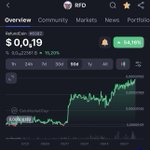
Over the past 30 days, while Ethereum ($ETH) has gained just 1.1%, Refund ($RFD) has delivered an impressive 30.2% surge!


$RFD: Quietly Gaining Momentum Alongside Ethereum
Over the past 90 days, $RFD has moved remarkably in step with ETH, while slightly outperforming it: roughly +54% vs. +50%.
Even more encouraging, the past 30 days have shown a slow but steady increase in new wallets buying RFD, suggesting gradually expanding participation.
If this momentum continues, the coming days could paint an even more interesting picture for $RFD. 📈
Slow growth. Stronger base. Brighter days ahead.
0x955d5c14C8D4944dA1Ea7836bd44D54a8eC35Ba1


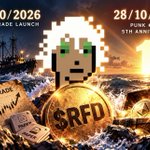
In my view, if we interpret the gun as a symbol of danger and risk, Blurr may be hinting at a ten-day period, from October 11 to 21, following Papertrade’s launch, as a potentially risky phase. But what’s particularly intriguing is that his gaze is fixed on the horizon, as if he sees a long-term vision beyond the short-term risks.
Mohsen retweeted

papertrade launch timing and details
papertrade is expected to launch at 14:00 UTC on 10.10.2026, following the scheduled hyperevm network upgrade.
at this time trading through the frontend will be enabled.
deposits will pause for a short period of time at 13:45 UTC, fifteen minutes before, to ensure that trading has the utmost priority during launch. if you wish to participate in the launch you must predeposit.
launch congestion
papertrade will be congested at the start due to launch demand. expect temporarily long confirmation wait times, especially for smaller notional trades.
the frontend relayer plays an important role during launch, controlling how transactions are submitted to the hyperevm. some actions like staking distributions run separately in big blocks. the chain will always look as if only half of all possible gas is being used, this is optimal. using more than this would exponentially raise fees within minutes to unpayable prices.
oi limits
papertrade has individual atomic position limits of 10m. there is no limit on the number of 10m positions a user can have. papertrade also has floating oi headroom per market/side, which determines how much oi can be opened in a very short period. these are not designed to be triggered through normal trading usage and are set at 1bn per market/side for launch.
asym pnl fee parameters
papertrade inherits rollbit’s asymmetric fee pnl curve
the parameters are:
-baseRate: .1
-rateMultiplier: 15000
-rateExponent: 1
-referenceNotional: 100000*k (k=1m)
-positionMultiplier: 814.598 btc / 483.979 eth
-profit deadman: 0.2 basis points
a visualization of the pnl parameter curve is below
admin keys
the papertrade admins (2 of 3 multisigs consisting of @izebel_eth @blurr @UngusTrade ) perform three separate roles:
-guardian: pause opens and freeze individual/global markets. if a market is frozen any existing positions can still be closed against the paused bbo mid.
-owner: set impact curve and fee parameters. change configure relayers/keepers. list new markets and upgrade the contracts. all contract upgrades are gated by a 7 day timelock.
-markets: adjust the oi headroom per market/side. set the minimum margin and minimum position sizes.
read more about these features at: docs.papertrade.xyz

Mohsen retweeted

A network upgrade is expected at 8:15 AM UTC, meaning trading on @papertrade_xyz should go live around 9:15 AM UTC.

The Refund Community: Exciting Days May Lie Ahead!
The $RFD (Refund) community may be approaching an exciting new chapter.
@blurr , the creator and deployer of $RFD (Refund), finally showed his face publicly in last week’s interview, nearly three and a half years after RFD’s launch. The occasion was the introduction of another remarkable and innovative creation: Papertrade.xyz
Developed in collaboration with @izebel_eth , this new platform has already generated considerable excitement and interest among traders and crypto enthusiasts. Both creators deserve sincere congratulations for this impressive achievement.
In my view, this success gives the Refund community another reason to take pride in Blurr’s creativity, innovative thinking, and willingness to challenge conventional boundaries.
Since RFD’s earliest days, his mysterious and thought-provoking cryptic messages have hinted at a deeper philosophy centered on long-term value creation, collective participation, and the untapped potential of decentralized finance.
Yet one fascinating question remains:
Will there be a meaningful economic connection between these two projects: Refund ($RFD) & @papertrade_xyz ?
Or perhaps Refund, along with its multimillion-dollar treasury, which has been built and managed over the past few years by Blurr, is part of an entirely separate and innovative vision that has yet to be unveiled.
debank.com/profile/0x4c53148…
Of course, these possibilities remain speculative, and only concrete developments can confirm them.
Nevertheless, I believe one important point deserves particular attention:
Even without any direct economic integration between $RFD and Papertrade, Papertrade’s success will become a valuable advantage for Refund’s future.
Why?
Because every new achievement by Blurr strengthens his professional credibility, demonstrates his ability to execute ambitious ideas, and reinforces his position within the crypto ecosystem.
That growing reputation could naturally attract greater attention to his earlier creations, mainly $RFD. Should meaningful economic utilities eventually emerge, this increased visibility and credibility could become powerful catalysts for Refund’s long-term development.
In other words, Papertrade’s success could help create a much more favorable environment for $RFD to realize its potential soon.
For that reason too, we, as members of the Refund community, have every reason to watch Papertrade’s launch and future development with even greater enthusiasm and optimism.
As a $RFD community member, I sincerely wish Blurr and Jez continued success.
The most exciting chapter of the Refund story has yet to be written!


EVEN BEFORE TRADING BEGAN, @PAPERTRADE_XYZ HAD SURPASSED $90M IN TVL.
nitter.cf/HyperliquidNews/status…
