



Pinned Tweet
In @JAMA_current, We examined all 1,000 new Medicare-funded residency positions created under the Consolidated Appropriations Acts of 2021 and 2023.
jamanetwork.com/journals/jam…

Tarun Ramesh, MD retweeted

A 76-year-old man presented to the emergency department with 5 days of worsening dyspnea at rest, lower extremity edema, fatigue, confusion, and poor oral intake. What is your diagnosis? ja.ma/4hb0h0O

Tarun Ramesh, MD retweeted

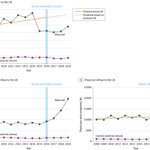
The 2016 Brexit referendum was associated with increased #NHS physician vacancies, indicating that higher non-EU recruitment did not fully offset workforce shortages.
ja.ma/3SLetEz

ALT Three line graphs show nurse inflow to the UK (EU, Non-EU, Total) from 2008-2019. A light blue bar in 2016 marks the 'Brexit referendum passed'. EU nurse inflow dropped sharply after Brexit. Non-EU and total nurse inflow dipped, then rose significantly, recovering by 2019.
What happened to the UK health workforce after Brexit?
In @JAMAHealthForum, we find the 2016 referendum was associated with an immediate decline in EU-origin physician and nurse immigration, followed by increased recruitment of non-EU physicians.
jamanetwork.com/journals/jam…

1
7
721
But substitution did not fully offset workforce gaps. NHS physician vacancies increased after the referendum.
After Brexit, EU-origin physician and nurse inflows fell sharply, while non-EU physician recruitment subsequently increased.

1
1
74
As other countries enter and exit free movement zones, such as the EU, or implement restrictive migratory policies, they should consider both anticipatory and unanticipated consequences on the health workforce and patient health outcomes. @DeptPopMed @mghmedres @MGBResearchNews
1
35
Tarun Ramesh, MD retweeted

Medicare-funded residency expansions from 2021 and 2023 Acts prioritized health professional shortage areas and psychiatry, but rural and primary care position targets were not met.
#MedicareGME #PrimaryCare
ja.ma/4uHMOkx

ALT JAMA article, 'Changes in Specialty and Geography of Medicare's New Residency Positions.' A bar graph shows residency distribution by specialty (Primary Care, Psychiatry, General Surgery, Others) for 2021 rounds and 2023, with Psychiatry rising. A line graph shows rural allocation decreasing from ~6% to ~1% over the same period.
But the story was different for primary care and rural America.
Across the four allocation rounds of the 2021 law, the share of new positions devoted to primary care fell from 53% to 31.5%. Never reaching the 10% statutory goal for rural areas.

1
2
139
As policymakers consider future GME expansion, simply creating new residency positions may not be enough. Explicit allocation strategies may be needed to address persistent primary care and rural physician shortages. @mghmedres @MGHMedicine @DeptPopMed @HarvardHPM
2
84
Tarun Ramesh, MD retweeted
Medicare-funded residency expansions from 2021 and 2023 Acts prioritized health professional shortage areas and psychiatry, but rural and primary care position targets were not met.
#MedicareGME #PrimaryCare
ja.ma/3QnKl0z

Tarun Ramesh, MD retweeted
From @JAMANetworkOpen:
Immigrants from banned countries contributed nearly 24 000 physicians and 56 000 nurses to the US workforce in 2023, with higher presence in counties with workforce shortages and vulnerable populations.
🔗 ja.ma/3Py5chC

In @JAMANetworkOpen, the current immigration ban could curtail physician and nursing care in underserved communities and shortage areas. 24 000 physicians and 56 000 nurses were from banned countries in 2023. jamanetwork.com/journals/jam…

Tarun Ramesh, MD retweeted

Amid surgical workforce shortages, H‑1B visa fee hikes could further strain access to surgical care, particularly in underserved communities that rely heavily on H‑1B surgeons
@LiuMichaelMD Vishal Patel @tarunr99 @rkwadhera @Thomasctsai in @JAMASurgery
jamanetwork.com/journals/jam…

In @JAMAHealthForum, we ask whether the 2010 WHO Global Code of Practice (a voluntary agreement to curb active recruitment from “shortage” countries + promote workforce investment) actually change physician migration? jamanetwork.com/journals/jam…

1
2
87
After 2010, shortage countries saw a relative reduction in annual physician outflow vs nonshortage countries of about 47 fewer physicians per country-year (adjusted DID) or approx 30% reduction.

1
1
62
However, there was no change in domestic physician supply. The WHO Code was important but should be strengthened to build sustainable global physician workforce. Withdrawing from the WHO is a step in the wrong direction. @DeptPopMed @harvardmed @MGHMedicine @mghmedres
1
1
61
Tarun Ramesh, MD retweeted
The 2010 #WHO Global Code reduced physician emigration from shortage countries, but physician density in those countries did not improve after implementation.
bit.ly/3Mforup

Tarun Ramesh, MD retweeted

Healthcare real estate has emerged as a lucrative target for financial firms.
This @bmj_latest research evaluates changes in hospital financial performance and quality of care after real estate investment trust acquisition
bmj.com/content/391/bmj-2025…

Tarun Ramesh, MD retweeted
Private equity has become a central driver of the financialisation of healthcare.
Hospitals risk closure and bankruptcy in the era of big finance, write @tarunr99 and colleagues
bmj.com/content/391/bmj.r264…
