

Founder @usemotley / Venture Partner @anthemis : board @Qover
Around the world
Joined February 2010
- Tweets39.8K
- Following8.5K
- Followers11.6K
- Likes17.5K






Pinned Tweet
Back in the builder seat. I have started @useMotley with my cofounders Egor (ex head of AI at Wise) and Artem. medium.com/motley-ai/motley-…. Lots of discussions around systems of records. We are building the best way to interface with those, starting from a reporting automation.

Reading time

The benefits of abundant intelligence will accrue far outside of San Fransisco.
Spent the last year writing about capital, sovereignty, and the coming reordering of economic power.
THE COMMANDING HEIGHTS
Commanding-Heights.com


Must read 👀.

lot of people making stuff up so here's some more context
you can imagine there's hidden enterprise demand for open source models that isn't visible
but if you look at the top inference providers that aggressively go after this business, they have shared some numbers and they are all roughly the same size as us. and at best there's 5 of them
if you think enterprises are self hosting inference on their own GPUs, there are so few people who can run reliable inference and they get paid a lot and work at ai labs. and if they really want sovereignty they're not getting that by leasing GPUs from a third party
the root point here is this is entirely the wrong way to look at things, you just have to look at products
how many products exist with a lot of traction that can use open models? this is what creates demand, it's not some magic thing that grows on its own
OpenCode is one of those and we do see a lot of enterprise inbound. but it's so early, all of these companies are just starting to look at mixing in some OSS inference
so yes demand will probably go up in the future but everyone in this industry is investing resources in preparing for that future. and so few people are building the products that will make it happen
The gap between OSS noise and usage reality.
Yann Ranchere retweeted

can you tell when we launched our AI analyst "Hermes" @mercury? this is our slack channel statistics for a channel where people could publicly ask data team humans questions.

Boom! This has been our thesis all along, data approach will apply to more and more use cases. Cant wait to connect @useMotley to Attio!

In the age of agents, systems of record have never mattered more. They’ve also never been less prepared for what’s coming.
Today, we’re announcing @attio's hybrid architecture, with the controls of application software at the scale of infrastructure.
To agents, Attio looks like a database, queryable in SQL - a language they're RL’d on. Unlike a database, the business logic, policies, and compliance sit behind the query.
This makes all of Attio’s data accessible by agents in the most powerful and flexible syntax. It gives GTM teams an order of magnitude more value from their time, with the full power of agents working across the entire customer lifecycle.
A new shape of software is here.
attio.ai/architecture
Having a great time testing Claude Dashboard's features. Nice to see @useMotley 's MCP server queries behind every component. Governed queries for both your agent and your agent's dashboard, with the full flexibility of Motley. The fastest way to create new dashboards from a semantic layer, without having to create every granular metrics.

Connected directly to Motley's MCP server, no need to maintain a separate BigQuery, Snowflake MCP connection. For the SQL nerds out there:
"formula": "line_sales / unit_price:sum(partition_by=[])" calculates each product’s share of total sales inside the same query that groups by product.
A much more complex query in SQL

Wait you are telling me Domain Specific Languages are making a come back with agents?
We had some pushback with @useMotley for creating a DSL for the agents to write query. But you gain a lot of benefits in terms of constraining outputs and error management
Great to see pattern validated by OpenAI!


Yann Ranchere retweeted

MCP Events lets you build automations that trigger work in ChatGPT when something happens in your app.
Think of workflows like:
- When a bug report lands, investigate it and prepare a draft PR with tests
- When someone comments on this proposal, work through the edits and show me what changed
- When a new podcast episode drops, pull out the ideas relevant to my project
Essentially you're giving ChatGPT instructions upfront. A matching event can start the work, without you having to notice the update, copy it into a chat, and prompt again.
Give this a try with a plugin that supports events!

Yann Ranchere retweeted

One cool thing deepagents now supports: dynamically loading tools when is a skill is loaded
Some skills require specific tools that you may not always want to have available. This now allows you to pair them
With openai/anthropic models, it’s possible to do this in a way where it doesn’t break the prompt cache!


Yann Ranchere retweeted

Exciting results from the polars team. With the rise of AI coding agents, we desperately need more performant query engines for data analysis. Agents write data analysis code so much faster than humans can, so the bottleneck is actually in execution rather than “think time”

We just released Polars 2.0.
It removed many of our legacy decisions makes the streaming engine our default and promotes SQL to a first class citizen within Polars.
It comes with initial out-of-core (spill to disk) support, a new Map data type and a lot of performance improvements. In fact, we think Polars is now one of the fastest analytical SQL engines on a single node. See benchmarks in the post: pola.rs/posts/release-polars…

Yann Ranchere retweeted

Thank you Yann! you've built a great product, and I learned a ton, thanks for that. I hope everyone can check SLayer, and learn too. Especially the concepts on your docs are amazing.
docs.motley.ai/slayer/concep…
Yann Ranchere retweeted
Why We Need Yet Another (OSS) Semantic Layer? This is my take on three core functionalities that must come built-in.
Context primitives, an expressive query engine that can define multi-stage queries beyond just a simple one, and the ability to work with any harness without building or writing a ton integration glue code. And everything must be open source.

A Semantic Layer is something that has accompanied me since the start of my business intelligence career, and it hasn't gone away.
Today, with agents and everything 'context'—the semantics and its layer, where you can clearly define your business logic, is crucial. That also means you need a truly open-source semantic layer that not only has a YAML syntax, but a sophisticated definition language to express multi-stage queries unambiguously.

ALT The Agent Says What, the Engine Says How: Why We Need Yet Another (OSS) Semantic Layer
Thanks @sspaeti for the long post covering @useMotley 's OSS semantic layer SLayer 🤘. It was great to work with you on it!
A Semantic Layer is something that has accompanied me since the start of my business intelligence career, and it hasn't gone away.
Today, with agents and everything 'context'—the semantics and its layer, where you can clearly define your business logic, is crucial. That also means you need a truly open-source semantic layer that not only has a YAML syntax, but a sophisticated definition language to express multi-stage queries unambiguously.
ALT The Agent Says What, the Engine Says How: Why We Need Yet Another (OSS) Semantic Layer
Yann Ranchere retweeted
great writeup by @pirroh
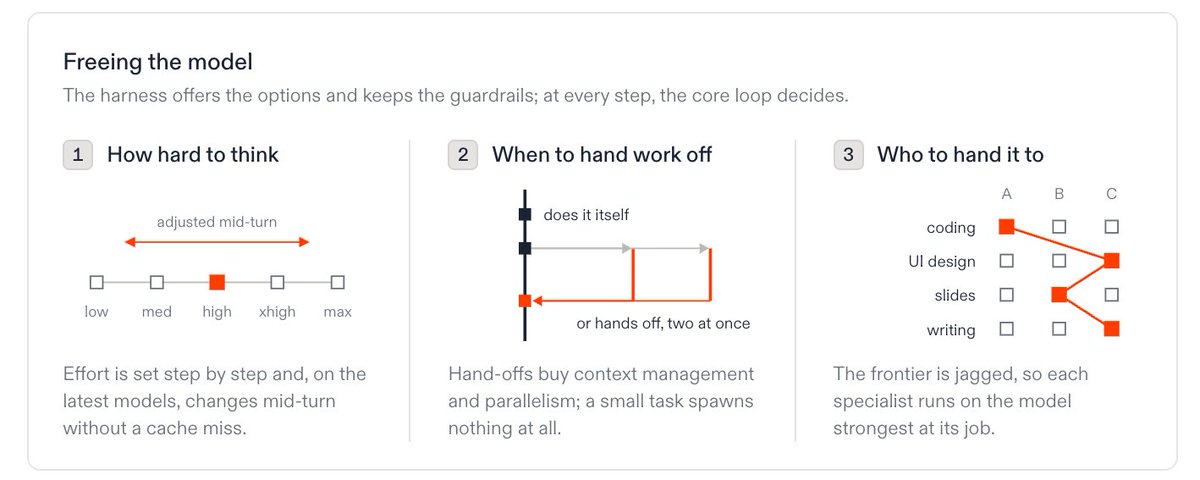
harness doesn't disappear as models get smarter - it shifts from deciding to offering
in deepagents you give each subagent its own model, tools, and permissions - the main loop picks which to spawn and when
docs: docs.langchain.com/oss/pytho…


Big big change for us at @useMotley , opens up a lot of possibilities

A pretty big change is that Pi now has MCP at the core. How is this even possible? What made us change our way? earendil.com/posts/you-said-…

Yann Ranchere retweeted

How do you know if your semantic layer is bad?
Users' AI agents already know, but they have no way to tell you. Every time an agent has to invent a metric definition or can't find the data it's looking for, it's a signal that gets lost.
Motley now captures it.
Every question a user asked, every step their agent took, and the agent's own report: answered, missing data, unclear docs, wrong result.
Look at those and fix the causes (an agent can help with that too), and the semantic layer quickly gets good at even the most complex questions a team and its users have.
Full post: motley.ai/blog-posts/how-do-…
