

(she/her) Collaborative Scientist @kpwaresearch Health Services PhD from @uwsph VA pre-doctoral fellow @VAPugetSound Views are my own.
Seattle, WA
Joined March 2011
- Tweets293
- Following275
- Followers186
- Likes693



"People respond well when you offer them help beyond their clinical concerns," but doing this well in a clinical context is challenging. Excited to work with Joe and @CDIAS_Stanford to implement care navigation for people seeking care for substance use.

"We are trying to help folks resolve social and practical needs that get in their way when they are trying to get care." Joe Glass, PhD, leads a new project that will support people seeking care for substance use: bit.ly/3L1F1u3
We need better tools for assessing substance use disorder. Psychometric analyses now support use of a brief substance use symptom checklist in primary care.
kpwashingtonresearch.org/new…
Congrats Lesley!! – at Burien, WA

Congratulations to Lesley Steinman, PhD, MSW, MPH (she/her), Research Scientist at @uwsph's Health Promotion Research Center on being awarded the Gilbert S. Omenn Award for Academic Excellence at the 2023 SPH Excellence Awards!
Tessa Matson retweeted

Getting this @NIDAnews T32 to train next gen leaders in #equity and structural solutions for addictions (TESSA) is a dream come true, and it took a village. We are thrilled and grateful. @ElizabethJ_Aus @G_Chander_GIM @UW_Dept_HSPop @uwsph @profe_ornelas

1/2 Principal investigators @emcatwil1 (Public Health), Judith Tsui, and @G_Chander_GIM have recently received >$1.4 million over five years to establish the Training in Equity and Structural Solutions in Addictions (TESSA) program.
This decision aid is an excellent resource for people thinking about their drinking and are curious about what options are out there. Human-center designed with patient and provider feedback, ft. real stories reflecting a range of experiences with alcohol
kpwashingtonresearch.org/liv…
Tessa Matson retweeted

“One of the beautiful things about qualitative work is interacting with people most affected… I’ve been touched how willing people have been to be part of this study, it wouldn’t be possible without them.” -Érica Chavez Santos, PhD candidate
Read more: deohs.washington.edu/nwcohs/…

ALT Érica Chavez Santos stands on campus wearing a backpack.

ALT A Washington state agricultural worker stands while picking apples from a tree.
Congrats @yayyyates!
Biostatistics researcher Yates Coley, PhD, (@yayyyates) recently received a 2023 Emerging Leader award from @COPSSNews in recognition of leadership and contributions to help shape the future of the field. Learn more about their work in this Q+A: bit.ly/3Ul0DVv
Tessa Matson retweeted

Excited to share results from SPARC trial @kpwashington! We implemented alcohol-related care w/a broader program of integrated mental health in primary care & ⬆️ alcohol screening, brief preventive alcohol counseling, new dx of alcohol use disorder & alcohol treatment initiation.

The SPARC trial resulted in high rates of alcohol screening and assessment & increased brief preventive alcohol counseling. More research is needed to meaningfully increase patient-centered prevention and treatment of alcohol use disorder in primary care. ja.ma/3Y3ZqCf
Tessa Matson retweeted
Practice facilitation (w/love) can help get #alcohol on the #primarycare agenda in the context of organizational integration of behavioral health! Decades of #impsci learning but more needed. @amykzlee @KPWaResearch @jangerhofer @cea1962 @EvetteLudman
The SPARC trial resulted in high rates of alcohol screening and assessment & increased brief preventive alcohol counseling. More research is needed to meaningfully increase patient-centered prevention and treatment of alcohol use disorder in primary care. ja.ma/3Y3ZqCf
Tessa Matson retweeted

Screening for cannabis use in primary care is helpful for understanding how and why patients use cannabis. Read more about three recent studies from our researchers looking at cannabis use in Washington state: bit.ly/3liXisN
Tessa Matson retweeted

“Over the course of the pandemic, we saw racist violence against multiple marginalized racial and ethnic groups, including violence perpetrated by police, the immigration system, and more,” said @fan_carolyn, who led research on these hate incidents. bit.ly/3Gx1XOH
Tessa Matson retweeted
Congratulations to our 2022 mentorship award winners: Anne Renz, Outstanding Mentor of Staff, and Allen Cheadle, Outstanding Mentor of Scientists. Read about how they help colleagues grow professionally: bit.ly/3j92mPu
Tessa Matson retweeted
Both patients and clinicians valued a standardized question about firearm access and felt that it helped promote dialogue, according to new research led by KPWHRI researcher Julie Richards, PhD (@jangerhofer) and published in @JAMAHealthForum: bit.ly/3u8Cd5p
Tessa Matson retweeted
How do patients and clinicians prefer to use apps in routine primary care? KPWHRI investigator Joe Glass, PhD, & co-authors look at answers to this question in a new paper in @ImpResearch focused on digital interventions for alcohol use disorders: bit.ly/3NWcxCb

Tessa Matson retweeted
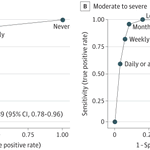
In a new study in @JAMANetworkOpen, KPWHRI Research Interventionist @tessamatson & co-authors find that a single screening question used in routine primary care performed well to screen for cannabis use disorder in a state with legal cannabis use: bit.ly/3UotYgR

Tessa Matson retweeted
Today was a big day. In addition to @taylorswift13 announcing her tour, @tessamatson -- awesome @UW_Dept_HSPop PhD alum--'s first dissertation paper is now OUT, people!! jamanetwork.com/journals/jam… @KPWaResearch @uwsph #SISc --it works.

Very excited to share Aim 1 from my @uwsph @UW_Dept_HSPop dissertation focused on evaluating screening, assessment, diagnosis and treatment of #cannabis use disorder in real-world care! @KPWaResearch

Single-Item Screen for Cannabis (SIS-C) demonstrated excellent performance when screening for cannabis use disorder in routine primary care. #OAResearch ja.ma/3fmeNFW
A threshold of "less than monthly" or more frequent cannabis use had the best balance of sensitivity (88%) and specificity (83%).
A single-item screen for #cannabis, administered to @kpwashington primary care patients as part of routine annual screening for behavioral health conditions, had high discriminatory power (AUROC=0.89).
