

India’s finest magazine of politics and culture. @thecaravanhindi: https://nitter.cf/t.co/QdFgOOw57j
New Delhi
Joined October 2009
- Tweets114K
- Following266
- Followers407K
- Likes1.7K






Pinned Tweet
The October 2026 issue—The historic wave of labour unrest that swept India; Prashant Kishor’s theory of power cannot be trusted; The spiritual cronyism of Modi and BAPS; How to write a dictator; Trump’s familiar playbook on dealing with the media; and more
Read now: caravanmagazine.in/magazine
The October 2026 issue is now available online for all subscribers. If you are a subscriber and unable to log in to our website, please write to [email protected]
Print copies of the issue will be delivered to print subscribers and rolled out to newsstands over the next two weeks, depending on location. Copies will also be available for purchase on Amazon from October 10th.
The Caravan is able to publish journalism like this thanks to the support of our subscribers. To help us continue doing this work, subscribe today: caravanmagazine.in/subscribe
Or contribute: caravanmagazine.in/contribut…
Cover Photograph by Anushree Fadnavis/REUTERS

Archives | After Rohith Vemula’s death, the HRD minister, Smriti Irani, falsely claimed that a Dalit had headed the committee that had recommended the expulsion of the five ASA students from their hostels.
Report by Praveen Donthi: caravanmagazine.in/reportage…


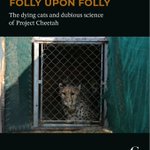
Archives | The cheetah project has been plagued by scientific and logistical failures from the outset. Reports have exposed a lack of expertise, irregularities in implementation and the government’s refusal to acknowledge its mistakes—even as cheetahs die in captivity and communities near Kuno suffer the fallout. International experts have raised concerns over India’s lack of space and prey for the species, while experts and officials within the Modi government who once backed the project have since been sidelined.
Two and half years on, three foreign experts associated with the project are no longer actively involved. MK Ranjitsinh, one of India’s foremost wildlife bureaucrats and chairperson of a committee appointed by the Supreme Court to oversee the experimental introduction of African cheetahs, told me that the project “has become more an exercise in political propaganda than a scientific conservation endeavour.”
Read our cover story from April 2025, a report by @akhileshhpandey: caravanmagazine.in/environme…
Given that the landscape being managed for the introduction of African cheetahs continues to lack adequate numbers of prey, free-ranging cheetahs have been spotted travelling far from Kuno, sometimes crossing over into Rajasthan’s drier ecology and hunting cattle to sustain themselves. If they sprint too far or cross state boundaries, the monitoring teams following them round the clock often tranquillise the cats—110 times in the project’s first two years alone—to capture and bring them back to Kuno. In early June, the cheetah KP-3 was seen near the Band Baretha sanctuary in Rajasthan. It soon became the third cheetah in six weeks to be tranquilised and brought back from Rajasthan to Kuno.
@akhileshhpandey reports: caravanmagazine.in/environme…

In the attempt to establish their territories in the wild, the cats could die of any number of causes. The unluckier ones among Kuno’s free-ranging cheetahs died in freak accidents: a cub died in a suspected fall from a hill just a day after his release into the wild last December; the same month, another young cheetah escaped the park only to be run over on a highway link road in Gwalior district; and, in August 2024, a lone free-ranging male was found dead near a river.
Although it is tempting to blame fatal accidents and deaths in the wild for the caginess of the authorities at the Kuno National Park, the prized cheetahs are not safe in captivity either. @akhileshhpandey reports: caravanmagazine.in/environme…

Stories beyond the headlines. Commentary that challenges conventional wisdom.
Subscribe now to read and support journalism that stands the test of time.
caravanmagazine.in/subscribe

For a project whose key aim is to establish cheetah populations in the wild, captive breeding is just the opposite of a desirable outcome. Yet, more than half of the 52 surviving cheetahs were born in Kuno, amid celebratory social-media posts and press releases by politicians and government officials, who hailed each birth as a sign of Project Cheetah’s success. That most of the cheetahs are now being confined to and bred within enclosures goes against the Cheetah Action Plan.
@akhileshhpandey reports: caravanmagazine.in/environme…

Even the plan to breed African cheetahs from the same subspecies in captivity, though scientifically permissible under certain conditions, is antithetical to Project Cheetah’s central aim: establishing a free-ranging population that can protect its territories and sustain its numbers in the wild. Holding wild-caught animals in captivity was only meant to be a necessary stopgap while transferring them from one habitat to another, or conducting medical screenings or treatment. Today, the arrangement has become near-permanent—with African cheetahs being fed goat meat inside fenced enclosures in Kuno—in a clear deviation from the Action Plan for Introduction of Cheetah in India, the key government document outlining the project’s goals, indicators of success, timeline, challenges and mitigation strategies.
@akhileshhpandey reports: caravanmagazine.in/environme…

This photograph, showing a tall man lying in front of a tranquilised African cheetah, his back leaning against the sedated cat’s belly, surfaced on Facebook in late 2025. The image, which appeared to have been clicked on 30 October, caused outrage on social media before it was quickly taken down.
@akhileshhpandey reports on the dying cats and dubious science of Project Cheetah: caravanmagazine.in/environme…

Archvies | Kuno is one of the sites of Prime Minister Narendra Modi’s grand vanity project: Project Cheetah. The scheme, announced to great fanfare in 2022, involved introducing African cheetahs to India.
The cheetah project has been plagued by scientific and logistical failures from the outset. Reports have exposed a lack of expertise, irregularities in implementation and the government’s refusal to acknowledge its mistakes—even as cheetahs die in captivity and communities near Kuno suffer the fallout. International experts have raised concerns over India’s lack of space and prey for the species, while experts and officials within the Modi government who once backed the project have since been sidelined.
Read @akhileshhpandey's cover story from our April 2025 issue:
caravanmagazine.in/environme… #KunoCheetah
📷 Stills from a video, shot on 24 March 2025, show a crowd watching cheetahs on the outskirts of Behardha village, near Kuno National Park’s northern boundary. According to a wildlife expert who saw the video, the cheetahs looked hungry and showed “clear signs of physiological and behavioural stress.”

The Caravan retweeted
On Sunday, the United Hindu Front, the Global Vaishya Federation and the Delhi Agroha Vikas Trust held a demonstration at Delhi's Birla Mandir in support of CEC Gyanesh Kumar. Speakers alleged that the protests demanding Gyanesh's resignation were part of a conspiracy to spread anarchy and inflict losses on the country's traders. The protesters then began marching to Rahul Gandhi's residence, waving national flags, but were stopped by police just outside the temple. They sat there for a while, before returning to the temple for lunch.
Videos by Sibtain Hyder and Sunil Kashyap (@SunilKashyap0)
The Caravan retweeted
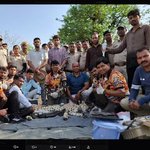
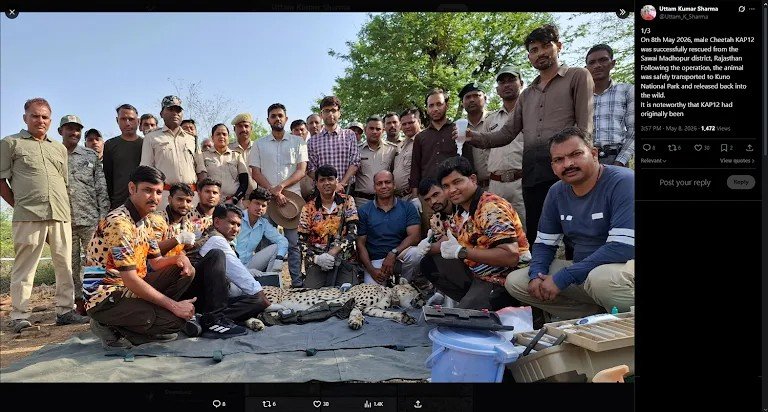
Cheetahs attempting to establish territories beyond Kuno have often been tranquilised, captured and brought back to the national park, such as in May 2026, when panicked forest officials brought back two cheetahs from human-dominated areas of Rajasthan. In photographs shared on X by Uttam Kumar Sharma, the field director at Kuno, officials, trackers and wildlife staff are seen posing over each sedated cheetah.
Read the full reportage by Akhilesh Pandey (@akhileshhpandey): caravanmagazine.in/environme…
The Mazdoor Kisan Shakti Sangathan carried out a social audit of the ongoing SIR process at Trilokpuri, Delhi. In four booths, volunteers followed up on 1,236 deleted names from the electoral rolls, going house to house to verify the Election Commission's grounds for deletion. On 27 October, the grassroots organisation held a public hearing to present their findings. They alleged that 416 names—more than a third of their sample—were wrongfully deleted.
Residents could verify their status, and people who stand to lose their voting rights spoke out. Noting that the election manual already provides for this type of exercise to be carried out every time voters are excluded, the MKSS demanded that such social audits be conducted in each polling booth of the country, at least three months before an election.
Video report by Sibtain Hyder, Sunil Kashyap (@SunilKashyap0) and Hiral Trivedi (@hiraltrivedi17)
Workers in industries such as mining, quarrying, construction, glass are exposed to high quantities of active silica dust, and often contract a fatal and incurable lung disease called silicosis. It causes the formation of fibrous nodules in the lungs, slowly choking patients to death. The scale of silicosis in India is staggering—research estimates suggest that 52 million workers will be at risk of the disease by 2025.
But just as staggering is the absence of the disease from the public imagination, and the government’s indifference to it. Silicosis is often misdiagnosed as doctors lack awareness of the disease.
Over the course of one and a half years, Akhilesh Pandey (@akhileshhpandey) visited silicosis victims in close to two hundred villages across 12 states in India. It became clear in his reporting that no one thing had damned the victims more than the accident of their birth—they were poor, forced to migrate for work, and undertook any job they could get. Most worked as undocumented daily-wagers, outside the basic protections of Indian labour laws and without access to any reliable healthcare.
This documentary sheds light on the deadly malady that is stalking India’s workers. Watch here: youtu.be/_oyLShli0r4

In the episode 16 of #CaravanBaatcheet, Vishnu Sharma (@hellovishnu) spoke to former Supreme Court of India judge and jurist Justice Madan B Lokur about the collegium system to understand why the executive and the judiciary are at odds.
Watch the episode: youtu.be/ELhO76I_qbg

Cheetahs attempting to establish territories beyond Kuno have often been tranquilised, captured and brought back to the national park, such as in May 2026, when panicked forest officials brought back two cheetahs from human-dominated areas of Rajasthan. In photographs shared on X by Uttam Kumar Sharma, the field director at Kuno, officials, trackers and wildlife staff are seen posing over each sedated cheetah.
Read the full reportage by Akhilesh Pandey (@akhileshhpandey): caravanmagazine.in/environme…
Stories beyond the headlines. Commentary that challenges conventional wisdom.
Subscribe now to read and support journalism that stands the test of time.
caravanmagazine.in/subscribe

Archives | The IITs, at both institutional and alumni-association levels, do not embody a progressive vision for India—as in, furthering a democratic, secular, and egalitarian ethos. In fact, owing to their upper-caste demographic, non-liberal pedagogy and location at the apex of a grasping middle-class order, the IITs have come to display reactionary, nationalistic and pro-establishment attitudes.
Read the entire essay on caste and the delusion of “merit” in Indian higher education by Namit Arora: caravanmagazine.in/caste/the… #IIT

The official policy of Namibia, which sent the first batch of cheetahs for the project, in 2022, states that large carnivores captured from the wild should not be held captive for more than ninety days. If they are held captive for longer, they should either be euthanised or remain permanently captive. The longer a wild-born cheetah stays in captivity, the more it struggles with hunting, re-adapting to the wild and resuming its communication system. Cheetahs in prolonged captivity are also prone to physiological changes that leave them unfit for release in the wild. It is worth asking, then, why it took the Modi government nearly two years to act on the Supreme Court’s suggestion to disperse their population over a wider geographical range. In April 2025, the government made its first transfer of the cheetahs to a site other than Kuno, sending two mature males and, soon after, a female—all from South Africa—to an enclosed area of sixteen square kilometres in the Gandhisagar wildlife sanctuary in Madhya Pradesh. It is highly unlikely the three will ever be released into the wild.
Read the full reportage by Akhilesh Pandey (@akhileshhpandey): caravanmagazine.in/environme…

On Sunday, the United Hindu Front, the Global Vaishya Federation and the Delhi Agroha Vikas Trust held a demonstration at Delhi's Birla Mandir in support of CEC Gyanesh Kumar. Speakers alleged that the protests demanding Gyanesh's resignation were part of a conspiracy to spread anarchy and inflict losses on the country's traders. The protesters then began marching to Rahul Gandhi's residence, waving national flags, but were stopped by police just outside the temple. They sat there for a while, before returning to the temple for lunch.
Videos by Sibtain Hyder and Sunil Kashyap (@SunilKashyap0)