

Crime made headlines. Law enforcement fought back. Explore the history of organized crime at The Mob Museum in Las Vegas.
Las Vegas - Downtown
Joined July 2009
- Tweets10.8K
- Following2.4K
- Followers25.3K
- Likes7.4K






“Success. It's got enemies. . . You can be successful and have enemies or you can be unsuccessful and have friends.”
In the 2007 film "American Gangster," fictional Mob boss Dominic Cattano delivers this warning to Frank Lucas, portrayed by Denzel Washington, as Lucas’s growing drug empire threatens to upset the balance of power in New York’s criminal underworld.
The warning captures one of the film’s central themes: In organized crime, success often comes at a price.
Inspired by real events, "American Gangster" tells the story of Frank Lucas, a notorious drug trafficker who challenged the Italian Mafia’s influence over the heroin trade in New York City and New Jersey during the early 1970s. Lucas built a lucrative criminal operation by establishing a supply network from Southeast Asia, bypassing traditional Mob intermediaries. But his rise to power eventually attracted the attention of law enforcement, culminating in his arrest in 1975.
When "American Gangster" hit theaters, it became one of Washington’s highest-grossing films, earning more than $269 million worldwide.

In 1986, John and Sandra Vaccaro made Nevada gaming history when they became the first casino cheaters added to the state's List of Excluded Persons, better known as the Black Book.
Their inclusion marked a turning point in Nevada gaming history, signaling a gradual shift from notorious Mob figures to casino cheaters as the primary additions to the list.
As casino technology evolved, so did the methods used to beat the house.
At The Mob Museum, artifacts on loan from the Nevada Gaming Control Board reveal the extraordinary lengths some cheaters went to exploit casino machines. From a homemade computer designed to predict video poker hands to a device that could turn $1 into $100 in slot machine credits, these seemingly rudimentary inventions exposed vulnerabilities in casino technology.
How did a few buttons, wires and a little ingenuity threaten the house? Watch to uncover the stories behind these casino cheating devices and discover how their creators tried to beat the odds.
The Mob Museum retweeted

The DEA extends its profound gratitude to the many cities that illuminated their buildings and landmarks, during #RedRibbonWeek. Thank you, City of Long Beach, for adding a red glow to more than just your building! You lit up landmarks and bridges, including the International Gateway Bridge. City of Las Vegas you also came through, lighting up City Hall. Also in Las Vegas, the Mob Museum blushed in red. Thank you! Big shout outs also to the cities of Los Angeles, Lancaster, and Palmdale. Thank you Port of Los Angeles! You all helped shed light on the importance of living a healthy lifestyle, free from drugs. Together, we honor the legacy of fallen DEA Special Agent Enrique “Kiki” Camarena.
@DEAHQ @DEATerryCole @TheJusticeDept @City_of_Anaheim @longbeachcity @CityOfLasVegas @themobmuseum @LACity @cityoflancaster @cityofpalmdale @PortofLA
Did the Chicago Mob have a hand in the assassination of President John F. Kennedy?
A new feature film, "November 1963," explores one of the most enduring conspiracy theories surrounding Kennedy's assassination: that the Chicago Outfit helped orchestrate his murder.
Directed by Roland Joffé, the film stars John Travolta as mobster Johnny Rosselli, Mandy Patinkin as Chicago Outfit boss Tony Accardo, and Jefferson White as Lee Harvey Oswald. Set to hit theaters Dec. 4, the film explores the theory that the Mob turned against Kennedy after his administration launched an aggressive crackdown on organized crime.
But where did this theory come from?
Screenwriter Nicholas Celozzi, a relative of notorious Chicago Outfit boss Sam Giancana, told The Mob Museum that his screenplay draws on stories from individuals who claimed to have inside knowledge of the events, including Giancana’s brother, Joseph “Pepe” Giancana.
According to the theory, the Chicago Outfit helped Kennedy win the 1960 presidential election in exchange for an understanding that his administration would go easy on organized crime. Instead, Attorney General Robert F. Kennedy intensified the federal crackdown, allegedly leaving the Mob feeling betrayed.
But historical evidence tells a more complicated story.
Historian John Binder disputes the notion that the Outfit influenced Kennedy's election. In a 2007 statistical analysis, Binder found no evidence that Chicago neighborhoods, suburbs or labor unions with alleged Outfit ties voted disproportionately Democratic in the 1960 presidential election.
More than six decades after Kennedy's assassination, questions about possible Mob involvement continue to fuel speculation. But how much of the story is rooted in fact, and how much remains conspiracy theory?
Read more about the film, the claims behind its storyline and what historians have uncovered about the Mob’s alleged involvement in Kennedy’s assassination on our blog.
themobmuseum.org/blog/novemb…

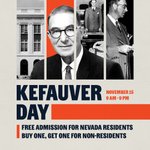
It’s everyone’s favorite day of the year: Kefauver Day!
On November 15, 1950, the historic courthouse that now houses The Mob Museum hosted a hearing of the Kefauver Committee, a U.S. Senate investigation into organized crime in interstate commerce.
To commemorate this pivotal moment in history, The Mob Museum is celebrating its 14th annual Kefauver Day on November 15 with special admission offers!
🎟️ FREE admission for Nevada residents
🎟️ Buy one, get one FREE admission for nonresidents
Join us as we celebrate the history that happened right here, more than 75 years ago!
themobmuseum.org/events-post…

It's Halloween, which means we have a chilling tale of betrayal, revenge, and a deadly Mafia power struggle for you. 🎃
When Carlo Gambino died in October 1976, he left behind more than a criminal empire. His decision to name Paul Castellano as his successor instead of longtime underboss Aniello “Neil” Dellacroce sparked a bitter rift within the Gambino crime family.
But some grudges don't stay buried.
Nearly a decade later, those tensions culminated in a deadly assassination plot orchestrated by John Gotti.
Swipe through to uncover how one decision changed the Gambino crime family forever. Then, click the link below to read the full story.
themobmuseum.org/blog/new-yo…


Enrique “Kiki” Camarena was a Drug Enforcement Administration (DEA) special agent assigned to investigate drug trafficking in Guadalajara, Mexico, during the 1980s. His investigative work helped Mexican federal police and the DEA uncover a massive marijuana-growing operation, leading to 177 arrests and an estimated $50 million in losses for cartel figure Rafael Caro Quintero.
But Camarena's efforts came at a devastating cost.
On February 7, 1985, Camarena was kidnapped in Guadalajara. He was later murdered by drug traffickers. He was just 37 years old, leaving behind his wife, Mika, and their three children.
Before joining the DEA, Camarena reportedly told his mother, who had tried to discourage him from pursuing the dangerous career, “I'm only one person, but I want to make a difference.”
His words would take on new meaning following his death.
In 1985, friends, family members and communities across the country began wearing red ribbons in Camarena's memory, symbolizing their commitment to raising awareness about the devastating effects of drug abuse and trafficking.
What began as a tribute to one fallen agent grew into a nationwide movement. In 1988, the National Family Partnership sponsored the first National Red Ribbon Celebration, establishing a tradition that continues to reach millions of children and families each year.

Happy Halloween to those with a curiosity for the macabre, the morbid, and the downright eerie. 👻🎃
Some of history’s darkest stories have left behind chilling reminders. From evidence recovered from gruesome crime scenes to the personal possessions of notorious mobsters, these artifacts in The Mob Museum’s collection have some seriously sinister backstories.
Take a closer look at the sinister histories behind:
•Bullets recovered from victims of the St. Valentine’s Day Massacre
•Joe Pesci’s animatronic torso from the 1995 film "Casino"
•Roy DeMeo’s machete and ice pick
•Nevada’s gas chamber chair
Because sometimes, history is far more horrifying than fiction.
Halloween takes over The Mob Museum for an unforgettable night of Prohibition-era revelry, live entertainment and spirits of both the cocktail and supernatural kind. 👻🥃
Step into The Underground speakeasy and distillery or head outside to the Starlight Event Plaza for an evening of specialty craft cocktails, mocktails, live jazz and a little Halloween magic.
Coco and The Sidecars will bring roaring ’20s jazz to the Starlight Event Plaza, while Amanda King and Her Prohibition Three set the mood inside The Underground. Magician Nick Stone will add an extra touch of mystery to the festivities.
🎃 Admission is FREE!
To enter The Underground, simply give our guy on the inside the password: SPELLS & SPIRITS.
Must be 21 or older to attend. Outdoor festivities are weather permitting.

One of America’s most notorious mobsters wasn’t brought down by a rival gangster or a hail of bullets. Instead, it was tax evasion that ultimately landed Al Capone behind bars.
In October 1931, the Chicago crime boss stood trial on federal tax evasion charges. Throughout the proceedings, prosecutors pulled back the curtain on Capone’s extravagant lifestyle, revealing his lavish spending on luxury clothing, expensive automobiles, and his Florida estate.
Al Capone's lavish spending helped expose his wealth during his 1931 tax evasion trial. Among the expenses presented in court? A $3,141 Miami telephone bill, which is equivalent to nearly $71,000 today.
But it was the smaller luxuries that offered a glimpse into Capone’s expensive tastes. Jurors learned that he purchased $12 pairs of silk underwear, favored monogrammed shirts costing as much as $27 each (nearly , and owned sterling silver dinner sets. His furniture preferences were just as distinctive, with canary yellow and green among his favorite colors.
As the trial drew to a close on Oct. 17, U.S. Attorney George E.Q. Johnson urged jurors to consider where Capone’s wealth originated. In his closing remarks, Johnson delivered a statement that captured the significance of the case: “Future generations will not remember this case because of the name Alphonse Capone, but because it will establish whether or not a man can go so far beyond that law as to be able to escape the law.”
That same day, a federal jury convicted Capone of tax evasion and related tax offenses.
On Oct. 24, 1931, Judge James H. Wilkerson handed down a staggering sentence: 10 years in federal prison, an additional year and a half of jail time, and $50,000 in fines and court costs.
“I guess it’s all over,” Capone told his attorneys. “You done all you could.”
The conviction marked the beginning of the end of Capone’s reign over Chicago’s underworld. After initially serving time at a federal prison in Atlanta, he was transferred to the notorious Alcatraz Island in 1934.
Capone was released in 1939 after serving approximately eight years, but his health had deteriorated significantly. He spent his final years at his Florida estate, where he died on Jan. 25, 1947, just days after his 48th birthday.


Follow the evidence. Step into the underworld. Witness it all at The Mob Museum.
Discover the true stories of organized crime and law enforcement in the heart of downtown Las Vegas.
“I don't shine shoes no more.” 🍂
Hot girl summer is out. Goodfellas fall is in. 🤌
Forget pumpkin spice. We're talking wiseguys, tracksuits, and iconic Mob movie moments.
Get into the spirit of the season at The Mob Museum's Mob in Pop Culture exhibit, featuring artifacts that pay homage to "Goodfellas," and the real-life stories that inspired the film.
Our fall plans? Just “working nights,” Ma. Now pass the pasta and don't ask about the trunk...
On #ThisDayInHistory in 1935, notorious New York mobster Dutch Schultz died from gunshot wounds sustained when gunmen opened fire on him and three of his associates at a Newark, New Jersey, restaurant the night before.
Born Arthur Flegenheimer in the Bronx in 1902 to Russian-Jewish immigrants, Schultz entered a life of crime at an early age. After serving time for burglary, he became associated with Arnold Rothstein’s criminal network and rose through New York’s underworld during Prohibition.
Adopting the alias “Dutch Schultz,” he built a lucrative bootlegging empire that earned him the nickname “Beer Baron.” Following the repeal of Prohibition in 1933, Schultz shifted his focus to Harlem’s profitable numbers racket, further expanding his criminal empire. His violent feuds with rival underworld figures, including Jack “Legs” Diamond and Stephanie St. Clair, cemented his reputation as one of New York’s most ruthless criminals.
But Schultz’s growing power and increasingly reckless behavior would ultimately lead to his downfall.
By the mid-1930s, Schultz was facing mounting pressure from law enforcement, particularly special prosecutor Thomas Dewey, who had made organized crime a prime target. Determined to eliminate the threat, Schultz proposed assassinating Dewey. The Commission, the Mob’s ruling body, rejected the plan, fearing that murdering a prosecutor would unleash an unprecedented law enforcement crackdown.
Schultz reportedly refused to back down. His defiance sealed his fate, and the Commission moved to have him killed.
On the night of Oct. 23, 1935, at least two gunmen entered the Palace Chop House in Newark, New Jersey, where Schultz and three of his associates were gathered. Schultz had stepped into the restroom moments before the attack. Gunfire erupted, leaving all four men critically wounded.
As Schultz lay dying in a Newark hospital, police desperately tried to identify his attackers. But instead of answers, investigators were met with a stream of bizarre, fragmented statements.
When asked who shot him, Schultz replied, “The boss himself.” Moments later, he contradicted himself, insisting, “Who shot me? No one.”
Among his most haunting remarks was a line that would become part of his enduring legend: “A boy has never wept nor dashed a thousand kin for nothing. Did you hear me?”
A police stenographer recorded his ramblings, preserving one of the most unusual deathbed accounts in organized crime history.
Schultz died later that evening at age 33. His cryptic final words have fascinated historians for decades, fueling speculation about his killers and an alleged hidden fortune that some believe remains undiscovered.


Once dubbed the “Prime Minister of the Underworld” by Treasury agents, Frank Costello spent decades building his influence in organized crime while largely avoiding serious prison time. But in 1951, a nationally televised congressional hearing threatened to bring his winning streak to an end.
As one of New York’s most powerful organized crime figures, Costello was called to testify before the Kefauver Committee, a Senate investigation into organized crime across the United States. His evasive answers and refusal to discuss his finances and political connections frustrated lawmakers, setting the stage for a dramatic confrontation.
On March 15, 1951, Costello made it clear he wanted no further part in the committee’s proceedings.
“Am I under arrest?” he asked.
“No,” replied Rudolph Halley, the committee’s chief counsel.
“Then I am walking out,” Costello fired back, rising from his seat in defiance of the committee.
His actions came at a cost. Costello faced 11 contempt of Congress charges and, following two trials, was convicted on 10 counts. He was sentenced to 18 months in federal prison and fined $5,000, later reduced to $2,000 on appeal.
On Aug. 15, 1952, Costello surrendered to federal authorities in New York, telling reporters, “I don’t want no favors from nobody. I wanted to be treated like everybody else.”
After serving approximately 14 months, Costello was released from a federal prison in Michigan on Oct. 29, 1953.
The Kefauver Committee’s investigation also has a direct connection to The Mob Museum. On Nov. 15, 1950, just months before Costello’s dramatic testimony, the committee held a hearing in the historic Las Vegas courtroom that now serves as the centerpiece of the Museum.
Join us on Nov. 15 for Kefauver Day! Nevada residents receive free admission to The Mob Museum, while nonresidents can take advantage of buy one, get one free admission. Explore the historic courtroom where the hearing took place and discover how the investigation helped shape Las Vegas and the nation’s understanding of organized crime.

Joseph “Joey” Cusumano, a longtime figure in Las Vegas’ organized crime history and trusted confidant of Chicago Outfit enforcer Tony Spilotro, died Oct. 20 at age 90.
Originally from New York, Cusumano arrived in Las Vegas in 1968 with connections to Anthony “Fat Tony” Salerno and Vincent “Jimmy Blue Eyes” Alo. He helped deliver skimmed casino profits to New York and later opened Joey’s New Yorker, a popular restaurant and nightspot on the Las Vegas Strip.
By the early 1970s, Cusumano had become a close associate of Spilotro and was involved in various street rackets. Following the murders of Tony and Michael Spilotro in 1986, Cusumano was considered a possible successor to oversee the Chicago Outfit’s street operations in Las Vegas, but he declined.
In 1987, Cusumano was convicted of labor racketeering involving the Culinary Union’s life insurance plan. Three years later, Nevada gaming regulators added him to the state’s Black Book, barring him from entering Nevada casinos.
Just months later, Cusumano narrowly survived an assassination attempt outside his Las Vegas home. A masked gunman opened fire as Cusumano opened his garage door, striking him three times. Despite his injuries, he managed to escape in his Mercedes-Benz convertible and drive himself to Sunrise Hospital.
Reflecting on Cusumano’s death in a phone interview, former Las Vegas Mayor Oscar Goodman, who represented Cusumano as a defense attorney, recalled their meetings at the Las Vegas Country Club, where the two would often reminisce “about the old days.”
Goodman also remembered a running joke between them as their circle of longtime friends grew smaller over the years.
“We used to kid each other about who’s going to be the last man standing,” Goodman said. “We would laugh about it, because all of our friends were dropping like flies.”


Read more about Cusumano’s life and his place in Las Vegas’ organized crime history in our latest blog post.
themobmuseum.org/blog/joey-c…

In October of 1968, Circus Circus opened its doors on the Las Vegas Strip, welcoming more than 10,000 people to what was dubbed the “green felt Disneyland.” Founder Jay Sarno celebrated in a top hat and tails, introducing a casino unlike anything Las Vegas had seen before, complete with trapeze artists, carnival games, and slot machines.
But behind the spectacle, Circus Circus struggled financially. Without hotel rooms and with an unusual admission fee, the casino failed to turn a profit. Desperate to keep his dream alive, Sarno sought financing through the Teamsters Union, ultimately securing a $7.6 million loan in 1971 with help from Kansas City Mob boss Nick Civella.
The deal came at a price. Circus Circus became entangled with organized crime, with casino profits skimmed and cash funneled to Mob interests in Kansas City and Chicago. Notorious Chicago Outfit enforcer Tony Spilotro even operated a jewelry and gift shop inside the property under the name Anthony Stuart.
In 1974, casino operators Bill Bennett and Bill Pennington took over management, transforming Circus Circus into a profitable, family-friendly destination. They modernized the casino, expanded its appeal to budget-conscious travelers, and brought an end to the Mob's skimming operation.
In this photo, Ernie Burch, dressed as Blinko the Circus Clown, the resident clown at Circus Circus Hotel-Casino in Las Vegas, poses in front of the property’s marquee celebrating National Clown Week.
Photo credit: UNLV Special Collections and Archives, University Libraries.

It was a gambling scandal that made national headlines, involved one of baseball’s biggest superstars, and exposed a multimillion-dollar illegal sports betting operation.
In 2024, the world learned that Ippei Mizuhara, longtime interpreter for Los Angeles Dodgers superstar Shohei Ohtani, had stolen nearly $17 million from the baseball player to pay off gambling debts.
At the center of the scandal was another name: Mathew Bowyer, the illegal bookmaker behind the scandal.
Bowyer pleaded guilty to federal charges of operating an illegal gambling business, money laundering, and filing false tax returns. He was sentenced to 12 months and one day in federal prison, ultimately serving about half that time.
But his story didn't end there.
In April 2026, Bowyer was added to the Nevada Gaming Control Board’s List of Excluded Persons, better known as the “Black Book,” which bars designated individuals from entering Nevada’s licensed casinos. Once associated with notorious organized crime figures such as Tony Spilotro and Sam Giancana, the list now includes Bowyer.
Today, Bowyer is back home, serving a two-year probation that prohibits him from gambling. He has written books, launched an online television channel, and spoken publicly about the dangers of gambling addiction.
As sports betting becomes increasingly accessible through smartphones, television advertising, and online platforms, Bowyer is raising questions about an industry he once operated in illegally.
In a recent interview with The Mob Museum, Bowyer reflected on his past, his controversial inclusion in Nevada’s Black Book, and what he believes needs to change in the sports betting industry.
Read the full story here: themobmuseum.org/blog/former…

On Oct. 17, 1929, Charles “Lucky” Luciano was found battered, bloodied, and disoriented along a deserted stretch of Staten Island. Luciano had survived a brutal kidnapping and beating but was left with a drooping right eye and permanent scars across his cheek, neck, and chin. The healed wounds would give him a more “sinister” appearance.
According to Luciano’s account, he had been abducted at gunpoint in Manhattan after receiving a mysterious phone call from a woman. His attackers bound him, covered his mouth with tape, and repeatedly beat and stabbed him before abandoning him near the shoreline. When a police officer discovered him the following morning, Luciano reportedly muttered, “I was taken for a ride.”
Over the decades, conflicting accounts transformed the incident into underworld folklore. Some stories suggested Luciano had survived an attempted Mob execution, while others falsely claimed the ordeal earned him the nickname “Lucky.” In reality, Luciano had been using the nickname long before the attack.
The mystery deepened when Luciano offered his own version of events. In a 1960 interview with journalist Oscar Fraley, he claimed his kidnappers were not rival mobsters but corrupt police officers seeking information about fellow gangster Jack “Legs” Diamond.
“Now I know this is no gang job,” Luciano said. “They don’t put a pistol to your head and make bargains.”
Luciano also claimed that, after recovering from the assault, he threatened retaliation against his attackers. But when another carload of men reportedly came looking for him, Luciano quickly issued a retraction through the grapevine: “I ain’t squealin’ on nobody, and the incident is closed.”
Although Luciano was already familiar to law enforcement, the infamous “gangland ride” thrust him into the national spotlight, drawing widespread attention from authorities and the public alike.

On Oct. 13, 1927, Cleveland crime boss Joseph “Big Joe” Lonardo walked into a barbershop for what would become his final meeting.
By the mid-1920s, Lonardo had emerged as one of Cleveland’s most powerful organized crime figures. During Prohibition, he and his brothers built a lucrative bootlegging operation centered on corn sugar, a key ingredient in the production of illegal whiskey. By controlling much of the local corn sugar trade, Lonardo established a powerful foothold in northeast Ohio’s underground alcohol industry.
But his growing influence fueled dangerous rivalries. As competition intensified, Lonardo became entangled in a violent struggle for control of Cleveland’s bootlegging industry. His associates included Salvatore “Black Sam” Todaro, a trusted lieutenant who would later be suspected of betraying him. Meanwhile, the Porrello brothers emerged as formidable rivals, challenging Lonardo’s dominance of the lucrative corn sugar trade.
On Oct. 13, Lonardo and his brother John arrived without their usual bodyguards at a barbershop owned by Ottavio Porrello at 10902 Woodland Avenue. The brothers entered a back room, where they were ambushed by gunmen. Both were fatally shot, bringing Lonardo’s reign as one of Cleveland’s most powerful figures in the Prohibition-era corn sugar trade to a violent end.
The murders immediately raised suspicions of betrayal. According to historical accounts, Angelo Porrello, who was present during the shooting, told investigators that two gunmen had appeared in the doorway and opened fire. Police questioned his account, but investigators were unable to establish who was responsible.
The brothers were buried on Oct. 18, 1927. Their murders remained unsolved, but the balance of power in Cleveland’s underworld had shifted. With the Lonardos gone, the Porrello family emerged as the city’s new corn sugar barons, intensifying a violent struggle for control of the lucrative trade that became known as the Cleveland Corn Sugar Wars.
