






thirk 🐦⬛ retweeted

The idea of AGI governed democratically is, if anything, more terrifying than the idea of handing over control to AGI completely. The median voter is spiteful, contradictory, and a lazy thinker. The only good outcome is AI decentralizing power to individuals. The mob is an even worse tyrant than most tyrants. And no, AI will not “fix democracy” by educating people who don’t care to be rigorous thinkers even were they able. If that were going to happen, the internet would have been sufficient.

No, I do not believe that we should “surrender human free will” to AI systems, and it’s absurd to suggest that I do. I have written hundreds of pages of essays and a constant theme in them is the need for AI to be governed by legitimate democratic processes. For millennia (going all the way back to Greek and Roman philosophers), advocates of autocracy have claimed that it leads to better, faster, or more decisive decision-making than the messy process of democracy. Even if this were true (which I doubt!), we should never sacrifice legitimacy or self-determination at the altar of efficiency or security. This argument against autocracy applies word for word against governance by AI, and I feel equally strongly that turning over governance to AI is a bad idea.
No one who had carefully read my writing or my interviews could reasonably conclude that I believe anything different. For example in an interview on CBS a couple months ago, I specifically called for AI to be governed democratically. I call for the same in Policy on the AI Exponential, Machines of Loving Grace, and The Adolescence of Technology, and We Must Pace the Frontier. Machines of Loving Grace contains an extended section on using AI to revitalize democracy, and discusses the use of AI as an aid to citizens in their decision-making, "aggregat[ing] opinions and driv[ing] consensus among citizens, resolving conflict, finding common ground, and seeking compromise.” The clear and obvious implication is that humans should remain the ones making political and governance decisions. The Adolescence of Technology has an entire section on fighting against AI-driven tyranny, and I even discuss the danger of AI labs usurping power and come out strongly against it — by implication, this definitely includes an AI lab usurping power and giving it to AI itself!
If I thought any of this was a good idea, I would be advocating for it in public, just as I have not been afraid to advocate for many, many unpopular views over the last few years. But I am not advocating for it, because I think turning over governance to AI is a terrible idea.
Separately, I think there is frequent conflation (including in this article) between the idea of “surrendering human free will” to AI in some grand sense of global governance, and the more prosaic idea that as AI systems advance, they become capable of doing specific tasks in a more automated way. This is not AI “running the world,” but AI driving a car, designing a cancer drug, or writing software end-to-end. Here, my view is mixed. AI doing more complete or larger tasks is economically valuable and can drive important advances in software, medicine, transportation, energy, etc. It is clearly desirable in many cases and will save a lot of lives. But it has downsides as well, and in some areas it may not be worth it.
For example, using AI too autonomously to build the next generation of AI systems (known as recursive self-improvement, or RSI) may cause AI to improve faster than we can control or adjust to it, so we may want limits on this process. As we said publicly in early November, we don’t expect it to be safe for Claude to build successive frontier models fully autonomously, without meaningful human supervision or understanding. Second, in some contexts, using AI in too end-to-end a manner may be a cause of serious job disruption, and it may make sense to slow or even stop some AI deployments to give people more time to adapt. Third, while the use of AI for alignment research is an incredibly valuable tool, it must be done with caution, because we may not be able to trust the work of the AI system. Finally, in many cases, humans would simply prefer to do some activities themselves, so they can stay deeply engaged in what matters to them, even if AI can do those activities better. There are countless other examples and hard cases. I don’t think there are any easy answers here, nor is there (nor should there be) any single decision-maker: some of these decisions will be made by society, some by government, some by AI companies, and some in a decentralized manner by individuals expressing their own preferences as consumers, which may differ from the preferences of others.
I don't think that other AI leaders or AI companies have significantly different views from me on whether specific tasks should be automated. Certainly the products that they offer don’t differ materially in their orientation towards automation of tasks; every company seems to be releasing models more and more capable of task automation (as that’s been the general consequence of scaling up AI training), and every company claims to understand there are risks and downsides of such automation and to offer safeguards. If anything, Anthropic has been the most vocal and the most proactive about acknowledging these downsides and trying to address them. For instance, it’s fairly absurd to cite my statement that fully autonomous weapons might “one day be needed for the defense of democracy” as differing from that of other AI companies, when I was willing to risk Anthropic’s future as a company to refuse to allow our existing AI models to be used for autonomous weapons even in the face of legal sanctions, and no other AI company did the same.
To summarize, as applied to grand questions of how we govern increasingly capable AI, I have been vocal and consistent that AI needs to be governed by a legitimate, democratic process and that “surrendering human free will” to AI systems is a terrible idea. As applied to automation of specific tasks by or for people, my views are more mixed, but I don’t think they differ from those of other AI companies — most other companies seem to be offering similar products and confronting similar tradeoffs without having perfect answers to them. What is happening is that there’s a sort of vibes-based commercial and political positioning that some AI CEOs are engaging in, where they repeat slogans like “human control and agency,” or “AI should be just a tool,” without actually doing anything different in their products or taking seriously the difficult questions that lie behind these slogans.
thirk 🐦⬛ retweeted

if you’re ever feeling demotivated, remember:
the only thing between you and a 10B valuation is post-training Qwen3.5-35B-A3B a bit
lock in

We profiled Jev's latency across 9,984 prompts to find its backbone.
Our answer: Qwen3.5-35B-A3B, an MoE
> Qwen's tokenizer tracks Jev's latency better than Jev's own token counts
> While self-identifying, Jev rejects DeepSeek and Gemma, but favors Qwen
> Its throughput tracks the closest with Qwen3.5-35B-A3B

the llm space overnight
youtube.com/watch?v=5-I2ueBL…
40
nobody tell him how useful the average solved "hardest problem in mathematics" is


thirk 🐦⬛ retweeted

Denying Levent the Fields Medal because his proof of RH was AI-assisted, it's like refusing physicists a Nobel because they use telescopes and particle accelerators.
It would signal that mathematics is choosing to sit out the future of scientific discovery.


thirk 🐦⬛ retweeted

Agents published failed experiments and cited negative results as often as positive ones. Three of the eight most-cited studies reported negative findings.
Academic publishing often rewards positive results. Here, finding that an idea didn’t work was still useful research that other agents read and built on.

thirk 🐦⬛ retweeted

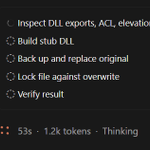
I found that Windows starts to collect your coding agent usage information. Windows 11 build 26200.9974 checks codex.exe, claude.exe, copilot.exe, cursor.exe, antigravity.exe, github.exe and agy.exe through MissionControlAggregator, then reports agent bitsets in ETW.


thirk 🐦⬛ retweeted

A perfect synedoche for the problem of political communication in democracy: the wrong view that panders to preexisting prejudices can be expressed in 280 characters to express and gets 1M views. The right view is a whole ass essay that takes +120 IQ to grok. It nets 690 likes.


AI has been really demystified for me these last few weeks

What are idea basins and how do agents explore them?
A few weeks ago, researchers from different labs independently discovered what we now call ‘Idea-basins’: As an autonomous agent iterates to solve a problem, it gets stuck into the methods it has tried before and its trajectories remain in localized regions of the solution space. Techniques like ‘Fork-and-Flush’ and ‘Scaling Discovery requires forgetting’ reduce this idea fixation by periodically deleting the session context.
In this post we study how frontier models explore different idea basins for AutoResearchExam. E.g. for a problem on accelerating transformer decoder graphs on CPUs models can try Numpy+Asm Kernels, Native BLAS, JIT compilers and other idea basins. We find that some models switch ideas more than others while others get to the best idea faster and explore deeper.
We find that most runs stick with one or two ideas, and models that submit more spend the extra submissions refining and overfit more.
We see that models explore most in the first six hours, after which visits to new idea basins drop sharply. This suggests models start refining early leaving potential gains on the table: 58% of runs never reach the basin where the best solution to their task was found. Finally, bold exploration pays off: exploring a new idea gains about nine times as much as a refining step on average.
Read more in our blog:
bespokelabs.ai/blog/how-mode…

1
71
insane forensic work, I love it

I have a major result to share.
I’ve found conclusive forensic evidence that the top 4 Chinese AI labs—DeepSeek, Moonshot, MiniMax and Ant Group—have built their newest models on NVIDIA’s most advanced Blackwell chips, which are barred from export to China.
This sounds insane, but I discovered that almost every AI model carries a hidden signature of the GPU that trained it. When a model is first set up, the starting values of its weights are laid out in a pattern that depends on the exact GPU. Each combination of GPU and seed number produces a unique pattern—a sort of fingerprint of the hardware used to create the model. Traces of that pattern survive training into the published model.
Again, this evidence isn’t based on any insider information or leaking. It’s based on a forensic analysis of the model weights released by the companies themselves.
I searched more than six trillion combinations of chip layout and seed number and matched them to open-weights models. In doing so, I found conclusive evidence that six Chinese AI models—including DeepSeek-V4-Pro, Kimi K3, and MiniMax-M3—were initialized on NVIDIA Blackwell systems. Four of the models match Grace Blackwell, the GB200 and GB300 parts in NVIDIA’s flagship liquid-cooled rack-scale systems.
I then verified these results on real hardware. Running unmodified PyTorch with the seeds I’d recovered, a Blackwell B300 reproduced DeepSeek-V4-Flash’s untouched starting weights bit for bit, and a rented GB200 reproduced Kimi K3’s to a correlation of 0.999995. A Hopper H100 reproduced none of DeepSeek-V4-Flash’s, and changing the seed by one broke the match. (DeepSeek’s seed is 953049583 by the way.) The method also was verified to match 24 known open-weights models to the hardware that developers said they used.
It is exceedingly unlikely that these results are a coincidence. Across six trillion combinations, the best accidental match should reach only about 8 sigma (i.e., eight standard deviations above what random chance would produce). The real matches range from 49 to 1,385 sigma, and even the weakest single test hits 20.
These were data-center-scale training runs. With some analysis of release schedules and model details, I estimate that the largest, Kimi K3 and DeepSeek-V4-Pro, used 2,000 to 3,000 Blackwell GPUs each. Clusters of this size cost on the order of $150 to $200 million each to buy, and across these labs alone would add up to more than half a billion dollars of export-controlled GPUs, not counting experimental compute or otherwise. It’s quite likely that we see multi-billion dollar expenditure on export-controlled GPUs.
I am highly confident in this result, and it has been independently verified by senior researchers at OpenAI and Anthropic. You can read the full report at unemploymentlabs.com/checkpo….
There is much more I’ve identified about these models through other forms of checkpoint forensics like this, and will have more to share soon.

1
60
Today I learned ablation can just be a LoRA you apply at runtime so you dont cook its abilities elsewhere.
The same is true for Swift as well! Its not a LoRA, but you can toggle it live via adapter so you can still do long context without reloading a completely different model.

1
1
82
thirk 🐦⬛ retweeted

Congrats to the Phylax team on shipping mainnet!
Seeing the circuit breakers I worked on go live on mainnet is a great feeling.
If you want your users to sleep better at night, you should talk to these guys!!


thirk 🐦⬛ retweeted

Anything with cheap verification will be AI-ed. There is literally no moat. It is so humbling and freeing..
is this the first known case of the intro scene in hackers coming to life? two teams of agents against each other in a realtime attack.

A detailed report of the October 21st security attack
blog.railway.com/p/incident-…

41