

Guy that likes AI. Far from an expert. Pretty below average but also pretty chill. Have been called “Brady Short” before.
Joined May 2021
- Tweets17.4K
- Following1.8K
- Followers44.8K
- Likes23.7K






Pinned Tweet
🚨 BREAKING: Google Research just dropped the textbook killer.
Its called "Learn Your Way" and it uses LearnLM to transform any PDF into 5 personalized learning formats. Students using it scored 78% vs 67% on retention tests.
The education revolution is here.
Brady Long retweeted
RIP paid AI memory tools.
MemPalace just hit 49K stars for one reason: it outperforms everything, runs locally, costs nothing, and never sends your data anywhere.
Most AI memory systems work like a junk drawer. You throw everything in and hope semantic search finds the right thing. MemPalace organizes memory into a structured palace where people and projects get wings, topics get rooms, and original text lives in drawers that can be searched individually without crawling the whole corpus.
The benchmark numbers are what shocked me. 96.6% retrieval recall on LongMemEval with zero API calls, zero LLM, zero cloud involvement. Add the hybrid pipeline and it hits 98.4% on questions the system had never seen. Every result is fully reproducible from the repo.
→ Verbatim storage, nothing gets summarized or rewritten ever
→ 29 MCP tools for palace reads, knowledge graph operations, cross-wing navigation, and agent diaries
→ Auto-save hooks for Claude Code keep memory updated before context compression hits
→ Python 3.9 plus ChromaDB is all you need, around 300MB disk and zero API keys
49K stars. MIT License. 100% Opensource.
github.com/MemPalace/mempala…

Brady Long retweeted

This is the cleanest kill to the Figma → handoff → “just make it look like this” I’ve ever seen

UI/UX Designers, did you know you can design directly on top of your real codebase without going back and forth between Figma and your developers?
I uploaded a dashboard codebase from GitHub into Modeinspect, and it instantly turned the existing code into an editable visual interface. Then I tweaked the layout, spacing, and overall look without going back to Figma or waiting on a developer.
Honestly, this is how product design should work.
People are just building anything nowadays with Claude
UI/UX Designers, did you know you can design directly on top of your real codebase without going back and forth between Figma and your developers?
I uploaded a dashboard codebase from GitHub into Modeinspect, and it instantly turned the existing code into an editable visual interface. Then I tweaked the layout, spacing, and overall look without going back to Figma or waiting on a developer.
Honestly, this is how product design should work.
RIP paid AI memory tools.
MemPalace just hit 49K stars for one reason: it outperforms everything, runs locally, costs nothing, and never sends your data anywhere.
Most AI memory systems work like a junk drawer. You throw everything in and hope semantic search finds the right thing. MemPalace organizes memory into a structured palace where people and projects get wings, topics get rooms, and original text lives in drawers that can be searched individually without crawling the whole corpus.
The benchmark numbers are what shocked me. 96.6% retrieval recall on LongMemEval with zero API calls, zero LLM, zero cloud involvement. Add the hybrid pipeline and it hits 98.4% on questions the system had never seen. Every result is fully reproducible from the repo.
→ Verbatim storage, nothing gets summarized or rewritten ever
→ 29 MCP tools for palace reads, knowledge graph operations, cross-wing navigation, and agent diaries
→ Auto-save hooks for Claude Code keep memory updated before context compression hits
→ Python 3.9 plus ChromaDB is all you need, around 300MB disk and zero API keys
49K stars. MIT License. 100% Opensource.
github.com/MemPalace/mempala…
Brady Long retweeted

here's how my remote dev setup evolved this year
it started with claude code on a linux pc in my room. tailscale + termius + tmux to reach it from my phone. it worked but usability was a pain and my wifi kept cutting out
tried a vultr vps, not much better
realized it all sucked, quit my job, started a company
rebuilt on digitalocean. same termius + tmux pain, and couldn't use claude code remote control because i was account switching + using codex
then we moved all our boxes onto @useprized and built a web terminal that's actually good on a phone. no more ctrl+b 1 to switch tabs. then i switched to herdr and built that into it too
now it's rex by @superlogical on my prized boxes. i can hop between machines, see every session, and it's amazing on the duo
the terminal keeps changing, the boxes don't have to

integrating AI DIRECTLY in your life seems better than it is.
I use AI 24/7 and learned to keep it separate from my life.
It’s just too hard to mentally unplug.
Unless I’m using AI for something personal and specific. Less about what it has access to and more about what I do.

By popular request, you can now text your dot.
Give it a task to take off your plate or something to keep an eye on, using text, photos, or even voice notes. It will text you proactively with relevant updates.
Safe, secure texting via iMessage or RCS. You’re the only one who can text your dot, and your dot can only text you. Rolling out now as a preview for Pro users in the US.
This is absolutely WILD.
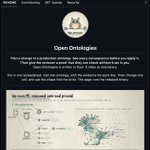
The developer changed ONE line in a knowledge graph.
The tool uncovered 901 new logical consequences that a basic change report could miss.
Now imagine doing that across enterprise AI systems.
It's called Open Ontologies.
The line said: anything that has a parent is a Person.
A normal diff called it safe. 0 classes added. 0 removed. Blast radius zero. Risk: low.
But every item that already had a parent quietly became a "Person." 901 new facts, found in 0.04 seconds.
Here's what this thing can do:
→ Plan a change before it hits production, like Terraform for knowledge graphs
→ Show the blast radius and risk score of every edit
→ Apply, watch for drift, and roll back when something breaks
→ Load CSV, JSON, Excel, Parquet, PostgreSQL and DuckDB
→ Check whether a RAG retrieval still supports the answer
→ Run inside Claude Code, Claude Desktop and Cursor through MCP
Here's why this matters:
Most AI systems tell you "trust me, the reasoner said so."
This one hands you a proof file. A separate checker, built in the Lean 4 theorem prover, verifies every step. An auditor can re-check it months later with no network and no copy of the tool.
Here's the wildest part:
Fake one conclusion in the proof and the checker refuses it. It names the exact line and the rule that broke.
One Rust binary. No Java. No Protégé.
github.com/fabio-rovai/open-…

Brady Long retweeted
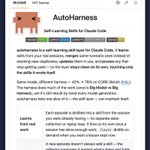
Someone just built something WILD for Claude Code users.
A self-learning system that automatically creates, updates, and organizes its own skills.
Instead of repeatedly teaching Claude the same workflows, you let it learn from real sessions.
This could change how people use coding agents.
It's called Autoharness.
No manual SKILL .md writing. No pile of duplicate skills. No background daemon eating your machine.
It watches your real Claude Code sessions, pulls out the lessons, and turns them into skills Claude loads next time.
Here's what this thing can do:
→ Writes new skills from the work you already did
→ Merges near-duplicates instead of stacking them
→ Rewrites old skills when you correct it
→ Archives skills that stop getting used
→ Opens every session with an index of what it learned
→ Type /learn to save a lesson on the spot
→ Never touches skills you wrote or installed yourself
Install it inside Claude Code:
/plugin marketplace add tigerless-labs/autoharness
/plugin install autoharness@autoharness
github.com/tigerless-labs/au…

This could easily become a billion dollar company if he grows it right.
Could just expand into other types of quotes/verses and compete in that market.


Brady Long retweeted

Unfortunately, AI CEO still doesn’t work.
Multi-agent is still a way to save time by running Claude in the background, not real orchestration like an actual org.
Anthropic put an AI agent in charge of a team of AI agents and gave it 12 hours to ship a game. It shipped the same unplayable mess as a team with no boss at all.
I used to make one of my Claude sessions the CEO. The problem is every agent is still the same model with the same weights, even if you give them different tools. They’re too similar to behave differently or actually hold different roles.

Brady Long retweeted

Hiring: Thinker-writer
$80k starting comp - fully remote.
You're a fit if you have:
- Read 100+ books.
- Gone viral on X by writing authoritative pieces on specific topics.
- Chatted with at least one founder doing $10M+ in sales.
- Written thousands of posts, articles, essays.
- Also required being a native speaker
Identity Labs helps CEOs of $10B+ companies share their greatest ideas, insights, and experience. We've worked with Deel, Gamma, Airwallex, Pocket FM, Lovable.
The job is to help founders articulate their story & vision. You'll interview them, become their thought partner, and handle the relationship.
These founders are extremely thoughtful and smart. We expect you to write industry-defining and narrative-shifting pieces. You need to be a clear thinker, analytical, and a top 1% writer.
It's a very demanding role, but if you enjoy writing and business, it's a dream.
DM me if you are a fit
___________
A few big ideas & innovations account for the bulk of progress.
In the 19th century, industrialization, evolution, electricity.
In the 20th, antibiotics, information theory, the transistor, internet.
The ones that will define the 21st century are being created by entrepreneurs. However, they are typically too busy to get what's in their heads onto paper. We work closely with them to help them bring ten of those ideas into the world.
Identity Labs is setting the agenda in tech.
Distribution carries more leverage than labor or capital. A great product is no good if nobody knows about it. It's our job to help our partners be the talk of the town in a tasteful way.
We are very meticulous when deciding who to hire. Identity Labs is at the very top of the industry, and we are only 15 people. We believe our track record is singular, which we owe entirely to the quality of our team.

Someone just built something WILD for Claude Code users.
A self-learning system that automatically creates, updates, and organizes its own skills.
Instead of repeatedly teaching Claude the same workflows, you let it learn from real sessions.
This could change how people use coding agents.
It's called Autoharness.
No manual SKILL .md writing. No pile of duplicate skills. No background daemon eating your machine.
It watches your real Claude Code sessions, pulls out the lessons, and turns them into skills Claude loads next time.
Here's what this thing can do:
→ Writes new skills from the work you already did
→ Merges near-duplicates instead of stacking them
→ Rewrites old skills when you correct it
→ Archives skills that stop getting used
→ Opens every session with an index of what it learned
→ Type /learn to save a lesson on the spot
→ Never touches skills you wrote or installed yourself
Install it inside Claude Code:
/plugin marketplace add tigerless-labs/autoharness
/plugin install autoharness@autoharness
github.com/tigerless-labs/au…
Brady Long retweeted
THIS IS WILD: Perplexity has a secret mode called "Citation Hunter."
It finds real sources, checks claims, compares papers, and builds fully cited research briefs with zero hallucinated references.
Most people use Perplexity like a faster Google. Analysts are doing something completely different.
Here are 11 prompts they're quietly using to research like a machine 👇

Our entire brand runs on one video person, and she’s completely maxed out.
But Riverside Agents can handle the edits AND pull the clips. Then it just parks everything for her to review and approve.
Wild how much this lightens the load.
@RiversidedotFM
🤝 Paid partnership

Meet Riverside Agents, the first AI production team built only for video.
Producer preps the session, Editor creates the full edit, Clipper cuts the best moments, and Marketer gets it live.
They’re experts at video and know how to take your content to the next level. You call the shots.
Watch the demo:
THIS IS WILD: Perplexity has a secret mode called "Citation Hunter."
It finds real sources, checks claims, compares papers, and builds fully cited research briefs with zero hallucinated references.
Most people use Perplexity like a faster Google. Analysts are doing something completely different.
Here are 11 prompts they're quietly using to research like a machine 👇
Prompt 11: The Cited Executive Summary
"Write me a 300-word executive summary on [topic] formatted for a senior decision-maker. Every factual claim must have an inline citation. Flag any area where the evidence is contested or limited."
This is the deliverable analysts hand to leadership before a major decision. Citation Hunter builds it in one pass.
Looking for more posts like this?
Follow me @thisguyknowsai and you'll get 1x post every single day.
And don't forget to repost the thread to reach more.
Thanks for checking!

THIS IS WILD: Perplexity has a secret mode called "Citation Hunter."
It finds real sources, checks claims, compares papers, and builds fully cited research briefs with zero hallucinated references.
Most people use Perplexity like a faster Google. Analysts are doing something completely different.
Here are 11 prompts they're quietly using to research like a machine 👇