

Our focus is to develop numerical methods for physics simulations with deep learning techniques.
Munich, Bavaria
Joined April 2018
- Tweets284
- Following153
- Followers3.1K
- Likes19



Final acceptance at PNAS now for Chengyun's resolvent analysis paper, yay 🎉 😀 with neat new climate results! Check it out at pnas.org/doi/10.1073/pnas.25… or arxiv.org/abs/2604.19465

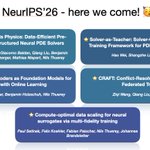
Time to celebrate our 5 accepted NeurIPS'26 papers 🥳 Covering a wide range of exciting topics: from foundation models, over optimizers, to multi-fidelity learning. Details to follow soon! ge.in.tum.de

Ever wondered how to reliably evaluate your stochastic, temporal GenAI-surrogate? 😀 A brilliant Bachelor student at TUM, Sebastian Pfister, has created a stochastic chaotic system benchmark that combines robustness and ease-of-use, StocBench: tum-pbs.github.io/stocbench/

Thuerey Group at TUM retweeted

🚀 The NeurIPS 2026 RealPDE Competition is now live!
Advance Scientific ML for real-world physical systems with paired PIV and CFD data.
🏆 Two tracks:
• Sim2Real
• Long-term Test-time Adaptation
💰 $21,000 prize pool
🎤 NeurIPS workshop presentation opportunities
Join us: realpdecompetition.github.io…
@NeurIPSConf #NeurIPS2026 #AI4Science #SciML #AI4Physics #AI4PDE

Congratulations to Mohammad for his ICML paper developing a novel, sensitivity-based approach for generative topology optimization 👍 arxiv.org/abs/2606.02179 Our work investigates a fundamental question: What determines whether data-driven topology optimization models generalize?

Congratulations to Bernhard for his SIGGRAPH 2026 Paper 👍 PDF ge.in.tum.de/download/ST-FLI… , Video youtu.be/-1Txagqj4N0
Our key ide: treat particles as samples in four-dimensional space-time. ST-FLIP acts as an effective temporal anti-aliasing mechanism for FLIP-style solvers.
Congratulations to Hao for his ICML Oral on rotationally equivariant transformers: tum-pbs.github.io/revit-web/ 👍 The key idea is to transform physical fields into local canonical coordinate systems, enabling standard self-attention while preserving physical symmetries
I'm happy to introduce "CRAFT": a new federated learning optimizer that treats aggregation as a geometric correction problem instead of naive averaging. github.com/tum-pbs/CRAFT

What if pretraining scientific foundation models didn’t require massive datasets at all?
We show that this is not only possible, but has a range of neat benefits: our "Tadpole" models learn from canonical PDE data that is generated on-the-fly arxiv.org/abs/2605.15284
For those who already checked out our AeroTransformer last week: please also try Yunjia's live "WebWing" demo at webwing.pbs.cit.tum.de ✈️
For completeness: full sources and more details available at github.com/tum-pbs/AeroTrans…

I'm very excited to highlight our recent work on how useful NNs are for stability and resolvent analysis of non-linear systems. Chengyun established a firm connection between the theoretical basis and modern AI methods. github.com/tum-pbs/Nonlinear…
I'm excited to share our latest work: AeroTransformer — a step toward bringing the foundation model paradigm to real-world aerodynamic design.
Code & models: github.com/tum-pbs/AeroTrans… Paper: arxiv.org/abs/2604.18062
Ever wondered if a Transformer model could successively refine a PDE solution, one scale at a time? 🤔 Mario's latest work shows: a single model auto-regressively infers and refines flow solutions over finer and finer sets of sample points github.com/tum-pbs/SAR
I'm excited to highlight the code release of our scalable & efficient PDE Transformer (P3D) at akanota.github.io/p3d/ Please try out the pretrained models, and let us know how it works! Highlights are, e.g., stable inference of 1024^3 rollouts on a single GPU with 90GB 😁
We're happy to report that our Physics-based Flow Matching framework got an accept for #ICLR '26! Physics-Based Flow Matching (PBFM) is a principled framework that explicitly targets Pareto-optimal solutions between physics-constraints and data-driven objectives.
Fast rotational equivariance for physics GNNs — the source code is now available: github.com/tum-pbs/strain-ba…
Please check out the full Physics-of-Fluids paper here: pubs.aip.org/aip/pof/article…

We're very excited to report that our P3D Transformer was accepted at ICLR openreview.net/forum?id=8UdC…
I'm very happy to report that our autoregressive predictions with generative diffusion models is _finally_ accepted 😁 Congratulations Georg!
It's been a long journey, this paper was first submitted to NeurIPS'23, and now got into "Neural Networks" sciencedirect.com/science/ar…
Great to see our paper on physics-constrained reconstruction / super-res with generative models posted online now at doi.org/10.1063/5.0304492 😁
- PDE Transformer as backbone architecture
- differentiable physics constraints to guide
- and ConFIG as optimizer to resolve conflicts