

Uncertainty in the face of optimism
Joined July 2011
- Tweets230
- Following91
- Followers405
- Likes46



1/
How should we structure the forward pass of a recurrent-depth model? And how should we train it?
From a fixed-point perspective of the forward pass we arrive at the Sparrow optimizer which is tailored to each parameter group and provides a drop-in replacement for Muon 🧵

Maybe interesting to you: nitter.cf/tmpethick/status/21256…

1/
How should we structure the forward pass of a recurrent-depth model? And how should we train it?
From a fixed-point perspective of the forward pass we arrive at the Sparrow optimizer which is tailored to each parameter group and provides a drop-in replacement for Muon 🧵
34
I should also mention this timely tweet by @AlexShtf and the follow up of @peter_richtarik !
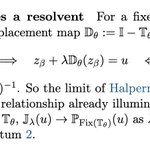
Halpern has a close connection to the resolvent
nitter.cf/AlexShtf/status/209852…


Prediction: the LLM community will notice that looped transformers are fixed point iteration of a learned operator, and will rediscover Halpern alg, resolvents, and other animals.. under new names (smth like "inverse residual looping").
Then they'll rediscover dynamical systems and well see "looping with auxiliary memory".
2
265
Yes, I remember visiting your poster in Singapore - you were early! (That’s why you’re listed first both here and in the paper!)
1
9
Indeed! I gave their work a shout-out here
nitter.cf/tmpethick/status/21256…
I also forgot to mention this great work of @timlautk which is similar in spirit nitter.cf/timlautk/status/208223…
1
2
138
Naive Occam's razor also says "if we pre-norm Attention block in the residual stream we should surely also prenorm the MLP block".
Our derivation suggests that this is not the case in general!
nitter.cf/tmpethick/status/21256…
7/
Same for gate and value matrices of SwiGLU, which make up 44% of all non-embedding parameters!
Gated attention and SSMs also naturally asks for a row norm constraint (but no spectral constraint... we will get back to this).

90
Occam's razor here is instead that there is a simply rule (Lipschitz) from which the choices follows
nitter.cf/tmpethick/status/21256…
6/
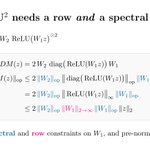
Simply changing the activation changes the geometry!
ReLU² is particularly instructive:
- quadratic in the input ⇒ Jacobian linear in the input
- so the input needs to be bounded (pre-norm!)
- and W_1 should be row norm (2->∞) constraint
So: row + spectral constraint!

1
1
172
Yes, I think there is an important general lesson here:
One might think Occam's razor says "treat all matrices the same and give them spectral constraints!"
But architectures are complex so a tailored optimizer will be as well!
nitter.cf/JohnCLangford/status/2…

Oh interesting, I wasn't aware of this work! When trying to find other strands of work using input injection I only uncovered that the graph neural net community surprisingly has been using it arxiv.org/pdf/1810.05997
1
13
Compared with the NorMuon part of Dion3, NorMuon divides each row by its running RMS after Polar, while Sparrow does RowClip ∘ Polar ∘ Row (history less)
When it comes to Dion, Sparrow can potentially be combined with the fractional row selection in Dion2-3
131
Interesting you also rely on pre-norm and then need to keep activations bounded - I'll give it a closer read! This was maybe the Friday group presentation I ended up missing? 😅

1
205
I also forgot to mention this great work of @timlautk which is similar in spirit nitter.cf/timlautk/status/208223…

We just posted a reorganized and formalized version of this work for a mathematical optimization audience, treating matrix-valued first-order methods as the primary object of study: optimization-online.org/?p=3…

If you are using Aurora then this might be interesting to you: nitter.cf/tmpethick/status/21256…
1/
How should we structure the forward pass of a recurrent-depth model? And how should we train it?
From a fixed-point perspective of the forward pass we arrive at the Sparrow optimizer which is tailored to each parameter group and provides a drop-in replacement for Muon 🧵
18
Oh, and it also seems like Dimuon from Thinky is doing some kind of row-wise normalization (although also column-wise) from this reverse engineering: github.com/anpaure/dimuon

Here we have focused on how to *optimize* gated blocks.
There is also recent interesting work on why such blocks are useful:
nitter.cf/rarefin15/status/21253…

In the original SwiGLU paper, @NoamShazeer attributed the success of GLU variants to "divine benevolence."
Can we explain some of that magic mathematically?
Excited to share our #NeurIPS2026 paper, CP-MLPs: A Tensor-Rank Theory of Tied and Untied MLP Blocks!
arxiv.org/abs/2611.13647
We use tensor rank to study MLP blocks such as ReLU², ReGLU, and SwiGLU, focusing on tied vs. untied feature detection and value readout.
The intuition:
x² − y² = (x + y)(x − y)
For this quadratic interaction, one untied unit does the work of two tied ones.
Our theory characterizes when this helps: untying can halve the required width for certain quadratic interactions, with even larger exact gaps at higher degrees.
The key: the advantage depends on the interaction.
Joint work with Farzaneh Heidari, @irinarish, and Guillaume Rabusseau at @Mila_Quebec.

This is exactly it!
nitter.cf/YouJiacheng/status/212…

row norm is the right way! we need to control the pre-activation hidden's ∞ norm to control the post-activation hidden's RMS. (cuz SwiGLU has elementwise multiplication)
1
3
448
Tagging a bunch of people who might be interested:
@gowerrobert @ErnestRyu @jxbz @wen_kaiyue @orvieto_antonio @konstmish @aaron_defazio @FSchaipp @stochasticchasm @fpedregosa @Jianlin_S @leloykun @JohnCLangford @_arohan_ @tonysilveti
1
4
529
16/
This has been a wild project for me, because it strangely tied together all the scattered topics I have been working on throughout my PhD: fixed-points, operator splitting, robustness and non-Euclidean methods.
Paper: arxiv.org/abs/2611.31513
Code: github.com/tmpethick/sparrow

There's more in the appendix:
- batch-size sweep
- step-size sweep
- robustness to the number of Polar Express iterations
What I find most promising is that we get a better accuracy/robustness tradeoff.
For the pareto frontier of a SwiGLU block:
- the row + spectral constraint dominates the spectral constraint (a)
- instructive, since we can construct a case where spectral vs spectral+row match (b)

