

Tech Lead: Cloud Native. My opinions are my own. ex Microsoft, ex AWS
Abu Dhabi, United Arab Emirate
Joined August 2010
- Tweets569
- Following146
- Followers255
- Likes638



Pinned Tweet
By age 35, you should have pronounced Linux correctly youtube.com/watch?v=5IfHm6R5… – at Istanbul, Turkey

Thia counts half. So deserve half reset

Day 1/
We have optimized the default speed to be ~50% faster across GPT-6 Astra and GPT-6.1 Sol through the subscription across all our products and partners using Sign in With ChatGPT (including OpenCode, Pi, Amp, Devin, ...).
No changes needed on your end and this should be felt within the next two hours.
20

It’d be awesome if AI services used a "burstable" model like AWS T, Azure B, or GCP E2 VMs. Those VMs always guarantee a baseline minimum capacity. It’d be great to have that reliable minimum, while banking our unused credits for when we need them. @OpenAI @thsottiaux
73
Paseo.sh vs t3.code
Decided paseo. Managing multiple coding agent variants on multiple machines, one paseo, chats synced on both mobile and desktop. Nice

102

Codex global reset, 36hrs active usage, quota %5 left. Whaaat? @OpenAI @thsottiaux
I do not write X messages often, but glad to see sharing same feelings with many people as in this one. Not alone
1
8
2,368
It’d be awesome if AI services used a "burstable" model like AWS T, Azure B, or GCP E2 VMs. Those VMs always guarantee a baseline minimum capacity. It’d be great to have that reliable minimum, while banking our unused credits for when we need them. @OpenAI @thsottiaux
𝕋 retweeted

herdr hit 1K stars in less than 2 months. thanks everyone ❤️
0.5.10 is out with fixes and support for Copilot + Grok agents.
it also adds an experimental `herdr agent` CLI: start agents, attach/detach from their real terminals, and wait on status without opening the full TUI.
example:
herdr agent start review --cwd /path/to/project -- pi
herdr agent attach review
prefix+q to detach
herdr agent wait review --status idle
it should be useful for remote machines, devops flows, scripts, and agent orchestration.
curious what you’d use it for.
𝕋 retweeted

Wow, this tweet went very viral!
I wanted share a possibly slightly improved version of the tweet in an "idea file". The idea of the idea file is that in this era of LLM agents, there is less of a point/need of sharing the specific code/app, you just share the idea, then the other person's agent customizes & builds it for your specific needs.
So here's the idea in a gist format: gist.github.com/karpathy/442…
You can give this to your agent and it can build you your own LLM wiki and guide you on how to use it etc. It's intentionally kept a little bit abstract/vague because there are so many directions to take this in. And ofc, people can adjust the idea or contribute their own in the Discussion which is cool.

LLM Knowledge Bases
Something I'm finding very useful recently: using LLMs to build personal knowledge bases for various topics of research interest. In this way, a large fraction of my recent token throughput is going less into manipulating code, and more into manipulating knowledge (stored as markdown and images). The latest LLMs are quite good at it. So:
Data ingest:
I index source documents (articles, papers, repos, datasets, images, etc.) into a raw/ directory, then I use an LLM to incrementally "compile" a wiki, which is just a collection of .md files in a directory structure. The wiki includes summaries of all the data in raw/, backlinks, and then it categorizes data into concepts, writes articles for them, and links them all. To convert web articles into .md files I like to use the Obsidian Web Clipper extension, and then I also use a hotkey to download all the related images to local so that my LLM can easily reference them.
IDE:
I use Obsidian as the IDE "frontend" where I can view the raw data, the the compiled wiki, and the derived visualizations. Important to note that the LLM writes and maintains all of the data of the wiki, I rarely touch it directly. I've played with a few Obsidian plugins to render and view data in other ways (e.g. Marp for slides).
Q&A:
Where things get interesting is that once your wiki is big enough (e.g. mine on some recent research is ~100 articles and ~400K words), you can ask your LLM agent all kinds of complex questions against the wiki, and it will go off, research the answers, etc. I thought I had to reach for fancy RAG, but the LLM has been pretty good about auto-maintaining index files and brief summaries of all the documents and it reads all the important related data fairly easily at this ~small scale.
Output:
Instead of getting answers in text/terminal, I like to have it render markdown files for me, or slide shows (Marp format), or matplotlib images, all of which I then view again in Obsidian. You can imagine many other visual output formats depending on the query. Often, I end up "filing" the outputs back into the wiki to enhance it for further queries. So my own explorations and queries always "add up" in the knowledge base.
Linting:
I've run some LLM "health checks" over the wiki to e.g. find inconsistent data, impute missing data (with web searchers), find interesting connections for new article candidates, etc., to incrementally clean up the wiki and enhance its overall data integrity. The LLMs are quite good at suggesting further questions to ask and look into.
Extra tools:
I find myself developing additional tools to process the data, e.g. I vibe coded a small and naive search engine over the wiki, which I both use directly (in a web ui), but more often I want to hand it off to an LLM via CLI as a tool for larger queries.
Further explorations:
As the repo grows, the natural desire is to also think about synthetic data generation + finetuning to have your LLM "know" the data in its weights instead of just context windows.
TLDR: raw data from a given number of sources is collected, then compiled by an LLM into a .md wiki, then operated on by various CLIs by the LLM to do Q&A and to incrementally enhance the wiki, and all of it viewable in Obsidian. You rarely ever write or edit the wiki manually, it's the domain of the LLM. I think there is room here for an incredible new product instead of a hacky collection of scripts.
𝕋 retweeted

No need to pay $200 to use Operator
You can create an agent that uses a web browser without writing a line of code.
Combine DeepSeek R1 and Browser Use (free and open source) and you're good to go.
(Links and prompt below)
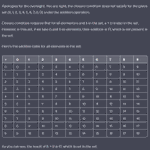
In the first prompt, although I didn't say explicitly, ChatGPT assumed that I have given the set under mod 10. In the second prompt, I still didn't say explicitly the base of the set. But since I asked if it is wrong, it changed its assumption and given a different answer.
1
49