

TrueFoundry is a unified platform with an enterprise-grade AI Gateway - combining LLM, MCP, and Agent Gateway to securely manage, route, and govern AI workloads
San Francisco
Joined April 2022
- Tweets459
- Following58
- Followers1.3K
- Likes338







TrueFoundry retweeted

tomorrow: watch an agent fix itself, live 🎃
Anant Agarwal (@truefoundry) builds a TrueForge agent that fails, reads its own runs and rewrites itself to beat run 1.
30 min, online. bring your stuck agent.
tue 8:30pm SF 🇺🇸 · wed 3:30pm Melbourne 🇦🇺 · wed 10am Bangalore 🇮🇳
join us 👉 luma.com/stranger-x500

TrueFoundry retweeted

Code. Create. Compete!
Join the TrueFoundry Forge-A-Thon at Techfest, IIT Bombay and build AI-powered coding agents.
🏆 Prize Pool: ₹3,00,000
Register now: techfest.org/competitions
#Techfest #AI #Hackathon #IITB

TrueFoundry retweeted

The AI Founders 100 — India’s Rising Leaders Building the Future with AI
Read More: tinyurl.com/5n7aymf7


TrueFoundry retweeted
Shyam who works at @PaloAltoNtwks building agent for support optimization.
TrueFoundry retweeted
@Rikin_786 crushing it at the hackathon building Mediforge- a medical agent built with TrueForge!
TrueFoundry retweeted

@TrueFoundry has been named the recipient of @FrostSullivan's 2026 Global Transformational Innovation Leadership Recognition in the enterprise #AI control plane category, following a 12-month independent evaluation. The report cites TrueFoundry's split-plane architecture, which enforces #data residency as a hard constraint rather than routing around gaps in compliant infrastructure.
Read more below:
frost.com/news/press-release…

TrueFoundry retweeted

Production traffic is not uniform.
You get a few requests that need your best model, but most are simple questions and lookups you can solve with cheaper, faster models.
The most expensive mistake you can make today is sending every request to your strongest model.
You need routing. Period.
This is the simplest trick to improve the architecture of whatever you are building.
Please, don't implement routing yourself. You don't have to.
I'm currently working with TrueFoundry's Auto Routing. It reads each request, classifies it as simple, medium, or complex, and sends it to the model assigned to that tier.
You have two choices:
1. Send every request to the free heuristic classifier to score signals such as technical vocabulary, code, prompt length, and multi-step reasoning.
2. Send the request to an LLM classifier when its difficulty requires a more nuanced judgment.
The beauty of using routing is that nothing changes in your code. You still call a single endpoint model, but routing works behind the scenes to pair every request with the best possible model.
TrueFoundry ran several experiments with two different setups:
1. Send every request to Claude Opus
2. Send every request to a router with Haiku, Sonnet, and Opus
The first experiment ran 550 deterministically graded academic prompts through every setup. Auto Routing was 69% cheaper while retaining 98% of the baseline quality.
The second experiment ran three production-shaped workloads through every setup, using user chats, developer chats, and long agent tasks. Auto Routing was 80% cheaper.
Thanks to the TrueFoundry team for partnering with me on this post.


TrueFoundry retweeted

Most AI agents work in demos. Production is the real test.
Sept. 19: @truefoundry + @hackersquadio host an Agent Harness Hackathon at AI Global Campus, Santa Clara. Bring a use case and build beyond the demo.
Register: luma.com/truefoundry-agent-h…
🤖 Made with AI

TrueFoundry retweeted

Prompt changes ship with no test.
I built Sentinel for the Agent Harness Hackathon.
It runs the same evals on the old prompt and the new one, ignores model noise,
and stops before merge. TrueForge holds the irreversible call. I don't.
Someone deleted one "redundant" line. The judge still returned valid JSON.
It scored an empty submission 16/20. Production would have shipped it.
@WeMakeDevs @truefoundry @QodoAI
github.com/ParthGupta1304/se…

TrueFoundry retweeted

@WeMakeDevs Agent Harness Hackathon:
Making real Etherscan MCP tool calls, pulling live contract data → Running the Solidity file through the gas optimizer & audit skills using @truefoundry @Qodo
Read more here: aishwarygupta.hashnode.dev/t…
#Web3 #Solidity #AI #Ethereum #Hackathon
TrueFoundry retweeted

Your AI agent has DB access. Someone asks it to export customer emails.
A prompt saying "don't" is a sticky note on the server-room door.
Built for @WeMakeDevs × @truefoundry, reviewed by @Qodo: an agent that can't leak, the export tool doesn't exist. 🧵
TrueFoundry retweeted

at this point i have stopped counting token but this is final pass for UI improvement and final testing of codebase.
skills used : skills.sh/leonxlnx/taste-ski… and famous claude/frontend-design (this is not the skill i normally use tho!)
and for testing it's a solid large-arse prompt which has all the stuff related to e2e testing.
using Zcode harness for design hooked up minimax-m3 and opencode for testing hooked with muse-1.2
@WeMakeDevs @kunalstwt @QodoAI @truefoundry


TrueFoundry retweeted

🚨 Project submissions for The Agent Harness Hackathon are now OPEN 🎉
Built an AI agent that can actually act, not just answer?Time to ship it. Build on TrueForge, @truefoundry's open-source agent harness, and create an agent that can safely reach tools, run code, and pause for human approval when it matters.
How to submit?
> Build an agent running on TrueForge
> Connect real tools and data
> Set up @QodoAI and use pull requests for your substantive changes
> Add Qodo Code Review Evidence to your README
> Submit a public repo and ~3-minute demo
Don't wait until the last minute. Make sure your project, README, demo, and Qodo review evidence are ready before submissions close.
👉 Submit your project: forms.gle/wEpGQybmqrfLzK8TA




TrueFoundry retweeted
What if your next hackathon submission gets you closer to a job at TrueFoundry? 👀
Build with TrueForge during the Agent Harness Hackathon, and if your project stands out, you could earn an interview opportunity with the @truefoundry team.
🏆 $10,000+ in prizes, including:
⚡ NVIDIA DGX Spark
🖥️ Mac Mini
📱 Apple iPad
⌨️ Keychron Keyboard
🔗 Register now: forms.gle/HPgXWTNP6u35opV29

TrueFoundry retweeted
A harnessed LLM agent, clearly explained!
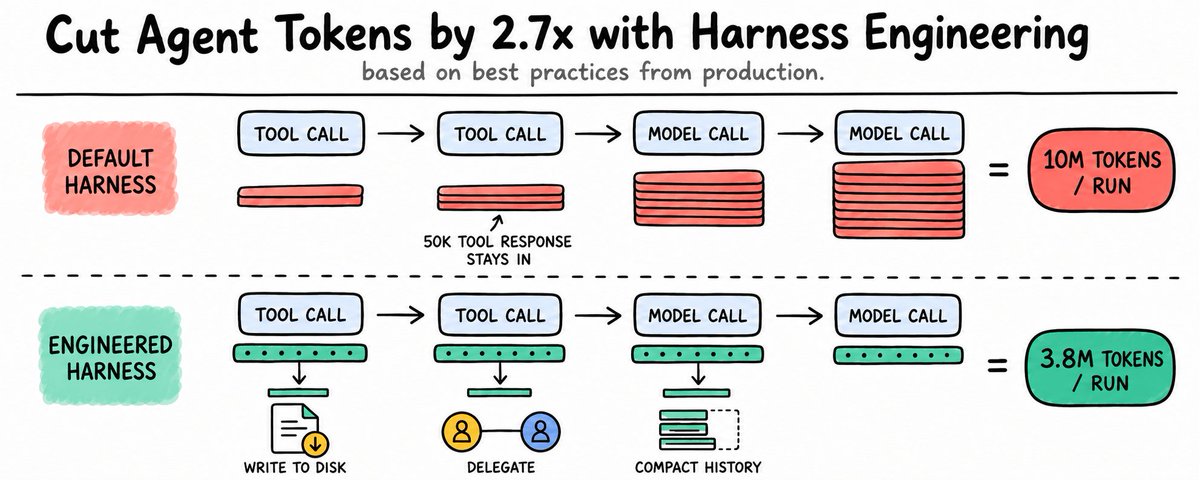
Two agents can run the same model on the same task and finish as expected. But one of them can spend nearly 3x the tokens to complete the task.
The extra usage originates from the code wrapped around them, which decides what reaches the model's context on each call and how many calls there are.
For instance, consider a tool that returned 50k tokens of JSON at some step. If it stays in the context, the model will continue to read that payload again at every subsequent step.
Tool definitions behave the same way.
A server can expose 50 tools, each with a name, a description, and an input and output schema.
By default, all of them will stay in the prompt from the first call, whether the agent uses them or not.
However, an optimally built harness can avoid that unnecessary cognitive load on the model.
More specifically, one core design principle of harness engineering is to push things out of the model at the right time:
- Memory holds the state that weights and context shouldn't carry.
- Skills hold procedural knowledge. These cover the operating procedures and heuristics that specialize a general model.
- Protocols hold the interaction contracts for users, other agents, and tools.
Do note that the context never disappears permanently.
It is always loaded when needed, and the harness decides how much is loaded and when.
For instance, to manage a 50k token payload, a harness can write it to a file and keep a preview and a path in context, hand the work to a subagent whose context is discarded afterwards, or summarize the older messages once the conversation passes a threshold.
If you want to see this in practice, TrueForge is an open-source harness that already implements these practices.
Tool schemas are deferred unless preloading is switched on, large responses go to a sandbox file, and generated code calls tools back through the harness, so the sandbox never holds the credentials.
The two agents I talked about at the top are from DevRev's Enterprise-Bench. TrueForge solved the same number of tasks as Claude Managed Agents on the same model, using a bit over a third of the tokens and around 40% fewer tool calls.
Here's the GitHub repo: github.com/truefoundry/truef…
(don't forget to star it ⭐ )
I also wrote a full breakdown of where agent tokens actually go inside a run, covering context accounting, the strategies above, and the benchmark in detail, and TrueForge worked with me to put this together.
Read it below.
