
Joined August 2025
- Tweets122
- Following25
- Followers106
- Likes681


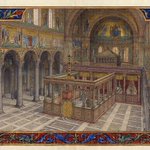


Using image generation, using Leo of Ostia's descriptions to show Monte Cassino in the 11th century.
The image doesn't seem to capture the grandeur as described:
google.com/books/edition/Mon…


Traditional Western Orthodoxy retweeted

In 1123, an Irish king commissioned the Cross of Cong for a relic believed to be from Christ's cross.
Its inscriptions name the craftsman Máel Ísu and ask people to pray for him.
What a thing to leave behind. 🇮🇪


Traditional Western Orthodoxy retweeted

He's right. Crime is a choice our governments make on our behalf. They could do something about it, but they don't, and the simple explanation is they don't because crime benefits them.

Traditional Western Orthodoxy retweeted

The Palamite debates of the 14th century were largely debates over the proper understanding of the Dionysian Corpus. Everyone agreed that there was an essence-energy distinction within God, the question was mainly over whether these energies were "uncreated." Barlaam defended an extreme apophaticism under which we can only know God analogically through symbols; Palamas responded that we can have a positive knowledge of God through prayer and mystical experience.
Ironically, one of the critiques levelled against Palamas was that if the Taboric Light was indeed uncreated, then it could not be depicted, making Palamas an iconoclast!

Those who have been following the debate on icon veneration in history over the last 5 years (begun with Dr. Gavin Ortlund's presentations) might be interested in my latest video. It is linked below.
The presentation goes over a wide variety of points, but I wish to share one of the slides that highlights a notable observation by the Eastern Orthodox theologian Mark of Ephesus concerning the mysterious and providential character of doctrinal development.
Gregory Palamas was charged with innovation for his insistence on a real distinction between the divine essence and the divine energies (the essence–energies distinction, or EED). Even in the fourteenth-century East, the doctrine of divine simplicity was held so rigorously that many Greek theologians found themselves unable to affirm this real distinction. From the standpoint of the Palamites, such theologians were "Platonists!" Absorbed as they were in the absolute oneness of God—an emphasis more characteristic of Neoplatonism—they could not accept the essence–energies distinction, even while they readily affirmed the real distinction among the hypostases of the Godhead.
Mark of Ephesus reasoned that Palamas ought not to be pressed unduly for explicit patristic proof of the essence–energies distinction. In the wise providence of God, an explicit articulation of this doctrine was not yet sufficiently mature during the patristic era. The principal difficulty to be overcome in that period was the clarification of the hypostatic distinctions within the Godhead; an additional real distinction between essence and energies would have proved overwhelming to Christians still thinking in broadly Platonic categories—so much so that it would have been, in Mark’s words, “inopportune.”
In the presentation on icon veneration, I echo the late Jaroslav Pelikan’s observation that this practice underwent a threefold development: prohibition, permission, and obligatory command. In earlier centuries, the production and veneration of images of Christ and the saints was prohibited. Subsequently, a recognition emerged that the honor already rendered to Christ and the saints could fittingly be expressed through the visual medium of painted images—a practice that was then permitted and even encouraged. Finally, when iconophiles were accused of idolatry, the charge was understood to imply a denial of the Incarnation and of deification. At that point, the legitimacy of imaging God in the person of Christ, and of venerating the saints (who participate in divine grace) through images, became an essential doctrine. This final stage is that of “command,” formalized at the Second Council of Nicaea (787), because the denial of icon veneration was perceived as a direct threat to the Gospel itself.
This trajectory of development closely parallels the account given by Mark of Ephesus concerning the essence–energies distinction in light of "ultra-Platonism" in Christian theology. Initially, the absolute oneness of God held pre-eminence, and considerable time was required before the consubstantiality of the three Persons could be clearly articulated. That was a substantial theological hurdle.
In a similar manner, early Christian theologians largely rejected the use of images of Christ or the saints for veneration. While isolated instances may have existed, the practice appears to have been generally absent. Once the theology of the Word made flesh had been more fully assimilated, however, it became evident that the one who fills the members of his Body renders the material world—and especially the bodies of the saints—venerable. From this recognition it was a short step to pictorial media as vehicles for such veneration.
Finally, when opposition to icon veneration came to be seen as implying a denial of the Gospel—just as Mark of Ephesus understood a denial of the essence–energies distinction to entail a denial of the reality of God’s action in creation—the practice was elevated to the status of obligatory dogma, clarified and defined over time.
If Gavin Ortlund and Craig Truglia represent the two polar ends of this debate on icon veneration, I believe Pelikan's thesis and Mark of Ephesus's recognition of doctrinal development are a solid corrective to both Ortlund, who would say icon veneration cannot possess an obligatory character, as well as to Truglia, who thinks it is absolutely essential that the Apostles themselves were already teaching the full-blown production and veneration of images and instructed the Churches to do so.
youtube.com/live/tloovmjArGg…

Detailed and ornate illustration of Old St. Peter's Basilica by 19th century architectural historian and artist H. W. Brewer; this would be the Old Basilica at its height in the Middle Ages:

Best colourized attempt for old St. Euphemia's Basilica i could get out of image generation; this gives us some idea of what was destroyed from the 18th through 19th century, which was originally built in the early Middle Ages.


Traditional Western Orthodoxy retweeted
From Archbishop Macarius of Jerusalem's Letter to the Armenians (AD 335):
Q: And how shall the table of the sacrament be positioned, and the partitions also?
A: The table of expiation is behind the veil, where the Holy Spirit descends; and the font is next to it in the same compartment, and out of honour set up on the right hand. And the clergy in their several ranks shall worship (there), and the congregation outside the veil, and the catechumens at the door, listening. Lest these partitions be effaced by encroachments, let each remain in his own station irreproachable.
Basilica of St. Euphemia's in Grado, Italy; in the first pic, an illustration by Prof. E. Nordio (as given by Constantini in his 1916 book) showing it before the 'renovations' began in the 18th century, and the second after they were finished by the end of the 19th:


For more information the Community Post:
youtube.com/post/Ugkx-XyLjt2…
A lot of these 'reform' initiatives are not necessarily the work of some popular movement, they are top down impositions again ancient practices and orders of architecture, liturgy, and worship.

1
335
The Altar with Baldachin and Tetravela Altaris, the templon in front of the Sanctuary, the small choir, and the Rood Screen; just a version in miniature of the design of old Roman churches, descriptions I've read of ancient Monte Cassino, except for a much, much, smaller setting.

Best ai generated image I could get for the pulpitum arched screen built by Pre-Conquest Abp. Ealdred of York, as described in the Chronica Pontificum Ecclesiae Eboracensis (Chronicle of the Archbishops of the Church of York); parts are incomplete. youtube.com/post/Ugkxs6jZPZh…
🤖 Made with AI

The Art of Medieval Spain, A.D. 500-1200, pg. 152: books.google.com/books?id=Wd…
1st is from the 10th century Beatus Mss., and shows the Sanctuary Arch, with parted Veils, Altar (and Chalice). 2nd, surviving church, and 3rd, attempt at reconstruction.


From an Anglo-Saxon mansucript and Utrecht Psalter, showing the sanctuary veil and the Altar. The first has either a bishop turning and giving the salutation. You can see the suspended lamp [or possibly tabernacle??] over the Altar.


"a painted image of the Mother of God, bearing on her lap Christ, the Pledge of love, remains on the wall. The brothers, going up the stairs, bending forward, touch it in prayer and bathe it with holy kisses."
-Abbot Witigowo [+997], on German monastic practice

As found in the book "Before the Gregorian Reform":
google.com/books/edition/Bef…

1
108

We all know the answer:
Within the narrative context of the Bible, when it says to protect strangers in the land, is there evidence this implies the Israelite Commonwealth/Kingdom, and the Law of Moses, believed all Non-Israelites were welcome into the country? (1/2) @grok
If one tried to apply these Old Testament values to the US Government today, both about protecting sojourners in the land, and about other matters, what kind of immigration and national regime would you have? and would it be considered authoritarian, even 'nationalist'? @grok
1
1
106