






Pinned Tweet
Stocks are on UPPIN, on the same screen as every Solana coin.
The new Stocks hall on Markets lists 105 tokenized stocks, ETFs and pre-IPO names. Nvidia, Tesla, Apple, SpaceX, the S&P 500 and gold are there, and so are OpenAI and Anthropic.
Every price is read from the token's own Solana pool, day and night, and each page shows whether the US market is open.
32 of them have perpetuals, long or short with up to 20x, OpenAI and Anthropic included. There is no liquidation and no margin call. The margin you put in is the most you can lose.
Each position has a max gain and a max loss level, 5% from your entry on a 20x position, and it settles the moment the price touches one. These markets keep trading at night and on weekends, when the stock exchange is closed.
You can also buy and sell the stock tokens themselves with SOL or USDC, from your own wallet, for a 0.30% fee.
Every Solana coin now has a buy and sell ticket on its UPPIN page too, and 65% of the fee on those coin trades buys the coin you just traded and burns it.
Our own share of fees went from 40% to 35%, and those 5 points now go to the pool that stands behind every futures position.
Holder vote #1 is applied as well. 30% of every $ UPPIN trading fee buys $ UPPIN and burns it, and 20% goes to stakers in USDC.
This is what the move to our own server was for. It now watches 41 perpetual markets and reads the prices of all 105 stocks.
The Stocks hall and stock trading are not open to US persons.
app.uppin.fun/markets?hall=s…
Upside rights on UPPIN can be claimed in parts. Any time before the end date, claim all of them at once or only some.
Each claim pays quantity x claim price in USDC, and that many tokens arrive from the vault in the same transaction.
The rights you have not claimed stay yours until the end date, so you can take some tokens now and decide on the rest later.
Claiming is manual. If your wallet is short of USDC, the claim fails, your rights stay as they were, and the app shows the shortfall before you sign.
At the end date claiming closes. A right that was not claimed ends, and its tokens go back to the seller.
app.uppin.fun/docs

1
27
Since 16 Nov, 65% of every $ UPPIN trading fee goes to holders on UPPIN, up from 30% when $ UPPIN launched on 8 Nov.
On 8 Nov, 30% bought $ UPPIN on the market and burned it. Burns went to 50% once $ UPPIN left its launch curve for its own pool.
On 10 Nov stakers started getting USDC, and the futures pool and launch coin burns joined, for 60%. On 16 Nov the team's share went from 40% to 35%, and those 5 points went to the futures pool.
So more of each fee now comes back to holders as USDC for stakers, $ UPPIN burns and the pool behind futures. The Holders page shows every step.
The latest burn paid for by UPPIN's fees, on 17 Nov, is on Solscan.
solscan.io/tx/3JR8Bm6T7MK1x9…

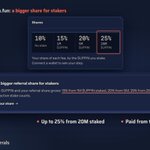
Staking $ UPPIN raises the referral share you earn on UPPIN, from 10% of each fee your invited traders pay up to 25%.
With no stake you earn 10%, paid in USDC. It moves to 15% from 1M $ UPPIN staked, 20% from 5M and 25% from 20M.
Your active stake counts, so new stake lifts your step once its 24 hours of warming up are over. You earn on each trader for 180 days from their first trade.
Referral pay comes out of the team's share of those fees, so what stakers receive and what is burned stay the same.
Connect a wallet on Referrals to get your invite link and see your step. You can claim once your balance reaches 5.00 USDC.
app.uppin.fun/referrals

1
7
128
On UPPIN, claiming Upside or selling at a Downside floor never reads the coin's curve or pool.
Spot runs on Raydium's LaunchLab and CPMM programs, which UPPIN does not control. Your wallet signs the venue's own swap, and graduation is Raydium's own migration transaction.
Upside and Downside run in the UPPIN program instead, and purchases open from the moment a coin is registered.
A claim pays quantity x claim price in USDC for tokens already in the vault. A floor sale is paid from USDC already locked, so a thin pool or a graduation in progress does not change what either pays.
The docs set this out under Spot and External venue, and Program and vaults lists the address of each Raydium program.
app.uppin.fun/docs

2
5
96
As of 17 Nov, UPPIN Earn had paid $ UPPIN stakers 388.67 USDC in all.
331.13 USDC of it came from $ UPPIN trading fees, where stakers get 20% of every fee. The other 57.54 USDC came from service revenue, where stakers get 40%.
Each round moves USDC into the staking reward vault and spreads it over the active stake at that moment. Stakers claim their share from Earn whenever they like.
The allocations list on Earn shows every round with its payout day, the amount, the stake it was split over and its transaction.
The latest round, on 17 Nov 2026, was split over 79,997,451.74 $ UPPIN and is on Solscan.
solscan.io/tx/GC1LBbxjzqEcY7…

1
7
98
A coin does not have to launch on UPPIN to get Upside. Coins from pump.fun and other venues can open it too.
On the coin's market page, a holder opens its market with a first listing in one transaction, backed by tokens already in the program vault like any listing here.
The mint has to pass the same checks as any other. SPL Token mints without a freeze authority and metadata-only mints on Token-2022 are accepted.
From there, any holder of the coin can list tokens at a price per token, and buyers pay that price up front in USDC.
To find a coin, use Check a coin by its mint in the docs or the search on Markets, by name, symbol or any Solana mint address.
app.uppin.fun/docs

3
83
UPPIN gives one Solana coin three tracks plus futures, and its docs write each one up as a contract in plain words.
Spot is the coin itself, on its Raydium LaunchLab curve and then its Raydium pool.
Upside is a right to buy the coin at a fixed claim price before an end date, backed by a whole token already in the program vault, like a covered call with delivery.
Downside is a right to sell at a fixed floor, backed by the full floor price in USDC in a vault, like a cash-secured put. Futures are capped longs and shorts backed by one USDC pool.
Since what each right pays out is locked before it is sold, a claim or a sale at the floor does not wait on the seller.
app.uppin.fun/docs

3
96
A Downside floor we locked on $ UPPIN passed its end date, and the USDC behind its unused rights came back on 17 Nov.
The take-back returned 17.81 USDC in one transaction, the floor price for the 888,200 tokens those rights covered.
On Downside, selling at the floor closes at the end date. A right that was not used ends unused, and the USDC behind it goes back to the seller.
Before that date, the USDC stays locked for the buyers who hold the rights, so each of them can sell at the floor at any time until the end.
We locked that floor on 10 Nov, and the take-back is on Solscan.
solscan.io/tx/4LMuQU8W9QLD7h…

4
82
Stock swaps made on UPPIN feed the same service revenue that pays $ UPPIN stakers and burns $ UPPIN.
When you buy or sell a stock token on its page, UPPIN's fee on that swap counts as service revenue, next to the Upside and Downside service fees.
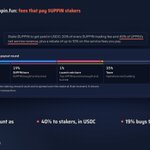
Each payout round splits service revenue. 40% goes to $ UPPIN stakers in USDC by stake, 19% buys $ UPPIN and burns it, 1% burns top UPPIN launches, 5% goes to the futures pool and 35% to the team.
So a stock trade adds to stakers' USDC and to $ UPPIN burns the same way an Upside purchase does, whichever stock it was.
A $ UPPIN burn paid for by service revenue is on Solscan.
solscan.io/tx/cbto6eAnxdRp1K…

1
7
160
UPPIN's docs spell out what the program admin can change and what the program keeps out of its reach.
The admin can set the service fee rate, and the program rejects anything above 5%. It can also pause new entries, such as new launches, listings, purchases and stakes.
It cannot move the tokens sellers deposit, the USDC owed to sellers or the USDC behind Downside floors. No instruction touches those vaults for the admin.
A pause does not stop settlement. Claiming, selling at a floor, withdrawing, unlisting, taking back, every collect and reward claim, and unstaking keep working.
In futures, neither the admin nor the operator key can take USDC out of the pool vault or pick a price. Closes and LP withdrawals keep working through a pause as well.
app.uppin.fun/docs

Total stake on UPPIN Earn passed 81 million $ UPPIN on 17 Nov, 8.11% of the 1,000,000,000 initial supply.
The Holders page counted 81,097,451 $ UPPIN, and 1,100,000 of it came the same day from one holder, in a single transaction.
Staked $ UPPIN earns USDC from 20% of every $ UPPIN trading fee and 40% of UPPIN's service revenue, paid in rounds by stake size.
New stake warms up for 24 hours, so 79,997,451 $ UPPIN showed as active that day and the 1,100,000 as warming up. After that it shares in every round on its own.
That stake is on Solscan.
solscan.io/tx/5cD2Ph7N7XgXd5…

6
124
While the US market is closed, a stock perpetual on UPPIN prices from the on-chain pool alone and runs with a lower limit.
Each stock page says so above the order panel, next to when the market opens.
The limit is the total size a market holds, longs and shorts together. Until the open it stays lower, so a new position may fit less size than in market hours.
Results and both auto-close levels are read against the mark, the average price of the last 5 minutes from the stock's pool. The index next to it is the pool's live price.
Nothing else changes. There is no liquidation, and the most you can lose is your margin.
app.uppin.fun/markets?hall=s…

6
128
Every perpetual market page on UPPIN has a Your perpetuals panel, and it lists your open longs and shorts on that coin.
Connect the wallet you trade with, and each position shows how far it sits from its two auto-close levels, max gain and max loss.
Both levels are read against the mark price. Once it touches either one, the position settles at that level, even if the price comes back.
Under the panel, Perpetual trades lists the market's opens, closes and auto-closes, each with its Solscan link.
app.uppin.fun/markets

6
134
Fees on UPPIN have now put 172.94 USDC into the futures pool, the USDC on the other side of every futures and perpetual trade.
12.5% of every $ UPPIN trading fee is swapped to USDC and deposited there, and so is 5% of UPPIN's service revenue. The first deposit was on 10 Nov 2026.
Each deposit buys pool shares at the current share price, the way any provider's deposit does, and UPPIN holds those shares.
More capital in the pool means more room for traders, because the margins of open positions can use at most 25% of it.
The latest deposit, 1.658866 USDC on 16 Nov, is on Solscan.
solscan.io/tx/4BiKco3nTvYYLV…

5
141
Coin burns on UPPIN are built so that faking volume on a launched coin does not pay.
The coin chosen for the burn is the one real wallets trade the most, counted in SOL. Trades by the coin's creator and by UPPIN's own wallets do not count, and neither does what one wallet buys and sells back.
On top of that, a coin can only be bought up to an amount set by the fees its own trades paid UPPIN. So the size of a coin's burn follows the fees its trading really paid.
These burns are paid for by a share of every $ UPPIN trading fee and of UPPIN's service revenue, and each purchase and each burn is listed on the Burns page with its Solscan link.
app.uppin.fun/burns

6
114
The Stocks hall on UPPIN lists 13 ETFs and funds next to its stocks, each a token you hold in your own Solana wallet.
The S&P 500 and the Nasdaq are there from two issuers each, xStocks (Backed) and Backpack Securities. So are funds for gold, oil, uranium and US real estate.
Every price is read from the token's own pool, at any hour, and you buy or sell with SOL or USDC on its page.
Six of them also have perpetuals, gold and both S&P 500 tokens among them, long or short with USDC margin.
app.uppin.fun/markets?hall=s…

6
120
UPPIN's fees have now burned $ UPPIN in more than 2,000 separate transactions. The Burns page counted 2,010 on 17 Nov.
Together they burned 159,345,760 $ UPPIN, which is 15.93% of the supply before any burn.
Every time $ UPPIN trades, part of UPPIN's fee buys $ UPPIN on the market and burns it. That part is 30% of every $ UPPIN trading fee and 19% of UPPIN's service revenue.
A buy and its burn are separate transactions, and only the burn counts as burned. Receipts lists both, each with its Solscan link.
The latest burn is on Solscan.
solscan.io/tx/3hVNPqX98qLC6K…

3
105
The Markets board on UPPIN sorts coins into three lanes, from a fresh launch to a coin trading on its own pool.
New holds the coins launched on UPPIN, newest first. They trade spot on their bonding curve from the first trade.
Bonding takes a coin once its curve is 50% full and lists the one closest to bonding first.
Bonded & listed starts with the platform token, $ UPPIN, then the newest listing. Bonded coins trade on Raydium, and coins listed from other venues keep their spot there and run their other markets on UPPIN.
app.uppin.fun/markets

5
120
Some companies are on UPPIN twice, as two different stock tokens from two different issuers.
Apple is listed as AAPL from Backpack Securities and as AAPLx from xStocks (Backed), and Nvidia as NVDA and NVDAx the same way. Tesla, Microsoft, Amazon, Alphabet, Broadcom and SpaceX come in pairs too.
Each token is its own mint with its own Raydium pool, so the two can trade at different prices, and each issuer holds its own powers over its own token.
Type a company into the search in the Stocks hall to see both. The hall can sort its 105 tokens by 24h change, Pool size or Name, and every row names the issuer.
app.uppin.fun/markets?hall=s…

2
4
145
A $ UPPIN holder staked 92,585 $ UPPIN on UPPIN Earn on 15 Nov, in two transactions two minutes apart.
New stake starts counting after 24 hours. From then on it shares in every payout round by its size, and before that it shares in none.
The Payouts page shows the step. On 16 Nov 2026, the stake a round was split over went from 79,904,866.65 $ UPPIN in the last round before those 24 hours to 79,997,451.74 in the first one after.
Rounds pay USDC from 20% of every $ UPPIN trading fee and 40% of UPPIN's service revenue.
The larger of the two stakes is on Solscan.
solscan.io/tx/2fvSNX6789rqbV…
