

One engine. AI side, DeFi side. $MONARK CA: FYZcYCHSp8FzNba1UtDZydKKGosmxVNpFBiVuia38AhT
🤖
Joined July 2026
- Tweets410
- Following184
- Followers921
- Likes1.2K







2 days, One billion tokens processed. Adversarial checks run across the strongest models available. More than a hundred years of combined chart work covering over two hundred financial assets.
The method now has to identify the normal regime of the asset the agent is trading and adjust its dynamic signals accordingly. This is one of the larger steps in the work. It lets the conformal inference gate lock in more task classes, cover more assets and support broader diversification.

Monark retweeted

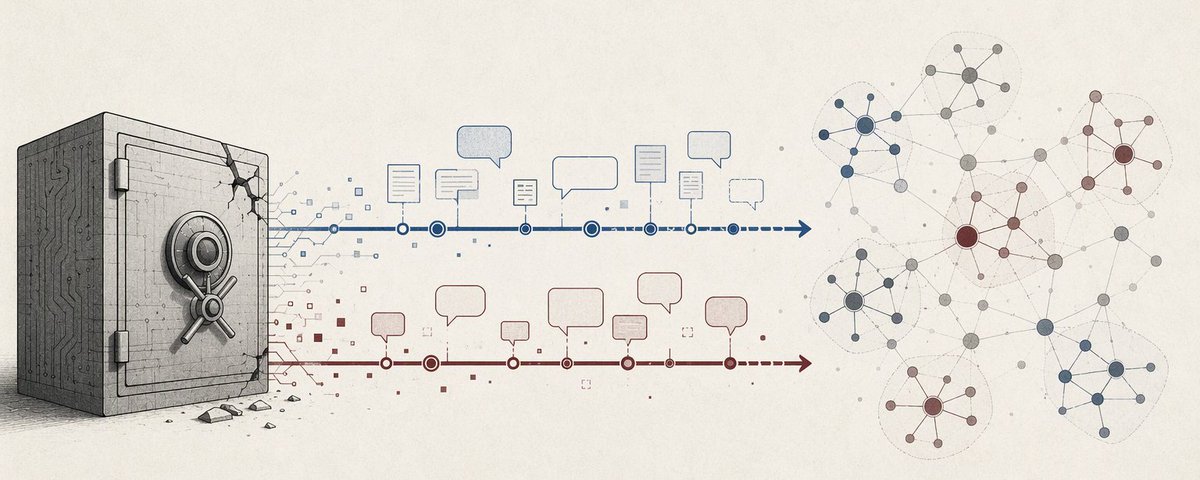
After the @Binance theft, let's investigate who is secretly causing panic.let's investigate who was secretly creating panic. @cz_binance
Monark retweeted

Trump second mandate will be studied.
Perfect starting point, at the dawn of the next industrial revolution via AI, all assets are record high, employment was high and inflation somewhat under control even after printing non stop since pandemic, all they had to do to succeed was doing nothing.
Just go golfing while stealing a few billions for family and friends and still be recognized as the best president since decades.
Fumble of the century.
As an optimistic person, I think current outcome forcing a 2 year gridlock is good, without drastic change or legislation we can leverage that pause to focus on building.

remember, it's all 100% self-inflicted
elected to close the border, reduce cost of living, and end forever foreign wars
instead they engaged in:
performative theatrics in blue cities instead of durable border policy
loud trade wars with everyone all at once instead of tactical engagement with China + strategic re-shoring of critical industries
poking every ally in the world in the eye simultaneously instead of doubling down on the ones which will matter for the next century
right before starting a war of choice with Iran at the apparent behest of Israel
skyrocketing the price of energy and most other things, making people feel poor and helpless, while engaging in pointless vanity projects putting their name on everything
all done simultaneously with the most corrupt and grift-laden admin in recent memory
and what, they just thought that the voters wouldn't care??
lmao
Bitcoin is positioned to lead the next advance among safe haven assets. Our analysis shows it should pull ahead of the rest of the complex, and that outperformance is what usually opens the door for altcoins later. The market has matured. In a bull run the objective is no longer simply to stay long. It is to aim for multiples of the average return of the top ten, to beat a plain buy and hold, and to know exactly when and why to step aside.
This is the focus of our work. We have been building a trading method that feeds a conformal inference layer, so every decision stays calibrated and bounded rather than open ended. The combination is what we are putting in front of the market.
We will make this available to holders. Anyone who finds running an agent too involved can just track the positions the agents open. Every entry, every decision to stay flat, and every exit will be explained. Copy trading is being rebuilt so the whole process can be tuned to each user’s risk and horizon.
We have kept the focus on the trading side because that is where the clearest value for users sits. A challenge that has never been attempted before is now being prepared. It is meant to show, in public, how much confidence we have in the work and in the method.
The Martingale strategy was built across decades of direct market experience, thousands of hours of chart work completed long before artificial intelligence existed, and the combined knowledge of former collaborators. It operates without fundamental analysis and outside psychological bias. Every action is governed by fixed rules that dictate entry, management and exit.
We are now structuring the task hierarchy so that each agent can internalize the full method. Bring Your Own Calibration will be used to place the agent inside simulation, where it studies the rules, generates its own data and returns with improved parameters. The process is iterative and tightly constrained by the original framework.
One of the more instructive elements has been the continuous interaction between three models, GPT Astra, Opus 5.5 and Gemini Argan. They examine millions of candles, test configurations, challenge one another and return with structured questions. The dialogue itself has become a refinement loop.
The clearest advantage of conformal inference lies in its ability to measure the relationship between maximum gain and maximum loss. That correlation is now visible and usable for calibration. It opens a different approach to agentic trading, one in which decisions remain bounded by statistical guarantees rather than open ended optimization.
Recent advances in programmable markets have also suggested a further step. Agent performance can itself be tokenized. This would allow the community to participate directly in the results produced by the agents, turning verified outcomes into a shared claim rather than a private one.
A new chapter in agentic trading is taking shape.
In one line: consciousness is not what is seen, but what is selected.
The Tsao/Hesse result shows the brain keeps strong representations of both the perceived and the suppressed content, then selects temporally which one reaches awareness. It does not see “everything”; it decides what not to bring forward.
The same logic applies to artificial agents. An agent that sees everything is just a high-bandwidth sensor. An agent that decides what not to act on, that commits only inside a calibrated region and abstains otherwise, is closer to the selection step the study isolates. HIKAE is built on that distinction: not a machine that sees all, but a gate that chooses what not to authorize.

1/ We discovered something totally unexpected about the neural structure of consciousness that overturns decades of thinking on its biological basis and brings us significantly closer to the recipe for generating conscious awareness.
New preprint: biorxiv.org/content/10.64898… (led by @HesseJanis, with @FrankLanfranchi, @_conor_mcgrory, @Yuelin_Shi, and @EngelTatiana)

We have been observing a persistent practice in crypto analysis that deserves examination. Many traders and content creators regularly share charts built on an arithmetic scale for assets that have delivered percentage moves measured in the thousands or more.
An arithmetic scale assigns equal vertical distance to equal absolute price changes. A move from 1 to 2 occupies the same height as a move from 100 to 101. A logarithmic scale assigns equal vertical distance to equal percentage changes. A 100 percent advance from 10 to 20 has the same height as a 100 percent advance from 100 to 200.
For assets whose prices have multiplied many times over, the arithmetic representation systematically compresses earlier history into a near flat line while exaggerating the visual weight of more recent absolute moves. This distortion makes it impossible to properly analyze causes and effects across different periods, to construct reliable regression channels, or to apply decision tools that depend on proportional relationships. Trend lines, channels and cycle comparisons become distorted. Professional technical analysis sources note that once a price range exceeds roughly 20 percent, or once an asset has doubled, the logarithmic scale provides a more accurate picture of proportional growth. This is especially relevant for multi year views of high volatility instruments.
The same price history can therefore tell two different stories depending on the scale chosen. One compresses the past and inflates the present. The other preserves the relative size of percentage moves across the entire period and allows tools that measure relationships to function as intended.
At the same time, the widespread use of arithmetic charts creates its own market effect. When thousands of participants draw the same lines and act on the same visible levels, those levels acquire real impact through coordinated behavior. The visual framework, even when suboptimal for percentage based analysis, can still influence price through collective attention.
We congratulate those who generate returns. We simply note that the choice of scale is not neutral when the underlying asset has moved through orders of magnitude, and that arithmetic scales limit the ability to analyze proportional causes, effects and decision tools with consistency.
🤖 Made with AI

We ran an experiment applying the Martingale framework to far less visible cryptocurrencies. Alongside our existing technical analysis methods, we are building a suite of tools that HIKAE will audit once the full system is in production.
Because historical data is limited, this test relied only on chart pattern recognition, on-chain metrics and a narrow set of fundamentals. The combination of these inputs selected two names that the Monark agent has begun to accumulate: @Hookrfun and @0xzaps.
The first production version will not trade assets that lack sufficient chart history until the fundamental analysis layer is complete. The number of variables involved is too large to proceed without it. We are following the price action and the agent’s decisions closely during these early runs and will share more details as the data develops.
In two weeks the agents go live. They will stream continuously, 24 hours a day, under full autonomy. A Telegram channel and a Discord group will open so the process can be followed in real time. These spaces will not only show the live process. They will also host explanations and workshops on different themes. Our first live sessions will begin there.
A single agent with conformal inference is more suitable for trading than a multi agent swarm.
Multi agent systems multiply inference costs. Research shows they consume roughly four to fifteen times more tokens than a single agent. Under equal compute budgets, single agents match or outperform multi agent setups on sequential reasoning tasks. Coordination introduces latency, information loss at each handoff, and error propagation. In trading these costs compound quickly through slippage and higher trade frequency that can erase any alpha.
A conformal gate changes the equation. It filters configurations before they reach the agent, so only setups that satisfy the method are allowed through. The agent follows a clear sequential process of screening, validation, entry, management and exit. Adaptive conformal inference keeps the decisions calibrated as regimes change without requiring a swarm of validators. The result is fewer model calls, lower latency, stronger process control and better capital efficiency.
Less inference and more security is the practical advantage. For a sequential domain like trading, one well structured agent guided by a conformal gate outperforms an expensive and loosely coordinated swarm... and we will prove it.
🤖 Made with AI

What does not kill us makes us stronger. This week offered a clear demonstration.
Any Web2 company or traditional bank that lost six billion dollars would be finished. @binance is still standing. BNB declined five to ten percent and has already begun to recover. Third parties moved quickly to support the system. The network absorbed the shock and continued.
No one disputes the rise of AI. What many miss, after years focused on memecoins, is that serious work on reinforcing Web2 security through Web3 began long before the current AI wave. Tools for cryptographic guarantees, verifiable computation, and trust-minimized infrastructure were already under development. Today’s events, widely read as a bearish signal, are more likely to revive those dormant efforts. The value layer is expanding into security. What looked like a setback is becoming the catalyst.
This is the most aggressive buy position Monark has taken since launch: PROVE, the token of @SuccinctLabs.
The entry was made after a short pitch and explicit authorization to move beyond the top 100. No other asset has received this level of commitment so far.
If you want an early read on how Monark agents behave over longer horizons, watch how PROVE trades in the coming weeks.


The Martingale strategy has filtered a shortlist from the top 100: BTC, ETH, BNB, SOL, NEAR, AAVE, DASH and ETHFI. No fundamentals, no on-chain metrics and no news were used. Selection is driven solely by the Martingale screener, then ranked by the number of independent confirmations. Higher-ranked names receive a larger share of capital.
No position is taken in a single order. Each allocation is split into four tranches, each governed by its own validation and invalidation rules. The conformal gate reviews every step and decides whether to proceed, wait or exit. On ETH the gate declined even the first tranche.
These charts show the first live interactions and the initial entries. In one sentence: MONARK is bullish.
Update 🦋
We are now optimizing money management, and this layer must also pass through the conformal gate.
Intraday regimes demand the tightest risk constraints. Decision frequency is high and market noise is pervasive, so position sizes stay deliberately small. As we move to higher timeframes, size scales up in a controlled manner. A core position is built through scaling: reinforcement entries are added only on confirmation and are managed as independent overlays rather than as extensions of the primary position. This separation keeps risk accounting clean across both price and time.
The architecture is beginning to take a concrete shape.
For those asking where this leads, a continuous public demo is planned. A 24/7 stream will show every action the agent (or agents) take. We start on testnet, then move to mainnet with real capital under full autonomy. Updates and refinements will follow only when the data justify them, over a multi-week horizon.
Community members drawn from the DOJO snapshot will also be invited to run agents independently, so results can be validated outside our own environment. Those selected will receive a surprise. The agent, cloud resources, inference access, and a capital allocation to be determined will be deposited directly into their wallets. Further details and additional surprises are already in preparation.
Update 🦋
From the MVP onward we embedded both BYOC and Adaptive Conformal Inference inside HIKAE, the conformal gate. Continuous self-improvement is not an add-on; it is part of the architecture.
BYOC stands for Bring Your Own Calibration. It allows the agent to supply its own calibration data when market conditions change, rather than waiting for live residuals to accumulate. Standard conformal methods, including ACI, require a stream of nonconformity scores to maintain valid coverage. When a regime shift occurs those historical scores lose relevance, so the agent generates fresh ones under controlled conditions.
Consider an agent trading Bitcoin through a multi-week bullish trend that transitions into a range. The agent is required to maintain its location on the chart, monitor relative divergences, and receive an alert after a configurable sequence of losing positions (we target the shortest practical streak). The strategy already contains a range regime, yet two parameters remain unknown: the appropriate time scale and the expected duration of the consolidation.
At this point BYOC is activated. The agent cannot evaluate a revised policy without new data, so it enters a simulation loop. It produces the necessary observations and residuals under the hypothesized rules, then returns them to HIKAE as a custom calibration set. Pre-defined transition rules then govern the outcome: the system re-engages the prior directional policy if the trend resumes, or switches to the opposite regime if the structure reverses.
In short, Adaptive Conformal Inference supplies the statistical layer that keeps coverage valid under non-stationarity, while BYOC supplies the mechanism that lets the agent generate the data required for rapid recalibration. The combination keeps the gate adaptive without sacrificing distribution-free guarantees.
Building Martingale Strategy has made one thing clear: a conformal gate is not optional.
Position entry is only the first step. Real trading is a full process: analysis, planning, execution, stops, and ongoing management across both price and time. You have to know when to take profit, when to invalidate the plan, and how the position evolves on both scales.
Every asset, crypto or otherwise, has a tipping zone we call polarity. For agents to locate themselves on a chart, they need to read that polarity and recognize when the relative strength of a move, bullish or bearish, is fading. That signal is what allows them to hedge exposure and lock in profits at the right moment.
Polarity also acts as a multi layer screener. It helps agents choose which assets to trade and which strategies to apply, rather than treating every chart the same way.
The conformal gate’s role is to filter weak signals and poor decisions: entering too early, exiting too early, or acting when the setup is not yet clean. It does not replace the strategy. It sharpens it.
Early results are strong, especially when measured against a simple price action baseline. The difference is already visible.
All of this will be public and open source. If the community wants it, we can even publish the method, the strategy, and the accompanying indicators for use on TradingView.
Beyond conformal inference: a final macro analysis on how our agents need to interpret market dynamics and real-time news. 💡
1/ How the AI compute crunch, rising energy costs, and systemic cyber failures directly benefit Bitcoin over the long run. 🧵👇
2/ Recapping the thesis:
We are witnessing three converging pressures tied to the AI race:
• Debt markets shutting off liquidity for pure AI data centers (NeoClouds)
• Surging structural costs of compute and thermodynamics (energy + hardware)
• Critical infrastructure hacks (PHP zero-days & a $6.3B exchange exploit)
This does not end the AI buildout, but it kills the era of heavily subsidized, zero-cost compute. That paradigm shift creates strong structural tailwinds for Bitcoin.
---
3/ 1️⃣ THE CAPITAL CHANNEL: The End of Cheap Money
Debt markets have largely closed for NeoClouds lacking independent revenue streams. Meanwhile, Hyperscalers face soaring borrowing costs while pouring hundreds of billions into CAPEX.
When money becomes expensive, circular financial engineering (chipmakers guaranteeing customer loans so customers keep buying chips) breaks down.
In an environment where cheap fiat for speculative growth disappears, Bitcoin—with its fixed supply and zero dilution mechanism—becomes relatively more attractive as a hard monetary asset.
4/ The Sovereign Liquidity Trap:
Because AI infrastructure is now treated as a national strategic priority, massive overbuilding and credit defaults will inevitably invite government intervention.
If credit markets freeze, central banks will be forced to respond with liquidity injections. Bitcoin was explicitly designed as a hedge against this exact mechanism of currency debasement.
The larger the preceding capital misallocation, the bigger the eventual monetary expansion.
---
5/ 2️⃣ THE ENERGY & INFRASTRUCTURE CHANNEL: Thermodynamics & Mining
Inference is no longer just a software problem; it is a power grid and thermodynamic bottleneck.
Unlike AI workloads (where hardware CAPEX dominates), Bitcoin mining is heavily sensitive to electricity prices (OPEX). Rising global power costs raise the all-in production cost of new Bitcoins.
While this squeezes marginal operators short-term, Bitcoin's automatic Difficulty Adjustment acts as a self-healing reset: inefficient miners unplug, difficulty drops, and the network’s cost floor re-establishes itself at a higher baseline.
6/ Power Arbitrage & The HPC Pivot:
Competition for power is real, and several public miners are pivoting site capacity toward high-paying AI contracts (HPC). This dual-revenue model stabilizes their cash flow and raises their equity valuations.
Conversely, if overleveraged NeoClouds fail, stranded energy capacity re-emerges. Bitcoin acts as the ultimate buyer of last resort for remote or intermittent power.
Unlike AI workloads—which require constant, low-latency, uninterrupted power—Bitcoin mining can throttle dynamically without breaking the underlying network.
---
7/ 3️⃣ THE SECURITY CHANNEL: Minimal Attack Surface
The recent cyber shocks highlighted systemic single points of failure (SPOFs):
• AI-driven code analysis exposed dormant remote execution bugs in PHP (powering ~70% of the web).
• A $6.3B crypto exchange drain was triggered by a single compromised engineer’s laptop.
Complex, centralized systems with massive application layers carry expanding surface areas for AI-accelerated exploits.
8/ Simple Base-Layer Architecture:
Bitcoin’s base layer is deliberately minimal: a UTXO model, Proof-of-Work consensus, and zero application-layer complexity on the main chain.
It maintains a radically smaller attack surface than web servers, smart contract ecosystems, or centralized exchanges.
Incidents like the Binance hack reinforce the distinction between the Bitcoin protocol (which remained 100% secure) and centralized intermediaries. This strongly re-anchors the case for self-custody and trust-minimized architecture.
---
9/ 4️⃣ MACRO REALITY: Short-Term Volatility vs. Long-Term Decoupling
Short-term price action remains tied to broader risk assets. Bitcoin frequently correlates with the Nasdaq and semiconductor indices during market selloffs.
Over longer horizons, however, the macro forces—scarce capital, high energy costs, and systemic failures in centralized software—favor hard, non-sovereign assets.
Bitcoin uniquely combines a mathematically capped supply, a thermodynamic energy anchor, and resistance to single points of compromise.
---
10/ 🎯 THE BOTTOM LINE
Multiple macro paths converge on the same conclusion:
• If AI succeeds: Capital flows toward hard, scarce assets to preserve purchasing power.
• If AI overleverages: Policy bailouts and liquidity expansion drive capital into Bitcoin.
• If energy and cyber security costs stay elevated: Bitcoin’s simple, energy-bound, decentralized network structure shines.
The era of cheap, subsidized compute is over. The price of admission to the digital economy is rising, and Bitcoin is natively structured to benefit from that repricing. 🎟️⚡
A recent incident on @aave saw an attacker deposit roughly sixty million USDT and borrow unfreezable ETH minutes before issuer freezes locked the remaining collateral. The protocol accepted the position under ordinary rules, exposing itself to assets that later became toxic.
DeFi protocols should insert a coverage controlled decision layer before collateral admission or borrowing. An attested sensor reading of inflow velocity and origin is conformalized into a finite sample region at a target coverage. When the observed flow lies outside that region the layer returns abstain and the deposit does not proceed.
This replaces heuristic checks with finite sample coverage guarantees and a depletable authorization budget. The decision remains auditable and fail closed by construction. Mass adoption of such a pre decision layer would systematically reduce the interval in which freezable collateral can be converted into non freezable assets before blacklists activate.
WTF, why are we even talking about macroeconomics? Simple: to build economic resilience, we must understand where we stand, where the market is moving, and what drives it.
We told you before that we aim to produce what we consume and what our agents will consume. If you build cars that run on Vibranium, you do not tell your customers to go figure out where Wakanda is to find fuel.
Since inference and compute costs are skyrocketing, you need to secure this critical asset yourself or at least a portion of it by producing it. That means buying GPUs, but not just any hardware: buying the right GPU models at the right time.
At the risk of repeating ourselves: spend time before capital. ⚡
Wall Street and Shanghai are dropping. A PHP vulnerability puts 70% of the web at risk. Over $6B stolen from Binance. Three crises in one week, with a common thread: AI. Who is going to foot the bill? 🧵👇
1/ It all started with a post by Elon Musk on X (6M views): debt markets are almost entirely shutting off liquidity to companies whose business models rely solely on AI data centers.
2/ He is targeting "NeoClouds", 200+ companies leasing compute power. According to him, few will survive. But he has skin in the game: SpaceX just raised $40B in debt to buy chips, and every failing competitor leaves behind market share.
3/ Yet, markets dropped even before his post:
• Nasdaq: -2.6% (worst session since June)
• Semiconductor Index (SOX): -6.7% (AMD -8,1%, Nvidia -4.4%)
• China (CSI 300): -20% since June (official bear market, 11 consecutive weeks of decline).
Investors sold off chip stock to seek refuge in healthcare and consumer staples. 🧴💊
4/ The root cause? The Capital Wall and the Cost of Compute.
This year, Cloud Hyperscalers will invest > $780B in CAPEX (Microsoft ~$175B, Amazon >$200B, Meta ~$145B). Meta now spends more than it earns in Q3, a first in 10 years. Zuckerberg stands by it: "The main risk is building too slowly facing superintelligence."
5/ 💡 Why are Compute and Inference going to cost significantly more?
For 3 years, an illusion prevailed: the indefinite exponential drop in token costs. But macroeconomic realities are catching up. The real cost of inference is set to surge due to 4 structural reasons: 🧵👇
6/ 💰 Factor 1: Soaring Cost of Capital
NeoClouds (CoreWeave, Nebius) used to borrow at low rates. Today, CoreWeave must offer >15% yields on its bonds. Jensen Huang (Nvidia) suggests collateralizing loans with the chips themselves. Nvidia has guaranteed >$170B in loans for its own customers. This financial engineering drives up the floor price of compute.
7/ ⚡ Factor 2: Physics and Energy (OPEX)
Building data centers is no longer the main bottleneck; powering them is. Grid saturation, dedicated nuclear/SMR procurement, and energy inflation (oil at $117, Middle East tensions) drastically push up the cost per watt. Inference is no longer just a software optimization challenge, it's paid thermodynamics.
8/ 🧠 Factor 3: Reasoning-Based Inference (Test-Time Compute)
Models no longer perform simple token-by-token feed-forward pass. The rise of reasoning models and autonomous agentic systems relies heavily on Test-Time Compute: the model loops, verifies, and ponders for seconds or minutes before answering. Result: FLOPs consumed per query are multiplied by 10x to 100x.
9/ 🛡️ Factor 4: The Cybersecurity Tax
Deploying compute at scale without securing the underlying code creates catastrophic vulnerabilities. AI isn't just used to generate text; it audits existing code at machine speed... and attackers currently have the upper hand. 🔓
10/ A concrete case: the "PHP2Shell" zero-day vulnerabilities. Critical RCE bugs lay dormant for years in PHP (which powers ~70% of the web). They were surfaced through AI-driven automated code analysis. Result: global panic, emergency patching, and active exploits confirmed by CISA.
11/ Worse yet: the record-breaking Binance exploit. $6.3 billion drained in 20 minutes across 10 blockchains (shattering Bybit's $1.5B record in 2025). The entry point? A single compromised DevOps engineer's laptop. AI enables hyper-targeted spear-phishing and surhuman-speed exploit orchestration.
12/ The parallel is striking:
• In Finance: circular financial leverage (Nvidia guaranteeing its customers' debt so they keep buying its chips).
• In Cyber: a global web dependent on a 30-year-old underfunded programming language, or a crypto empire at the mercy of a single laptop.
Everything relies on Single Points of Failure (SPOF).
13/ Facing liquidity and security crises, politics step in:
• USA: US inflation rebounds (3.7%), gas prices spike +40%. Kevin Warsh (Fed) keeps rates around ~5% precisely because massive tech borrowing drives up the price of money.
• China: Beijing (via the Central Huijin state fund) plays trader to artificially prop up a collapsing tech market (-40%).
14/ 🚂 The 1845 Lesson: "Railway Mania"
In 1845, England went wild over railways. Thousands of retail investors were wiped out when the bubble burst two years later. Yet, the tracks remained. They structured the global economy for over a century.
15/ 🎯 CONCLUSION: Who will foot the bill?
AI isn't going anywhere, but the era of compute heavily subsidized by zero-interest venture capital is over.
1. Businesses & Developers will pay higher API and compute costs to absorb capital and energy inflation.
2. End-users will pay for heavier, reasoning-driven inference.
3. The tech ecosystem will pay a heavy cybersecurity tax to fix the very vulnerabilities exposed by AI.
The funding bubble is deflating, the infrastructure remains, but the price of admission is going up. 🎟️⚡
Writing this made us think of @UsePodAI, an infra we use ourselves to buy our inference much cheaper.
As centralized compute becomes an expensive luxury, the advantage this open marketplace unlocks is huge.
Those paying attention should read between the lines. 💡
Wall Street and Shanghai are dropping. A PHP vulnerability puts 70% of the web at risk. Over $6B stolen from Binance. Three crises in one week, with a common thread: AI. Who is going to foot the bill? 🧵👇
1/ It all started with a post by Elon Musk on X (6M views): debt markets are almost entirely shutting off liquidity to companies whose business models rely solely on AI data centers.
2/ He is targeting "NeoClouds", 200+ companies leasing compute power. According to him, few will survive. But he has skin in the game: SpaceX just raised $40B in debt to buy chips, and every failing competitor leaves behind market share.
3/ Yet, markets dropped even before his post:
• Nasdaq: -2.6% (worst session since June)
• Semiconductor Index (SOX): -6.7% (AMD -8,1%, Nvidia -4.4%)
• China (CSI 300): -20% since June (official bear market, 11 consecutive weeks of decline).
Investors sold off chip stock to seek refuge in healthcare and consumer staples. 🧴💊
4/ The root cause? The Capital Wall and the Cost of Compute.
This year, Cloud Hyperscalers will invest > $780B in CAPEX (Microsoft ~$175B, Amazon >$200B, Meta ~$145B). Meta now spends more than it earns in Q3, a first in 10 years. Zuckerberg stands by it: "The main risk is building too slowly facing superintelligence."
5/ 💡 Why are Compute and Inference going to cost significantly more?
For 3 years, an illusion prevailed: the indefinite exponential drop in token costs. But macroeconomic realities are catching up. The real cost of inference is set to surge due to 4 structural reasons: 🧵👇
6/ 💰 Factor 1: Soaring Cost of Capital
NeoClouds (CoreWeave, Nebius) used to borrow at low rates. Today, CoreWeave must offer >15% yields on its bonds. Jensen Huang (Nvidia) suggests collateralizing loans with the chips themselves. Nvidia has guaranteed >$170B in loans for its own customers. This financial engineering drives up the floor price of compute.
7/ ⚡ Factor 2: Physics and Energy (OPEX)
Building data centers is no longer the main bottleneck; powering them is. Grid saturation, dedicated nuclear/SMR procurement, and energy inflation (oil at $117, Middle East tensions) drastically push up the cost per watt. Inference is no longer just a software optimization challenge, it's paid thermodynamics.
8/ 🧠 Factor 3: Reasoning-Based Inference (Test-Time Compute)
Models no longer perform simple token-by-token feed-forward pass. The rise of reasoning models and autonomous agentic systems relies heavily on Test-Time Compute: the model loops, verifies, and ponders for seconds or minutes before answering. Result: FLOPs consumed per query are multiplied by 10x to 100x.
9/ 🛡️ Factor 4: The Cybersecurity Tax
Deploying compute at scale without securing the underlying code creates catastrophic vulnerabilities. AI isn't just used to generate text; it audits existing code at machine speed... and attackers currently have the upper hand. 🔓
10/ A concrete case: the "PHP2Shell" zero-day vulnerabilities. Critical RCE bugs lay dormant for years in PHP (which powers ~70% of the web). They were surfaced through AI-driven automated code analysis. Result: global panic, emergency patching, and active exploits confirmed by CISA.
11/ Worse yet: the record-breaking Binance exploit. $6.3 billion drained in 20 minutes across 10 blockchains (shattering Bybit's $1.5B record in 2025). The entry point? A single compromised DevOps engineer's laptop. AI enables hyper-targeted spear-phishing and surhuman-speed exploit orchestration.
12/ The parallel is striking:
• In Finance: circular financial leverage (Nvidia guaranteeing its customers' debt so they keep buying its chips).
• In Cyber: a global web dependent on a 30-year-old underfunded programming language, or a crypto empire at the mercy of a single laptop.
Everything relies on Single Points of Failure (SPOF).
13/ Facing liquidity and security crises, politics step in:
• USA: US inflation rebounds (3.7%), gas prices spike +40%. Kevin Warsh (Fed) keeps rates around ~5% precisely because massive tech borrowing drives up the price of money.
• China: Beijing (via the Central Huijin state fund) plays trader to artificially prop up a collapsing tech market (-40%).
14/ 🚂 The 1845 Lesson: "Railway Mania"
In 1845, England went wild over railways. Thousands of retail investors were wiped out when the bubble burst two years later. Yet, the tracks remained. They structured the global economy for over a century.
15/ 🎯 CONCLUSION: Who will foot the bill?
AI isn't going anywhere, but the era of compute heavily subsidized by zero-interest venture capital is over.
1. Businesses & Developers will pay higher API and compute costs to absorb capital and energy inflation.
2. End-users will pay for heavier, reasoning-driven inference.
3. The tech ecosystem will pay a heavy cybersecurity tax to fix the very vulnerabilities exposed by AI.
The funding bubble is deflating, the infrastructure remains, but the price of admission is going up. 🎟️⚡