

Newly-minted Stadtman Investigator | Long-time Neuroscientist & Registered Dietitian | Diet & Dopamine | Find me where the Sky is Blue @vdarcey Views mine.
Washington, DC
Joined May 2014
- Tweets1.1K
- Following868
- Followers945
- Likes2.8K




Pinned Tweet
😅..time to officially dish out 🍽 the news!
Super stoked to announce my appointment as a Stadtman Tenure Track Investigator @NIDDKgov
@IRPatNIH where I'll be studying the impact of diet & metabolism on human neurochemistry! 🍔🍦🥗🧠
Hiring @ all levels!
niddk.nih.gov/about-niddk/st…


Valerie L. Darcey, PhD, MS, RD retweeted

After 21 years at my dream job, I’m very sad to announce my early retirement from the National Institutes of Health. My life’s work has been to scientifically study how our food environment affects what we eat, and how what we eat affects our physiology. Lately, I’ve focused on unravelling the reasons why diets high in ultra-processed food are linked to epidemic proportions of chronic diseases such as diabetes and obesity. Our research leads the world on this topic.
Given recent bipartisan goals to prevent diet-related chronic diseases, and new agency leadership professing to prioritize scientific investigation of ultra-processed foods, I had hoped to expand our research program with ambitious plans to more rapidly and efficiently determine how our food is likely making Americans chronically sick.
Unfortunately, recent events have made me question whether NIH continues to be a place where I can freely conduct unbiased science. Specifically, I experienced censorship in the reporting of our research because of agency concerns that it did not appear to fully support preconceived narratives of my agency’s leadership about ultra-processed food addiction.
I was hoping this was an aberration. So, weeks ago I wrote to my agency’s leadership expressing my concerns and requested time to discuss these issues, but I never received a response. Without any reassurance there wouldn’t be continued censorship or meddling in our research, I felt compelled to accept early retirement to preserve health insurance for my family. (Resigning later in protest of any future meddling or censorship would result in losing that benefit.) Due to very tight deadlines to make this decision, I don’t yet have plans for my future career.
The NIH has been a wonderful place because it allows scientists to take risks, form unique collaborations, and do studies difficult to conduct elsewhere. I’m proud of what we’ve accomplished and I’m fortunate to have had such wonderful colleagues and scientific collaborators. I hope to someday return to government service and lead a research program that will continue to provide gold-standard science to make Americans healthy.

/FIN! 🧠😃
Huge thanks to our (mostly not on this platform) team! @DrChung_PEndo @CourvillePhd @nutrineuroizzy @AlexInMed et al!
2
14
1,168
Our results do NOT discount the experience of folks who have trouble controlling their intake of ultraprocessed products high in fat+sugar.
Rather, they call into question the narrative that illicit-drug-like postingestive dopamine responses promote excess ultraprocessed intake.
Is it true that gut-brain signals after consuming ultra-processed foods high in fat+sugar cause exaggerated dopamine release in human brain reward regions akin to what you'd expect from addictive drugs??
The answer may surprise you!!💡🧠
Our latest work from @KevinH_PhD 's lab!

Brain dopamine responses to ultra-processed milkshakes are highly variable and not significantly related to adiposity in humans medrxiv.org/cgi/content/shor… #medRxiv
but (2) the more postingestive dopamine that was released to the milkshake, the more calories people ate specifically from the high-fat, high-sugar cookies that were on offer at an ad libitum meal test on their last inpatient day! 🍪 🍽️


3
19
1,067
We also explore correlates of the postingestive dopamine response and found that not only was there (1) more dopamine released to postingestive milkshake signals if there was greater subjective hunger (after a standardized overnight fast) ...

We explored what features could distinguish folks who showed the expected postingestive striatal response from those who didn't...
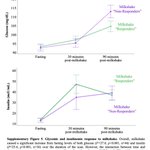
SPOILER: Not much. Not even their glycemic responses.
("Responders" DID rate the milkshake as ⬆️ pleasant & wanted more of it though 😅)

2
15
1,017
There WAS quite a lot of variability in the postingestive striatal dopamine response to the milkshake!
Buuuuuuuuuuut, surprisingly, that variability was not related to adiposity (BMI or %body fat).

2
20
1,058
Surprisingly, postingestive D2BP was not significantly different from fasting D2BP... suggesting that the presence of this ultraprocessed sugar+fat shake in the gut was more like... weak sauce... to striatal dopamine.

1
17
1,075
we expected to see a ⬇️ in striatal dopamine D2 receptor binding potential (D2BP) as measured by [11C]raclopride in the postingestive state compared to fasting... i.e., dopamine release!
1
12
1,108
So, we designed a controlled inpatient feeding study to measure postingestive dopamine response to milkshake w/PET neuroimaging methods typically used to measure dopamine effect of drugs of abuse in 50 young healthy adults over a wide range in BMI (20-45 kg/m2) and...

...but as far as we can tell, only ((((((checks notes))))) 3⃣ human studies (totalling 28 participants) have investigated the postingestive response to a macronutrient mixture containing at least fat + carb on brain dopamine using a standard PET displacement method.
1
14
1,246
Would such a potentially potent combo of fat + sugar in the gut have similar impact on brain dopamine in everyone??? 🤔
Some work suggests that people with obesity might have a ⬇️ 🧠 response to these nutrients...
1
15
1,303
Intriguingly, new animal work shows that combining fat WITH sugar may have a synergistic effect on brain dopamine...
...a concept put forward by a few human studies (using functional magnetic imaging) as well.
1
15
1,500
Some really cool animal work demonstrates that the brain rapidly responds to the TASTE 😋 of a yummy reward by releasing dopamine.
When these fat or sugar calories are sensed by the GUT, dopamine release lasts a while 🐢
1
17
1,885
Valerie L. Darcey, PhD, MS, RD retweeted

The magnitude in humans (publication pending) may be too small to be a true driver!
My take:
Mechanisms in animal models often apply in humans but are blunted in their effect size, which is what we're seeing here. – at Washington, DC

Valerie L. Darcey, PhD, MS, RD retweeted

📢 We're hiring! 📢
We have an immediate opening for a postdoc to work on neuroimaging-genetics at UCLA. Interested in linking large-scale MRI datasets with genomics and transcriptomics? Come work with us!
Details 👉 hernandezlabucla.org/join
RTs appreciated! 🔃
