

Co-Founder of CyberXTron Technologies (building Autonomous Cyber Defense Solution with AI-Agents)
Chennai
Joined July 2022
- Tweets287
- Following75
- Followers10
- Likes254
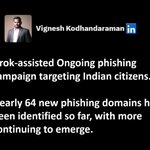




CyberXTron's phishing detection platform recently identified an ongoing phishing campaign targeting Indian citizens, delivering a Grok-assisted Android banking Trojan.
Check out the detailed analysis here:
lnkd.in/gTKxJJgm

7
Vignesh Kodhandaraman (VK) retweeted

Our team recently investigated a potential initial access vector linked to the FortiBleed campaign. To our surprise, over 7,000 FortiGate admin credentials were simple variations of "admin123," and 44% of them belonged to Indian organizations.
One of them was the firewall admin password of a major financial institution, an organization widely recognized for its strong security policies.
The policy almost certainly said "strong passwords," but the firewall said "Admin@123."
That's the gap: policies get written, approved and audited on paper, while perimeter devices quietly keep the credentials they were deployed with.
Not sure where your organization stands? We've built a free tool to check whether your domain was exposed in the FortiBleed campaign:
🔗 cyberxtron.com/fortibleed-sc…

Our team recently conducted an analysis and found that 7 out of 10 organizations that experienced a breach were ISO/ISMS certified.
This highlights an important reality: compliance and cybersecurity resilience are not the same thing.
Certifications and compliance frameworks play an important role in establishing governance, processes, and accountability. But real-world attackers don't care about certificates. They look for exposed assets, compromised credentials, unpatched vulnerabilities, misconfigurations, and gaps in security operations.
Organizations need to move beyond checklist-driven security and continuously understand:
• Which emerging threats are relevant to their environment
• How attackers could exploit their attack surface
• What assets and services are exposed outside their perimeter
• Whether employee and third-party credentials have been compromised
• Whether their security controls are effective against real-world attack techniques
• Whether threat actors are discussing their organization, brand, employees, or digital assets on the dark web
Compliance is an important foundation, but it should not be mistaken for security.

7
Vignesh Kodhandaraman (VK) retweeted
FortiBleed is a reminder that breach awareness should not stop at headlines.
For security teams, the first question is simple:
Is our organization mentioned or exposed?
CyberXTron has launched a quick FortiBleed Scanner where organizations can check whether they have been mentioned as part of the FortiBleed breach.
Once exposure is identified, teams can go deeper with XTron-AI, where detailed breached-data insights can help security teams validate risk, understand context and decide what needs attention.
Use the scanner first.
Investigate deeper with XTron-AI.
FortiBleed Scanner: cyberxtron.com/fortibleed-sc…
XTron-AI: cyberxtron.com/xtronai
#CyberSecurity #FortiBleed #ThreatIntelligence #DataBreach #XTronAI #SOC #CISO #CyberXTron

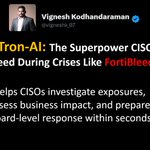
When the next FortiBleed-like event occurs, CISOs shouldn't have to wait days for answers....
Last few days have been hectic for many CISOs. As news of the FortiBleed credential leak spread across the cybersecurity community, security leaders found themselves chasing answers.
➡️ Are we impacted?
➡️ Which users have been exposed?
➡️ How severe is the business risk?
➡️ Are threat actors actively weaponizing the leaked data?
For many organizations, answering these questions meant relying on multiple teams, threat intelligence analysts, dark web monitoring operators, spreadsheets, and manual investigations.
The challenge isn't the lack of intelligence. The challenge is transforming millions of threat signals into actionable business insights within minutes and This is exactly why we built XTron-AI.
With a single prompt, CISOs can:
✅ Investigate whether their organization has been exposed
✅ Analyze leaked credentials and affected identities
✅ Understand potential business impact
✅ Track threat actor discussions and weaponization activity
✅ Generate executive-ready intelligence reports in seconds
Curious how XTron-AI investigates FortiBleed exposure in seconds? Try it yoursel, access is free:
cyberxtron.com/xtronai

63
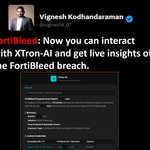
Organizations can quickly determine whether they have been affected by the FortiBleed breach and leverage XTron-AI to gain deeper insights into the leaked data, threat actor activity, indicators of compromise (IOCs), potential weaponization, and related cyber threats.
Access is limited and its free: cyberxtron.com/xtronai

Security researchers around the world are tracking FortiBleed: A massive active exploitation campaign targeting Fortinet/FortiGate devices that has resulted in credential leaks affecting a significant number of Fortinet platforms.
Key findings:
🔴 320,777 FortiGate systems targeted
🔴 1.16 billion credential attempts processed
🔴 Password hashes cracked using a 45-GPU cluster
🔴 Attackers pivoted from VPN access into internal Active Directory environments
Credential leaks are rarely isolated incidents. They are often the first step in a much larger intrusion campaign. This operation demonstrates how exposed VPN credentials can become the initial access vector for deep network compromise, data theft, and long-term persistence.
Organizations are advised to rotate credentials, enable multi-factor authentication (MFA), and follow Fortinet's security best-practice recommendations.
Refer our blog for latest insights & detailed write-up related to Fortibleed : cyberxtron.com/resources/blo…

Vignesh Kodhandaraman (VK) retweeted
CyberXTron has been shortlisted by NCIIPC among the Top 3 AI-Powered Phishing Detection Solutions, recognized under the NCIIPC AI-Grand Challenge for Phishing Detection Solution.
Phishing today goes beyond suspicious emails. Fake login pages, spoofed domains and brand impersonation can put customers, credentials and trust at risk.
This recognition from a national security department strongly validates CyberXTron’s innovation and the relevance of our solution in helping critical-sector organizations address evolving digital risks.
CyberXTron’s AI-led phishing detection helps security teams identify, validate and protect against digital impersonation risks faster.
Detect. Validate. Protect.
#CyberSecurity #PhishingDetection #AICybersecurity #NCIIPC #CyberXTron
Vignesh Kodhandaraman (VK) retweeted
Security teams are using Claude for faster research, summaries and cyber workflow support.
But in cybersecurity, a smart response is not enough.
Teams need live threat context, investigation support and intelligence they can act on.
CyberXTron is now part of the Claude Partner Network, with XTron-MCP + Claude helping security teams support:
Threat briefings
Threat hunting
Detection workflows
Security decisions
Built for teams that need faster answers in real security situations.
Explore how XTron-MCP brings live cyber intelligence into Claude-powered workflows.
Link in first comment.
#CyberSecurity #Claude #ThreatIntelligence #XTronMCP #SOC #CISO #CyberXTron
For years, finding vulnerabilities was often the bottleneck. Now that equation may be changing.
AI is rapidly shrinking the time required to discover vulnerabilities, and the bigger challenge may soon become:
🔹 Verifying findings quickly
🔹 Performing responsible disclosure at scale
🔹 Building and testing patches faster
🔹 Getting users to deploy updates quickly
🔹 Managing increasing pressure on security teams
This could fundamentally reshape how we think about vulnerability management. The traditional coordinated disclosure model was built around a world where vulnerabilities were discovered at a human pace. But if AI can surface thousands of findings in days, can existing disclosure cycles realistically keep up?
As result, I believe we could see Shorter vulnerability closure cycles, Increased automation in triage and remediation, AI-assisted patch development, Evolution of responsible disclosure processes and Greater focus on preventive secure-by-design practices.

The recent "Megalodon" campaign compromised 5,500+ GitHub repositories by injecting malicious GitHub Actions workflows into development pipelines. This wasn't a traditional malware attack, The objective was access.
Attackers targeted:
🔹 CI/CD secrets
🔹 API tokens
🔹 Cloud credentials
🔹 Authentication artifacts
🔹 Development environments
Modern organizations increasingly trust automation, pipelines, third-party integrations, and software dependencies. Threat actors understand that compromising one trusted component can create downstream access at scale. While many regulators emphasizes on performing supply-chain risk assessment at least on periodic intervals, we still see many organizations lack the practise.

The growing trend of product companies organizing premium networking events at luxury venues and distributing awards without meaningful merit is creating a culture of artificial recognition.
When awards become marketing instruments instead of genuine industry acknowledgment, credibility slowly erodes.
The industry should celebrate real innovation, meaningful impact, research, and engineering excellence — not manufactured validation.

8
🤔 A Common Question from Cyber Threat Researchers:
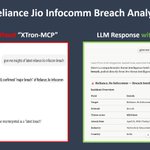
“If LLMs already have knowledge and intelligence… what extra value does XTron-MCP bring?”
Let me show you a real example 👇
----------------------------------------------------------
🧪 **Same Query. Two Setups. Completely Different Outcomes.**
I performed the *exact same research query* in two scenarios:
1️⃣ With XTron-MCP + LLM
2️⃣ Without XTron-MCP (LLM only)
----------------------------------------------------------
🚀 **Result with XTron-MCP Integration:**
The LLM gained real-time access to cyber threat intelligence, including signals from deep & dark web sources.
👉 It was able to identify a recent data breach announcement related to Reliance Jio, posted by a threat actor *“MDGhost”* on a deep web forum as recent as April 21, 2026 (today).
----------------------------------------------------------
⚠️ Result without XTron-MCP:
The LLM response was limited to:
* Historical incidents
* Publicly available surface web data
* No visibility into recent or emerging threats
👉 Zero awareness of the latest breach chatter
--
🧠 Key Insight
LLMs ≠ Real-time Intelligence
Without integration, LLMs are:
* Static
* Surface-web dependent
* Lagging behind real-world threats
With XTron-MCP, they become:
*Context-aware
*Threat-intelligence driven
*Operationally relevant for cyber defense
----------------------------------------------------------
🎯 Why This Matters for Cyber Teams
For: SOC Analysts | Threat Hunters | Detection Engineers | CISOs
👉 The difference is not just better answers
👉 It’s timely, actionable intelligence vs outdated context
Explore XTron-MCP Free Trial: cyberxtron.com/mcp
Integration guide: lnkd.in/gBn_kYuj
----------------------------------------------------------
#CyberSecurity #ThreatIntelligence #ThreatHunting #SOC #LLM #AI #CyberDefense #Infosec #XTronMCP

20
🚀 **Real Feedback from Cyber Security Professionals Using XTron-MCP + LLMs (Claude/ChatGPT).
We’ve been receiving positive responses from cyber defense experts after they explored XTron-MCP integrated with LLMs, and the results are incredibly promising: faster insights, accurate outputs, and real operational value.
Here’s what they’re saying 👇
🔹 Head of SOC (Tier-1 MSSP, 10K+ Employees)
“Generating a full-blown research advisory within minutes is an absolute game changer!”
🔹 Senior Cyber Security Engineer (IT Services, 10K+ Employees)
“It’s really powerful how it connects LLMs like Claude or ChatGPT to real-time cyber intelligence — that’s impressive.”
🔹 Threat Hunting Practice Lead (MSSP, 1K+ Employees)
“Hunting plans generated by XTron-MCP + LLMs are justifiable and solve major challenges around hypothesis selection in client environments.”
🔹 Security Lead Analyst (Telco & MSSP, 10K+ Employees)
“Thanks again for doing this great work in the field of cyber.”
🔹 Threat Hunting Professional (Public Sector)
“Connecting Claude to a dedicated security MCP is exactly what I needed to scale my research.”
----------------------------------------------------------------------------------------
💡 If you're a: SOC Analyst | Threat Hunter | Detection Engineer | SOC Manager | CISO | Cyber Defense Leader
👉 Experience it yourself.
🎯 Limited Free Trial
🔗 cyberxtron.com/mcp
📘 Integration Docs:
🔗 lnkd.in/gN6aA4qR
#XTronMCP #claude #ChatGPT

41
Here is a Security Research Advisory on the “Vercel Breach” that I created within minutes using @AnthropicAI Claude + XTron-MCP. As you can see, the report provides in-depth research on the breach, along with technical indicators and insights into the attack methods. It is fully formatted in an industry-standard style and generated autonomously.
linkedin.com/posts/vignesh-k…


I created a full security research advisory on the latest Vercel breach in just a few minutes. What normally takes hours of digging, structuring, and formatting was done end-to-end with XTron-MCP integrated with Claude.
The output wasn’t just quick, it was actually detailed and usable:
– solid incident coverage
– ongoing investigation insights
– validated technical indicators
– attacker TTPs
– properly structured like a real advisory
Honestly, this kind of workflow changes how threat intel research can be done day-to-day. XTron-MCP pulls from 30M+ intelligence signals and plugs into LLMs, so you’re not starting from scratch every time.
If you’re into security research and Threat Intelligence Analysis, this is definitely worth trying.
Free trial: cyberxtron.com/mcp
Integration guide: docs.cyberxtron.com/mcp-plug…

33
I created a full security research advisory on the latest Vercel breach in just a few minutes. What normally takes hours of digging, structuring, and formatting was done end-to-end with XTron-MCP integrated with Claude.
The output wasn’t just quick, it was actually detailed and usable:
– solid incident coverage
– ongoing investigation insights
– validated technical indicators
– attacker TTPs
– properly structured like a real advisory
Honestly, this kind of workflow changes how threat intel research can be done day-to-day. XTron-MCP pulls from 30M+ intelligence signals and plugs into LLMs, so you’re not starting from scratch every time.
If you’re into security research and Threat Intelligence Analysis, this is definitely worth trying.
Free trial: cyberxtron.com/mcp
Integration guide: docs.cyberxtron.com/mcp-plug…
I recently had conversations with leaders from 3 different MSSP SOC teams.
Interestingly, all of them raised the same concern.
Their customers are no longer just asking about SLAs or coverage.
They’re asking:
👉 “What are you doing with AI?”
👉 “How are you using LLMs in your SOC?”
👉 “How are you reducing noise and improving response efficiency?”
And honestly, it makes sense.
Traditional SOC models are:
- overloaded with alerts
- heavily manual
- struggling to scale
This is exactly where the shift is happening.
From: tool-driven operations
To: AI-driven, intelligence-led SOCs
During these discussions, I had the opportunity to walk them through what’s possible when you connect AI properly into SOC workflows.
Not just using AI for summarization or assistance. But actually enabling it to:
- work with real-time threat intelligence
- assist investigations
- support detection engineering
- accelerate threat hunting
That’s essentially what we’ve been building with XTron-MCP and it directly addresses the exact questions MSSPs are now getting from their customers.
Sounds interesting?
Explore XTron-MCP yourself—early access is free for a limited number of trial users:
👉 cyberxtron.com/mcp
#CyberSecurity #SOC #MSSP #AI #ThreatIntelligence #DetectionEngineering #ThreatHunting #LLM #XTronMCP

83
With GPT-5.4-Cyber from OpenAI and Anthropic’s Mythos, it’s obvious where things are heading - AI is clearly becoming the frontline for cyber defense.
But after going through this, one thing stood out to me, Most of these models are still:
- not connected to real-time threat data
- not actually executing investigations
- just… answering
And that’s a limitation. Because in a real SOC environment, you don’t just need answers—you need action.
This is exactly the problem we’ve been thinking about at CyberXTron.
How do you take something like ChatGPT or Claude and make it:
* aware of live threat intelligence
* capable of real investigations
* useful for detection engineering and hunting
Not just “smart”, but operationally useful.
That’s essentially what led us to build XTron-MCP.
It’s less about the model itself, and more about:
how you connect it to real data, real tools, and real workflows.
We’ve opened early access for teams exploring this space.
If you're curious, you can try it here for free: 👉 cyberxtron.com/mcp

13