
Engineering compact factory cells for AI automation. Mechanical | Electronics | Process - engineer. https://nitter.cf/t.co/Cmmkr5pZvu @fdotinc
San Francisco, CA
Joined October 2024
- Tweets580
- Following234
- Followers3.5K
- Likes1.9K





Pinned Tweet
Repeatability test 3.
Final test — pushing the limits. – at Fort Mason, San Francisco

Viktor Petrenko retweeted

Improving reliability with agentic robot control.
In the video, the robot works autonomously for 2.5 hours after 30 seconds of recharging materials.
It assembles 1 gadget per 7 minutes and stops because it runs out of parts.

Viktor Petrenko retweeted
Over the past month, we completely switched to frontier LLMs to control a robot in a customer deployment.
By doing this, we have a classic System 1/System 2 architecture, but on steroids.
For the high-level reasoning layer, we use an agent based on Opus and Astra, which are many generations more capable than any VLA. For the fast execution layer, we use computer vision code written by the model, which is fast, editable, and reliable.
As a bonus, we got in-context learning, which is just a basic feature of LLMs, and continual learning, since whenever a new situation arises, the large model steps in and adapts the pipeline.
And it just feels better to be on the right side of the Bitter Lesson, benefiting from the billions being invested in frontier models around the world.
Viktor Petrenko retweeted
We need self-replicating factories.
Reindustrialization won't happen against economic laws. Manufacturing has to be competitive worldwide. And improving existing factories, even with automation, is not enough. Only 30-40k robots were installed in the US last year, so the pull from existing factories is weak. They’re good.
Humanoids are being promised as the solution. But who will build them? Still humans. Humanoids not optimised for self-build.
The most practical solution to these problems is a self-replicating factory.
It will build humanoids, enable the US reindustrialization, and help colonise other planets as a side product.
Who should I talk to? I’m assembling people who think the same way.
Viktor Petrenko retweeted
Got a random question today.
"Do you think the microfactory could sew the leather covering onto a softball? 🥎"
An agent two hours later:
Viktor Petrenko retweeted
Continue switching our customer’s setup from direct model control to control by code written by Astra/Opus.
The gripper picks up the back cover, points it at the light to mask it, and then uses that image to align it for precise insertion.
Good thing we already have the light built into the box.

Industrial robots today are like computers in 1975: expensive, custom, need a team to run one.
We're changing that. MicroFactory is a desktop robotic cell for electronics assembly (and more) - deployed by an AI agent instead of an integrator.
We launched today. Video below 👇 – at San Francisco, CA
Viktor Petrenko retweeted
Introducing an AI robotic integrator.
An agent that handles an entire deployment for MicroFactory end-to-end.
Powered by the latest Astra and Opus models, it designs tooling, writes computer vision code, and guides a human operator, taking care of all the boring parts of hardware production.
Demos:

This arm is retiring from food processing and starting a new career in electronics assembly. – at San Francisco, CA


Viktor Petrenko retweeted
The benefit of using an advanced AI model is that it can adapt to small variations just by generalizing from a small number of examples. Exactly the kind of variations you’ll see in real life.
A few additional tests of picking material from a stack:
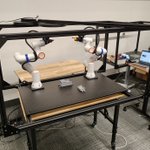
Our current dual-arm setup for autonomous electronics assembly. The teleoperation controllers in front are used to teach the robots precise manipulation of small objects.


Viktor Petrenko retweeted
Full run and a segment of a task.
100% from 16 examples.
To play with continuous learning, your base model needs to be data-efficient and stable, which we tested here, because any irrelevant fluctuations can compound over time.
Here's our custom-designed quick-change gripper.
We’re shipping an interchangeable gripper.
Our main goal, as usual, is to make modern AI tools work in environments where you need reliability.
Humanoid hands have their use cases, but it’s hard to pick up a tool firmly and control precisely with them.
We made an alternative - an interchangeable gripper. The tool is fixed to the gripper in advance, and the whole hand is swapped. AI is quite good at generating this kind of custom tooling.

Our new MicroFactory robots are ready to assemble electronics.
We'll be showing them in production soon. – at San Francisco, CA
Viktor Petrenko retweeted
Deployment is only the first step.
You need to learn from it and take the next steps toward positive ROI.
Our journey:
Step 1. Nine month ago, our robot already assembled a complex real product for our customer, from start to finish. But it wasn’t reliable.
Step 2. Our robot performed a complex benchmark task reliably 100 times in a row.
Step 3. (Completing) Our robot assembling a complex real product from start to finish 100+ times in a row.