Vasilis Ntranos (@vntranos) header
Vasilis Ntranos (@vntranos) profile picture

Assistant Professor @UCSF; Computational Biology and Information Theory

San Francisco, CA
Joined October 2012
Photo by Vasilis Ntranos (@vntranos)Photo by Vasilis Ntranos (@vntranos)Photo by Vasilis Ntranos (@vntranos)Photo by Vasilis Ntranos (@vntranos)Photo by Vasilis Ntranos (@vntranos)Photo by Vasilis Ntranos (@vntranos)Photo by Vasilis Ntranos (@vntranos)Photo by Vasilis Ntranos (@vntranos)Photo by Vasilis Ntranos (@vntranos)Photo by Vasilis Ntranos (@vntranos)
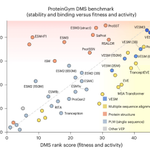
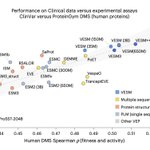
Excited to share that our latest work building on ESM is now published in @NatureMethods: A single, sequence-only protein language model achieves state-of-the-art variant effect prediction, surpassing hybrid approaches that use MSA, 3D structure, or population genetics data. nature.com/articles/s41592-0…
7
67
2
269
22,535
Vasilis Ntranos retweeted
Here we go... The paper opens by saying generalization abilities of specialized proteins models are a recurring challenge. They are! That is why good evaluations in biological machine learning take care to assess generalization and relationships between training and test data.
1
5
1
56
9,215
Vasilis Ntranos retweeted
It would be great to include scVI and scANVI here. They predate the earliest model in this figure by ~4 years and remain difficult to beat.
1
4
22
1,313
Vasilis Ntranos retweeted
Congratulations on solving a beautiful problem. This is bringing back old memories ; I still remember first discussing this problem with Sergio Verdu when he was on sabbatical at Berkeley in the late 1990's . With a wink of an eye it's now 25 years later. Some perspective on this problem from someone who has been around. This problem belongs to the class of problems called "multiuser or MIMO detection", pioneered by Sergio Verdu and received a lot of attention in the late 80's and early 90's, In the late 90's and early 2000's, there was a resurgence of interest in this problem via connections with random matrix theory. I myself have worked on a bunch of these problems, evaluating performance of different MIMO detectors. The problem that AI and @DimitrisPapai have solved is the ultimate of these problems because the optimal MIMO detector is the joint ML detector. I am very happy to see it solved. That being said, I have to say that MIMO detection as a whole has made little impact on how actual wireless communication systems are built. Because wireless communication systems, like all communication systems, use coding, while MIMO detection only talks about uncoded systems; the N information bits here in this problem are uncoded. It turns out that much lower SNR can be achieved with coding. Take this problem as an example, with coding, a constant SNR* = 1.32 is sufficient to support an information rate of 1 bit per antenna, in contrast to the growing SNR = 2 log N result just proved. That's one reason why although this problem is beautiful as a mathematical problem, it has not received the full attention of the information theory community even in those days of peak activity. Claude Shannon has already told us in his 1948 information theory paper: to achieve the ultimate limit of communication, one needs to do coding. Uncoded systems are sub-optimal. So SNR = 2 log N is only optimal among uncoded communication systems, but SNR* = 1.32 is optimal among all communication systems. The problem that Claude Shannon solved in his 1948 paper was the capacity of point to point communication, The problem here is one example (so called point to point MIMO channel), and hence the optimal SNR* = 1.32 can already be computed by Shannon's 1948 theory (no AI needed). Most of the information theorists' attention in the hey days of wireless communications research has been to extend Shannon's theory to network information theory problems, such as the broadcast channel, the relay channel and the interference channels. In those problems , one ask what is the best information rate (or equivalently, the minimum SNR needed) that a network of users can communicate with each other. These problems have been proposed since the 60's and the 70's and to this day none have been solved in their full generality. I'd love to see AI take a crack at some of those open problems.
7
14
2
151
54,996
Vasilis Ntranos retweeted
Proof of the 40-year old Bandelt-Dress conjecture on the maximum quartet distance between phylogenetic trees (and an interesting connection to independence testing). arxiv.org/abs/2608.03542
10
72
13,839
A tour de force from the ESM team @biohub! Huge progress in protein structure prediction from *single* sequence!
Today we're announcing ESMFold2, an open scientific engine to power prediction, design, and discovery across protein biology. The new model delivers state of the art performance on protein interactions, especially antibodies, a critical modality for therapeutics. We have designed and validated miniprotein binders and single chain antibodies across five therapeutic targets that are important in cancer and immunology. We are seeing very high success rates, and affinities at levels consistent with therapeutic activity. We’re also releasing an atlas of 6.8 billion proteins, and 1.1 billion predicted structures. ESMFold2 is built on a state of the art language model that has been trained on billions of protein sequences. A world model of protein biology emerges through language modeling. We’ve used the techniques of mechanistic interpretability developed to understand large language models to understand the concepts ESM uses to represent proteins. The model’s representation space has a compositional organization of features across scales, levels of complexity, and abstraction, that reflects and mirrors the understanding of protein biology developed through a century of empirical science. This understanding emerges without prior knowledge, just from language modeling of protein sequences. Language models are becoming a powerful substrate to understand and program biology. The design of protein interactions is one of the most fundamental problems in biophysics, and has critical implications for the discovery of new medicines. A simple gradient based search with the model was able to discover high-affinity protein binders. I'm excited by the potential this has to accelerate basic science and the understanding of proteins. And especially for the new avenues it opens up for therapeutic design and medicine.
2
1
9
1,271
Vasilis Ntranos retweeted
Scaling laws are powering AI. It’s time to scale biology. Today we’re launching the Virtual Biology Initiative to generate the data to unlock scaling laws in biology and build accurate predictive models of the cell. Digital representations of proteins are already expanding our understanding of life at the molecular level, and accelerating the design of molecules and medicines. Accurate digital representations of the cell could reveal the mechanisms that are responsible for disease, and show how to reverse them. The protein data bank, and worldwide repositories of protein sequence biodiversity were created through decades of work by the scientific community. The advances in artificial intelligence for proteins would not have been possible without them. The cell is orders of magnitude more complex, and we will need to create the data in just a few years rather than decades. This will require a coordinated global effort. We're partnering with Broad, Wellcome Sanger, Arc, Allen, Human Cell Atlas, Human Protein Atlas, NVIDIA, and Renaissance Philanthropy. Biohub is contributing to this effort as both a funder and a builder. We are developing microscopy to observe millions of cells in living organisms, and cryo-ET to resolve the cell in atomic detail. We're building instruments that expand the range of modalities and parameters that can be simultaneously measured. We’re developing molecular, cellular, and tissue engineering to create models of disease and design interventions. The data we generate will be available to the worldwide scientific community. We’re also committing $100M over the next five years to support work beyond Biohub. We invite other scientific teams and funders to join. Link: biohub.org/news/virtual-biol…
37
139
36
747
135,571
Vasilis Ntranos retweeted
If you use dim. reduction, you may be interested in two recent preprints we've posted on contrastive PCA: The Rayleigh Quotient and Contrastive Principal Component Analysis I & II w/ @MariaCarilli & Kayla Jackson. They cover a lot of ground from theory to practice. 1/🧵
3
46
1
227
25,741
Vasilis Ntranos retweeted
🚨 Over 1 billion rows of psychiatric genetics data. Now on Hugging Face. ADHD. Depression. Schizophrenia. Bipolar. PTSD. OCD. Autism. Anxiety. Tourette. Eating disorders. 12 disorder groups. 52 publications. Every GWAS summary statistic from the Psychiatric Genomics Consortium. Before: wget, gunzip, 20 minutes debugging separators, repeat 50 times. Now: one line of Python.
118
567
109
4,314
1,305,674
Great work showing that protein language model embeddings can sometimes be indistinguishable from noise. This aligns very well with our observation in nature.com/articles/s41592-0… that motivated VESM / co-distillation. Indeed, big knowledge gaps exist even within models of the **same family**, with almost identical architecture and trained on similar data: E.g., ESM2 and ESM1b each fail to detect well-conserved domains that the other recognizes as mutationally sensitive.
17
102
10,104
Vasilis Ntranos retweeted
What would it look like to see all ~13,000 proteins inside a single human cell at once? We share ProtiCelli — a generative model that makes this possible. Besides benchmarking, we demonstrate utility in many tasks. Preprint: bit.ly/3NY175q A thread 🧵👇
9
118
9
453
38,546
Vasilis Ntranos retweeted
AI × bio is the only field where: — you're too slow for AI people and too fast for bio people — you're too computational for biologists and too biological for ML folks — tech VCs overprice you and bio VCs underprice you You are permanently miscalibrated in every direction. It's great actually.
43
77
13
773
43,035